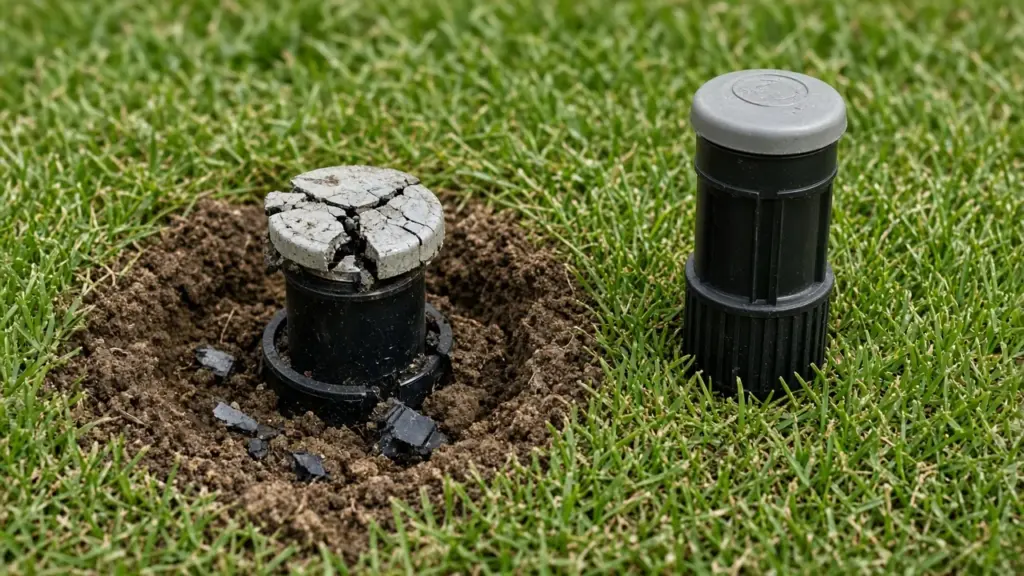
Most sprinkler problems in Dallas yards start at the head. It is the only part of the system you see every day, and it takes the most abuse: mower wheels, edgers, delivery trucks cutting across the corner, dogs, heaving clay, and summer heat. The good news is that head problems are usually the least expensive part of an irrigation system to fix, as long as you diagnose them correctly and do not just swap parts until something works.
This guide explains how sprinkler heads work, the failures we see most often across Dallas neighborhoods, how to tell which problem you actually have, and when it makes sense to call a licensed irrigator. It is the starting point for our series on heads and coverage, and it links out to deeper guides on valves, controllers, leaks, and clay soil.
How a Sprinkler Head Actually Works
A residential pop-up head has three main parts: the body buried in the ground, the riser that pops up when the zone pressurizes, and the nozzle that shapes the water into a pattern. A spring pulls the riser back down when the valve closes. A wiper seal at the top of the body keeps dirt out and keeps water from blowing out around the riser.
Dallas yards typically use two families of heads:
- Spray heads throw a fixed fan of water, usually a short distance. They are common in small front yards, parkway strips, and beds.
- Rotors send out one or more streams that turn slowly across an arc. They cover larger areas and apply water more slowly, which suits the heavy clay found across much of Dallas County.
A third option, multi-stream rotary nozzles, fits onto a standard spray body but applies water more slowly than a traditional spray nozzle. We cover the trade-offs in our guide to installation and retrofits.
The Most Common Sprinkler Head Problems in Dallas
Broken or sheared heads
A head that has been run over usually cracks at the body or snaps at the riser. You will see a geyser or a bubbling pool when the zone runs, and the other heads on that zone will look weak because the water is escaping through the break. Replacement is normally straightforward, but it is worth checking the fitting below the head. Many older Dallas systems connect heads with rigid PVC risers, and a hard hit can crack the tee on the lateral line as well. If the leak continues after you replace the head, the break is underground; see our sprinkler leak detection guide.
Heads that will not pop up
When a head stays down or rises only partway, the cause is usually one of three things: low pressure on that zone, debris jamming the riser, or a worn wiper seal. If every head on the zone is sluggish, the problem is upstream, often a partially closed valve, a leak elsewhere on the zone, or too many heads for the available flow. If only one head sticks, it is almost always that head. Our valve repair guide walks through the zone-level checks.
Sunken and tilted heads
The clay under many Dallas lawns shrinks when it dries and swells when it gets wet. Over a few seasons that movement pulls heads down below the turf or tilts them sideways. A sunken head sprays into the grass blades instead of over them, leaving a dry ring around it. A tilted head throws water at the fence or the sidewalk. The fix is to dig out the head, reset it at the proper height and angle, and support it with flexible swing pipe so it can move with the soil instead of cracking. Our Dallas clay soil guide explains why this keeps happening.
Clogged nozzles
Small grit, pipe shavings from an earlier repair, or scale can block the tiny screen under each nozzle. A clogged head sprays a broken, uneven pattern or barely dribbles. Unscrewing the nozzle, rinsing the filter screen, and flushing the head for a few seconds usually solves it. If many heads clog at once, there may be a break upstream letting soil into the lines.
Misting and fogging
If a head produces a fine cloud instead of droplets, pressure at that head is too high. Mist drifts on the wind and evaporates quickly, which wastes water and leaves dry areas. Pressure-regulating spray bodies or a pressure regulator on the zone can correct this.
Leaking at the base
Water weeping around the head after the zone shuts off is usually low-head drainage: water in the pipe draining out of the lowest head on the zone. Heads with built-in check valves stop this. Water spraying around the riser while the zone runs points to a worn wiper seal or a cracked body.
How to Diagnose a Head Problem Step by Step
Before you replace anything, run the zone manually from the controller and watch it for a full cycle.
- Watch every head on the zone. Note which ones pop up fully, which spray a normal pattern, and which are weak, misting, or silent.
- Look for water where it should not be. Bubbling soil, a puddle, or a stream running down the curb means a break.
- Compare with other zones. If one zone is weak and the others are fine, focus on that zone’s valve and pipe. If every zone is weak, check the backflow preventer and the main supply.
- Check the nozzle and screen on any single head that is misbehaving.
- Check the height and angle of heads in dry spots. A head sitting an inch too low can explain a dead patch by itself.
Write down what you see. A simple zone-by-zone note makes any repair faster, whether you do it yourself or call a technician.
Choosing the Right Replacement Head
Matching the replacement to the rest of the zone matters more than the brand. Rain Bird, Hunter, and Toro all make reliable heads, and many parts interchange. What must match is the type and the application rate.
- Keep sprays with sprays and rotors with rotors on the same zone. Sprays apply water much faster than rotors. Mixing them on one zone means the spray areas get soaked while the rotor areas stay dry.
- Match the pop-up height to the grass. Taller pop-ups help in St. Augustine, which is often mowed higher than Bermuda.
- Match the arc and radius. A quarter-circle head in a corner and a half-circle head along an edge should each get the right nozzle. Oversized nozzles throw water onto concrete.
- Consider check valves on sloped zones or low spots where drainage puddles form.
Coverage: Why Head-to-Head Spacing Matters
Well-designed systems place heads so each one throws water all the way to the next head. This is called head-to-head coverage. When heads are spaced too far apart, or when a replacement nozzle has a shorter throw than the original, you get a pattern of dry arcs between heads. In Dallas summers those arcs brown out first.
If you have dry spots in the same places every year, test coverage before you add more water. Set out several straight-sided cups or cans across the zone, run it for a set time, and compare how much water each one collects. Uneven results point to spacing, nozzle, or pressure problems that longer run times will not solve.
Watering Rules That Affect Head Repair
Dallas requires a working rain and freeze sensor on automatic systems and limits irrigation to your assigned days, with no watering by sprinkler between 10 a.m. and 6 p.m. When you test a repaired head, run it briefly and manually rather than adding extra watering cycles. Our guide to the Dallas watering schedule covers the current rules in detail.
DIY Fix or Professional Repair?
Replacing a single broken spray head or cleaning a nozzle is a reasonable DIY project for most homeowners. Texas law does require anyone who installs or repairs irrigation systems for hire to hold the appropriate license from the Texas Commission on Environmental Quality, and a professional becomes the better choice when:
- The same head keeps breaking, which usually means a design or traffic problem.
- Water keeps pooling after you replace the head.
- A whole zone performs poorly.
- Heads need to be moved, added, or converted to a different type.
- The problem involves the backflow preventer or the main line.
A licensed technician can also check pressure, verify coverage, and make sure repairs meet state irrigation rules.
Keeping Heads in Good Shape
A few habits prevent most head problems:
- Walk each zone monthly during the growing season while it runs.
- Keep grass and mulch trimmed back from spray heads.
- Mark heads near driveways and curbs so service crews can avoid them.
- Reset sunken heads before summer, when dry spots do the most damage.
- Schedule a professional inspection each spring as part of your seasonal maintenance calendar.
More Sprinkler Heads & Coverage Guides
- Spray Heads vs. Rotors vs. Rotary Nozzles: What Works on Dallas Lots
- Why a Sprinkler Head Keeps Geysering After You Replace It
- Sunken Sprinkler Heads in Black Clay: Raising Them the Right Way
- How to Read the Arc and Radius Markings on Rain Bird and Hunter Nozzles
- Matched Precipitation Explained for Mixed-Head Dallas Zones
- Fixing Heads That Spray the Street, Driveway, or House Wall
- “Check Valves in Sprinkler Heads: Stopping Low-Head Drainage Puddles”
- Replacing Mower-Damaged Heads Along Dallas Parkway Strips
- “Head-to-Head Spacing: The Coverage Rule Most Dallas Yards Break”
- “Pressure-Regulated Spray Bodies: When They Are Worth the Upgrade”
Frequently Asked Questions
Why does one sprinkler head spray much higher than the others?
A head that suddenly shoots a tall stream has usually lost its nozzle or has a cracked body. Water is escaping without the nozzle shaping it. Replace the nozzle or the head, and check whether the riser was damaged.
Can I replace a Rain Bird head with a Hunter head?
Usually, yes. Most residential heads use standard threaded inlets. What matters is keeping the same head type on the zone and matching the arc, radius, and pop-up height so coverage stays even.
Why are my heads sinking into the lawn?
Clay soil that shrinks and swells, heavy foot or vehicle traffic, and years of lawn growth and top-dressing all lower heads relative to the turf. Resetting them and using flexible swing pipe helps them stay at grade.
How do I know if the problem is the head or the valve?
If one head misbehaves and the rest of the zone works, the head is the likely culprit. If the whole zone is weak, will not turn on, or will not turn off, look at the valve, wiring, or controller.
Do I need a licensed irrigator to fix sprinkler heads in Dallas?
Homeowners may do basic work on their own property. Anyone repairing irrigation systems for pay in Texas must be licensed by the TCEQ, and larger repairs, zone changes, and backflow work should be handled by a licensed professional.
Get Sprinkler Head Repair in Dallas
If you have broken, sunken, or misting heads, or dry spots that longer watering has not fixed, our team can diagnose the zone and repair it properly. Learn more about our Dallas sprinkler repair service, or contact us to schedule a visit.
Request Service or call 214-227-7444
We serve homes throughout Dallas and nearby North Texas communities.