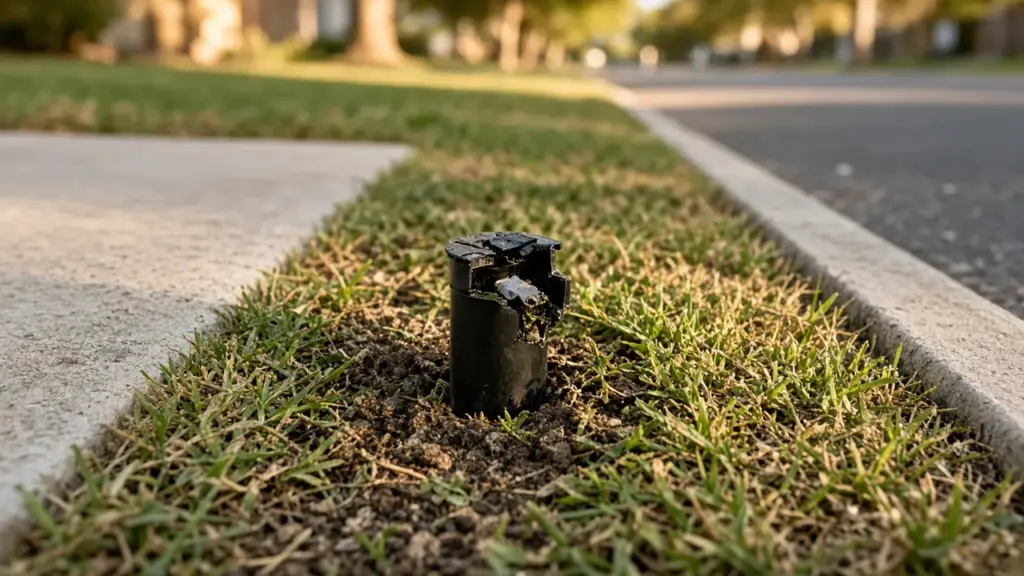
The narrow strip of grass between the sidewalk and the street, often called the parkway, is one of the toughest places for a sprinkler head. Mowers roll over it, edgers trim along both sides, cars park against the curb, people step out of vehicles, and trash bins get dragged across it. It is no surprise that many Dallas homeowners replace parkway heads more often than any others.
This guide explains how to replace mower-damaged heads in parkway strips and how to set them up so they last longer and keep water off the pavement.
Signs of a Damaged Parkway Head
- A geyser or bubbling when the zone runs
- A head that does not pop up or stays stuck up
- A cracked cap or body
- A nozzle that sprays in the wrong direction or in a broken pattern
- A soggy spot or water running into the gutter
- Weak pressure on the rest of the zone
Because parkway heads sit next to the street, a broken head can send water straight into the gutter. That wastes water and can lead to a violation under Dallas water waste rules.
Why Parkway Heads Break
- Heads set too high get clipped by mower blades.
- Edgers strike heads near the sidewalk or curb.
- Vehicles and foot traffic crush heads and crack risers.
- Heads that stick up after a cycle are easy targets.
- Settled soil leaves heads tilted or exposed.
Tools and Parts
- Replacement spray head body matching the zone
- Nozzle matching the pattern needed
- Small shovel or trowel
- Flush cap or a spare nozzle for flushing
- Towel or tarp for soil
- Possibly a riser or swing joint
Replacing the Head
- Turn off the controller and note the zone.
- Dig around the head carefully, keeping sod intact to replace later. Dig down to the fitting below the head.
- Unscrew the old head from the riser or swing joint. Keep dirt out of the open pipe.
- Inspect the riser and fitting. Cracked risers and fittings are common; replace them if damaged.
- Flush the line by running the zone briefly with the head removed, or with a flush cap on the new head.
- Install the new head on the riser, hand tight.
- Set the height so the top of the head sits flush with the soil grade.
- Install the nozzle and adjust arc and radius.
- Backfill in layers, firming the soil around the body so it stays straight.
- Test the zone and watch the head pop up, spray, and retract.
Our guide to raising sunken sprinkler heads in black clay explains how to set height correctly.
Getting the Height Right
Height is the single biggest factor in whether a parkway head survives. A head that sits above grade will be hit by mowers. A head buried too deep will be covered by turf and spray into the grass. Aim for the top of the body to be flush with the soil, so the mower passes over it.
Swing Joints Help
A swing joint, a flexible or jointed connection between the lateral pipe and the head, absorbs impact from traffic and allows easy height adjustment. If your parkway heads sit on rigid risers, consider replacing them with swing joints or flexible pipe connections when you repair them. A rigid riser transfers any impact directly to the pipe fitting below, which can crack.
Choosing Sturdier Heads
Some spray head bodies are built for high-traffic areas, with stronger caps and bodies. Heads with a check valve can prevent low-head drainage in sloped parkways. Our guide to check valves in sprinkler heads explains when they help.
Choosing the Right Nozzle
Parkways are narrow rectangles, which standard round-pattern nozzles do not fit well. Options include:
- Side strip nozzles, which spray a rectangle to one side
- End strip nozzles, which spray a rectangle from the end of a strip
- Center strip nozzles, which spray in two directions from the middle
- Low-radius rotary nozzles, which apply water slowly
Match nozzle types within a zone so all heads apply water at similar rates. Our guide to reading arc and radius markings helps identify nozzles.
Keeping Water Off the Street
Parkway heads are the most common source of water in Dallas gutters. After replacing a head:
- Adjust arc and radius so spray stays on the grass
- Check that no nozzle sprays into the street or across the sidewalk
- Use cycle and soak to reduce runoff on clay
- Consider rotary nozzles for lower application rates
Our guide to fixing heads that spray the street, driveway, or house wall covers adjustment techniques.
Tips for Mowing Around Parkway Heads
- Mark heads with small flags if your mowing service is unfamiliar with the yard
- Mow at the recommended height for your grass
- Edge carefully near heads
- Ask your lawn service to watch for heads and report damage
Alternatives to Grass in the Parkway
Some homeowners replace parkway grass with groundcover, mulch beds, or other landscaping watered by drip. That eliminates spray heads near the street entirely. Check any HOA or neighborhood rules before making changes, and call 811 before digging, since utilities often run under parkways.
Utilities Under Parkways
Parkways often contain utilities, such as water service lines, gas lines, and communication cables. When digging to repair a head, dig carefully by hand and avoid deep excavation. Call 811 before any significant digging.
After Replacing a Head
Run the zone a few days later and check the head again. Soil around a new head can settle, leaving it slightly low or tilted. Make adjustments while the soil is still loose.
Checking the Rest of the Zone
When one parkway head breaks, others on the same zone may be damaged too, just less obviously. After replacing the broken head, run the zone and walk the whole strip. Look for heads that tilt, spray unevenly, or pop up slowly. A head that has been struck but not broken may leak at its base or wobble on a cracked riser. Fixing everything on the zone at once saves another dig later.
Parkway Heads and Clay Soil
Dallas clay shrinks and swells with moisture, and parkways next to hot pavement can dry faster than the rest of the lawn. That movement can tilt heads and stress risers over a season. Firmly compacting soil around the head body during backfill helps it stay straight. Our sprinkler head repair guide covers other common head problems and fixes.
Frequently Asked Questions
How do I replace a sprinkler head damaged by a mower?
Dig around the head, unscrew it, inspect the riser, flush the line, install the new head flush with grade, set the nozzle, and test.
How high should a sprinkler head sit?
The top of the head body should be flush with the soil grade so mowers pass over it.
What nozzle works best in a parkway strip?
Strip nozzles designed for narrow rectangles, or low-radius rotary nozzles.
Why do my parkway heads keep breaking?
Common causes include heads set too high, edger strikes, vehicles, foot traffic, and rigid risers.
Get Help With Parkway Heads
We replace broken heads, install swing joints, and set up strip nozzles that keep water off the street. See our sprinkler repair service, or contact us to schedule.
Request Service or call 214-227-7444
We serve homes throughout Dallas and nearby North Texas communities.