Many Dallas sprinkler systems were installed decades ago, before current efficiency standards, before smart controllers, and often before the landscape looked anything like it does now. Trees have grown, beds have moved, patios and pools have been added, and the original zones no longer match the yard. At some point, repeated repairs stop making sense and a retrofit or a new system becomes the better investment.
This guide explains how to decide between repair, retrofit, and replacement, what good irrigation design looks like in Dallas conditions, and what to expect from an installation project.
Repair, Retrofit, or Replace?
Repair makes sense when
- The system is generally sound and coverage is good.
- Problems are isolated: a broken head, a failed valve, a single leak.
- Parts are available and the layout still fits the landscape.
Our guide to sprinkler head repair covers the most common of these situations, and valve and leak problems can usually be handled the same way.
A retrofit makes sense when
- Coverage is uneven even after heads are repaired and adjusted.
- Zones mix sprays and rotors or beds and lawn on the same valve.
- The landscape changed and some heads now water the wrong things.
- The controller is outdated.
- You want to reduce runoff and water waste.
A retrofit keeps the useful parts of the system, such as mainline, valves, and wiring, and upgrades the rest.
Replacement makes sense when
- The pipe is failing in many places, such as brittle old poly or galvanized lines.
- The layout is fundamentally wrong for the current landscape.
- Valves and wiring are unreliable throughout.
- A major landscape renovation is planned anyway.
Common Retrofit Upgrades
High-efficiency nozzles
Multi-stream rotary nozzles fit many existing spray bodies and apply water more slowly and evenly, which suits Dallas clay.
Pressure regulation
Pressure-regulating spray bodies or a regulator at the valve reduce misting and improve uniformity.
Drip conversions
Beds watered by spray heads are prime candidates for drip. See our drip irrigation guide.
Smart controllers and sensors
A weather-based controller, working rain and freeze sensor, and optional flow sensor improve scheduling and catch problems early. See our controller guide.
Re-zoning
Splitting overloaded zones and separating sun and shade areas lets each part of the yard get the right amount of water.
What Good Irrigation Design Looks Like in Dallas
Whether it is a retrofit or a new system, good design follows a few principles.
- Head-to-head coverage. Each head throws water to the next head so there are no dry gaps.
- Matched precipitation. Heads on the same zone apply water at similar rates.
- Zones by plant type and exposure. Lawn, beds, trees, sun, and shade are separated.
- Water stays on the landscape. Heads are placed and adjusted to avoid spraying streets, driveways, and walls.
- Right pressure. Pressure is regulated where needed so heads operate within their designed range.
- Clay-aware installation. Flexible swing pipe at heads, proper backfill, and sealed wire splices help the system handle soil movement. Our clay soil guide explains why this matters.
- Code compliance. Backflow prevention, a rain and freeze sensor, and an isolation valve are included. See our backflow and code guide.
Signs Your System Has Outgrown Its Design
Older Dallas systems often show the same warning signs when the original design no longer fits the property:
- Brown areas appear in the same spots every summer, even after heads are repaired and adjusted.
- Some heads are buried inside shrubs that were small when the system went in.
- Sprays water sidewalks, walls, or a pool that did not exist when the heads were placed.
- You need very long run times to keep one area green while another area floods.
- Repairs keep turning up old, brittle, or mismatched parts that are hard to find.
- The controller does not have enough stations to separate the zones you need.
If several of these apply, a retrofit or redesign will usually give better results than continuing to repair individual parts.
Getting the Most From a New or Retrofitted System
A well-designed system still needs attention. Walk each zone after the first few weeks to catch heads that settled, confirm the controller is on your assigned days, and adjust run times as the lawn establishes. Keep the zone map and any backflow test reports with your home records, since they make future repairs faster. Schedule a check-up each spring so small issues are caught before summer demand arrives.
Planning Around the Landscape
A good installation plan considers more than grass.
- Trees. Keep trenches away from major roots where possible, and plan separate tree watering with drip or bubblers.
- Hardscape. Sleeves under driveways and walkways make future repairs easier.
- Pools and patios. Keep spray away from pool water and outdoor furniture.
- Foundations. Plan a dedicated drip line if you want foundation watering on its own schedule.
- Future projects. If you plan landscape lighting, beds, or a patio, design the system around them now.
- Artificial turf. Areas converted to artificial turf need their heads capped or relocated.
What to Expect From an Installation
A typical project follows these steps:
- Site assessment. Measure the yard, check water pressure and flow, and identify plant areas and hardscape.
- Design. Lay out heads, zones, valves, and pipe routes, and choose equipment.
- Permitting. A licensed irrigator will determine whether a permit is required for the work.
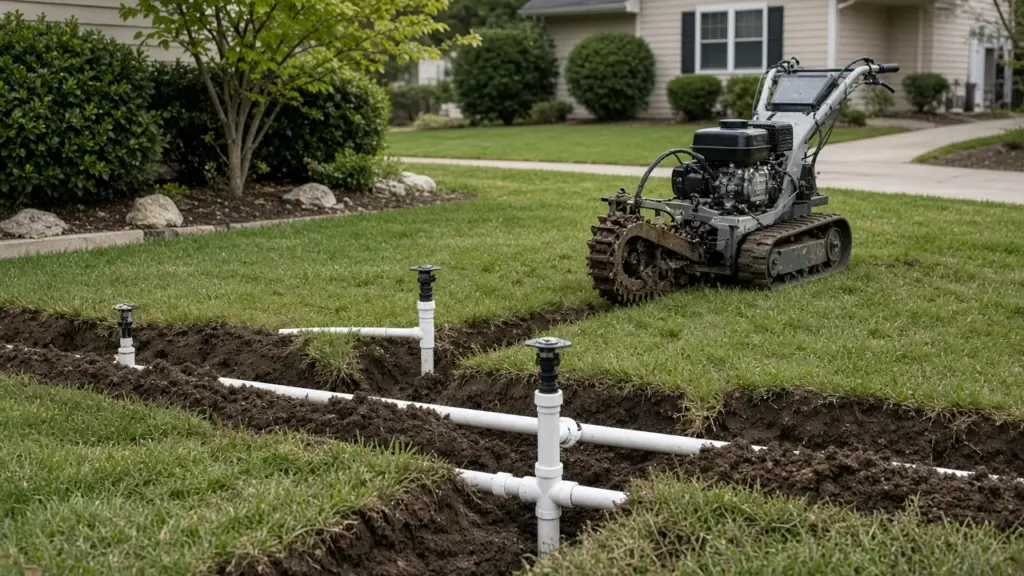
- Installation. Mainline and laterals are installed by trenching or pipe pulling, followed by valves, heads, wiring, backflow prevention, and the controller.
- Testing and adjustment. Every zone is run, heads are adjusted for coverage, and the backflow assembly is tested as required.
- Programming. The controller is set for your assigned watering days and the city’s time-of-day rules. Our watering schedule guide covers these rules in detail.
- Walkthrough. You should receive a zone map and an explanation of how to operate the system.
Reducing lawn disruption
Pipe pulling can install lines with a narrow slit rather than an open trench in suitable soil. Where trenching is needed, turf can be set aside and replaced. Some settling over trenches is normal, and good crews return soil and sod carefully.
Choosing an Installer
Texas requires anyone installing irrigation systems for hire to be licensed by the TCEQ. When choosing an installer, ask:
- Who is the Licensed Irrigator responsible for the job?
- Will I receive a design or zone map?
- How are rain and freeze sensors and backflow prevention handled?
- What warranty applies to parts and workmanship?
- How will the controller be programmed for Dallas rules?
More Installation & Retrofits Guides
- Is It Time to Replace Your Dallas Sprinkler System?
- Retrofitting an Old System With Modern Heads
- Adding Irrigation After a Landscape Redesign
- Upgrading to High-Efficiency Nozzles
- Irrigation for New Construction Homes in Dallas
- Redesigning Zones After Adding a Pool or Patio
- Irrigation Planning for Artificial Turf Areas
- Adding Drip to an Existing System
- Upgrading Valves and Wiring
Frequently Asked Questions
How do I know if my system should be replaced instead of repaired?
If leaks keep appearing in different places, coverage is poor throughout, and valves and wiring are unreliable, replacement is often more practical than continued repairs.
Can I keep my existing pipes and just upgrade heads?
Often, yes. Many retrofits reuse the mainline, valves, and wiring and upgrade heads, nozzles, and the controller.
How long does a sprinkler installation take?
It depends on the size of the property and the design. A technician can give a timeline after assessing the site.
Do new sprinkler systems in Dallas need a rain and freeze sensor?
Yes. Dallas requires automatic irrigation systems to have a working rain and freeze sensor.
Will installation ruin my lawn?
There will be some disturbance, but careful trenching or pipe pulling and proper soil and sod restoration keep it to a minimum.
Plan Your Dallas Sprinkler Installation or Retrofit
Whether your system needs targeted upgrades or a full redesign, our team can assess the yard and recommend the right approach. Learn about our irrigation services, or contact us to schedule an assessment.
Request Service or call 214-227-7444
We serve homes throughout Dallas and nearby North Texas communities.