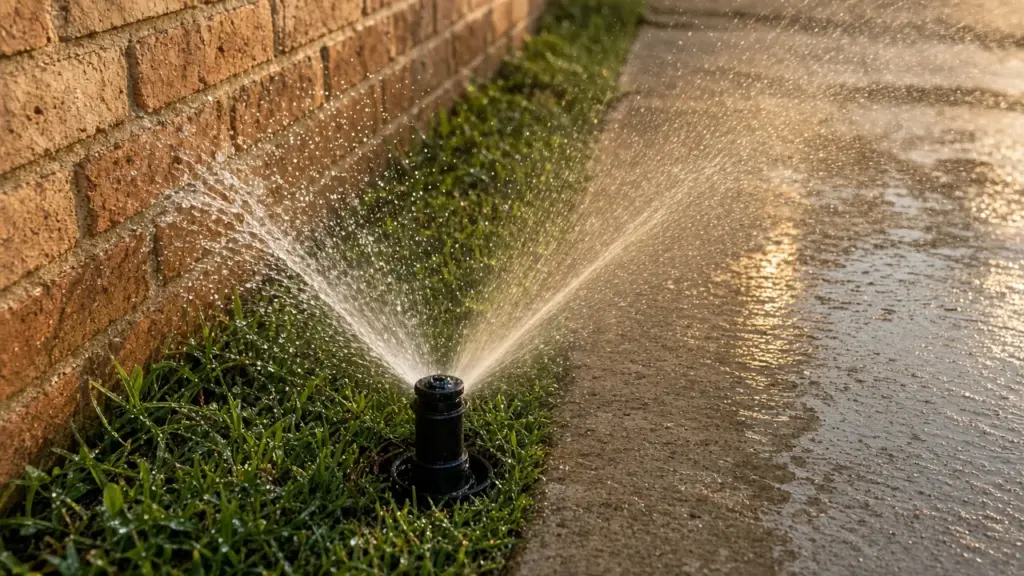
A wet driveway after the sprinklers run is one of the most common sights in Dallas neighborhoods. So is a brick wall streaked with mineral stains, or a sidewalk that stays slick every watering morning. Overspray wastes water, stains surfaces, can damage siding and wood fences, and sends water into the street, where it can count as runoff under city rules. It also means some part of your lawn is not getting the water it should.
The good news is that overspray is usually one of the easiest sprinkler problems to fix. This guide explains why heads spray where they should not and how to correct them.
Why Heads Overspray
- Arc set too wide. An adjustable nozzle turned past the lawn edge sprays pavement.
- Radius too long. The spray throws past the edge of the turf.
- Head knocked out of alignment. Mowers, foot traffic, and settling rotate heads over time.
- Wrong nozzle pattern. A full-circle nozzle where a half or quarter belongs.
- Tilted head. A head leaning toward pavement sprays over it.
- High pressure. Excess pressure extends throw and turns spray into drifting mist.
- Poor original layout. Heads placed too close to edges, or in the wrong spot entirely.
- Wind. Afternoon wind carries fine spray onto surfaces, which is one reason morning watering helps.
Step 1: Watch Each Zone
Run each zone and note which heads hit pavement, walls, fences, or windows. Mark them with small flags. Note whether the problem is the direction, the distance, or misting.
Step 2: Adjust the Arc
Many spray nozzles and rotors have an adjustable arc. For adjustable spray nozzles, turning the top or collar changes the pattern. For rotors, the arc is typically set with a small adjustment tool at the top of the head. Set each edge of the arc to stop at the lawn border.
For fixed-pattern nozzles, the arc is set by the nozzle itself. If a head at the corner of a driveway has a half-circle nozzle but needs a quarter, replace the nozzle with the right pattern from the same series.
Our guide to reading nozzle arc and radius markings explains how to identify patterns.
Step 3: Adjust the Radius
Most spray nozzles have a radius adjustment screw on top. Turning it reduces throw. Reduce it just enough to keep water off the pavement. Reducing radius too much distorts the pattern and can leave dry spots near the head, so if a large reduction is needed, choose a nozzle with a shorter rated radius instead.
Step 4: Straighten and Reset the Head
A head that leans toward pavement needs to be straightened. Dig around it, set it plumb, and firm the soil. If it sits too low or too high, reset it to grade. Our guide to raising sunken sprinkler heads covers the steps.
Step 5: Address Pressure
If heads mist and drift onto surfaces, pressure may be too high. Pressure-regulating spray bodies or nozzles reduce misting and keep spray in its intended pattern.
Step 6: Use the Right Nozzle for the Space
- Strip nozzles water narrow rectangles such as parkways and side yards without throwing onto pavement.
- Rotary nozzles throw heavier streams that drift less and can be adjusted precisely.
- Low-angle nozzles keep spray lower in windy spots.
Our comparison of spray heads, rotors, and rotary nozzles covers the tradeoffs.
Step 7: Move or Remove Heads
Sometimes a head is simply in the wrong place. A head placed right at a driveway corner or tight against a wall may never work well. Moving it a short distance inward, or removing it and adjusting neighboring heads, can solve the problem. Keep in mind that removing a head can create a coverage gap, so check the pattern afterward.
Beds Along Walls
Spray heads in narrow beds along the house almost always hit the wall. Converting those beds to drip keeps water off brick and siding and puts it at the plant roots. Our guide to converting spray zones in flower beds to drip explains how.
Why Overspray Matters in Dallas
- Wasted water: you pay for water that runs into the gutter
- Runoff rules: Dallas water conservation rules address water running into streets and gutters
- Surface damage: mineral stains on brick, rot on wood fences, and slick concrete
- Coverage gaps: water on the driveway is water not on the lawn
Our guide to the Dallas twice-weekly watering schedule covers the city’s rules.
Common Hot Spots
- Driveway edges
- Sidewalks and parkway strips
- Corners where lawn meets patios
- Heads near garage doors
- Beds along brick walls
- Fence lines
A Quick Fix Checklist
- Flag every head that hits a hard surface
- Adjust arcs to stop at the lawn edge
- Trim radius where needed
- Swap nozzles for the right pattern or a strip nozzle
- Straighten and reset tilted or sunken heads
- Add pressure regulation where heads mist
- Convert wall-side beds to drip
- Run the zone again and check coverage
Keeping Coverage After Adjustments
Every adjustment that pulls water off pavement changes coverage. After adjusting, check that each head still reaches the next one. If a gap opens up, a different nozzle or a small head relocation may be needed. Consistent nozzle series across the zone keeps application even.
When Stains Are Already There
Mineral stains on brick and concrete from years of overspray can be stubborn. Once overspray stops, cleaning methods suited to the surface can reduce them. Stopping the overspray first keeps stains from coming right back.
A Before-and-After Example
A common case: a front yard with a spray head at each corner of the driveway, both fitted with half-circle nozzles aimed along the concrete. Every cycle soaks a wide stripe of driveway and sends water down to the street. The fix is to swap both nozzles for quarter-circle patterns from the same series, trim the radius slightly, and straighten one head that had tilted toward the concrete. The driveway stays dry, and the lawn edges get more water than before.
Rotors Near Hardscape
Rotors throw water a long way, so a rotor with an arc set a few degrees too wide can soak a large section of driveway or street. Rotor arcs drift over time as heads are bumped. Check rotor arcs each spring. Many rotors let you set the left and right stops separately; set the fixed edge along the hardscape first, then adjust the other edge. If a rotor sits close to a sidewalk and still throws onto it at its shortest practical radius, a spray head or rotary nozzle may suit that spot better.
Frequently Asked Questions
How do I stop my sprinkler from spraying the driveway?
Adjust the arc to stop at the lawn edge, trim the radius, straighten the head, or replace the nozzle with the correct pattern.
Can I just turn down the radius screw?
A little, yes. Large reductions distort spray and leave dry spots, so choose a shorter-radius nozzle if needed.
Why do my heads mist onto the sidewalk?
Often high pressure. Pressure-regulating bodies or nozzles reduce misting.
Should beds along walls use spray heads?
Drip is usually better. It keeps water off walls and delivers it to roots.
Get Help Stopping Overspray
We adjust, replace, and relocate heads so water lands on your lawn instead of your pavement. See our sprinkler repair service, or contact us to schedule. Our complete guide to sprinkler head repair covers other head problems.
Request Service or call 214-227-7444
We serve homes throughout Dallas and nearby North Texas communities.