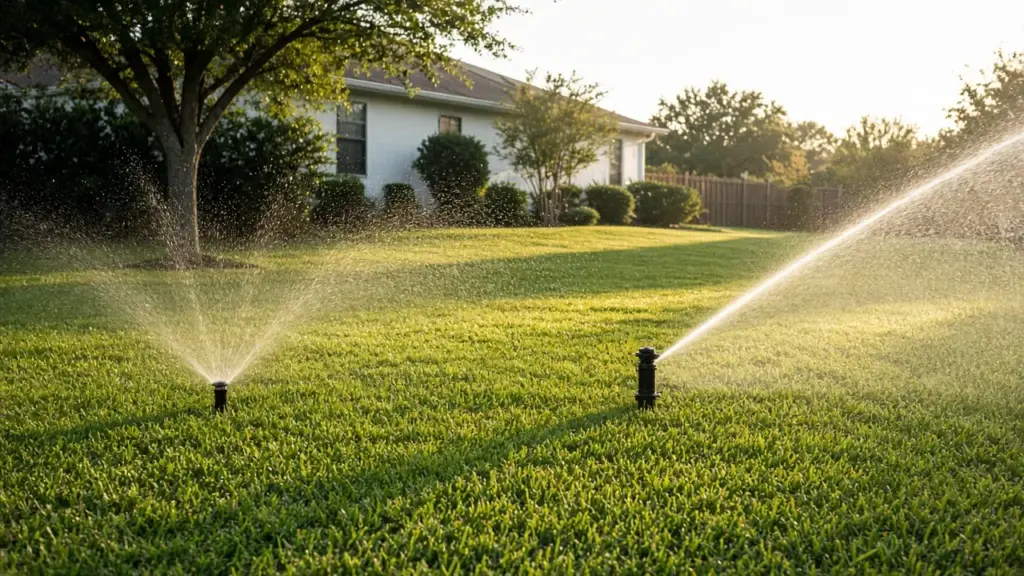
When a sprinkler head breaks, most people replace it with whatever matches. That is usually the right move for a single repair. But when you are fixing a zone that never worked well, retrofitting an older system, or redesigning part of the yard, the choice between spray heads, rotors, and rotary nozzles matters a great deal, especially on Dallas clay.
This guide explains how each type works, how they compare on application rate, coverage, and wind, and where each makes sense on typical Dallas lots.
The Three Main Options
Fixed spray heads
A spray head uses a pop-up body and a nozzle that throws a fixed fan of water. Common nozzles cover short distances, and patterns come in quarter, half, full, and adjustable arcs, as well as strip patterns for narrow areas.
Strengths: inexpensive, simple, good for small and irregular areas, easy to adjust.
Weaknesses: high application rate, which means water often lands faster than clay can absorb it; fine droplets at high pressure can mist and drift.
Rotors
A rotor uses a gear drive or similar mechanism to turn one or more streams slowly across an arc. Rotors throw water much farther than sprays and apply it more slowly.
Strengths: cover large areas with fewer heads, lower application rate that suits clay, larger droplets that resist wind.
Weaknesses: need room to work, so they are a poor fit for small beds and narrow strips; longer run times; gear drives can stall if debris gets inside.
Multi-stream rotary nozzles
Rotary nozzles screw onto a standard spray body but produce multiple rotating streams instead of a fan. They cover distances between typical sprays and small rotors and apply water much more slowly than a fixed spray nozzle.
Strengths: fit existing spray bodies, reduce runoff on clay, larger droplets than mist-prone sprays, good for retrofits.
Weaknesses: require longer run times than sprays; need adequate pressure to rotate properly; mixing them with standard sprays on the same zone causes uneven watering.
Application Rate: The Key Difference
Application rate, sometimes called precipitation rate, is how fast a head puts water on the ground. Fixed sprays have a high rate. Rotors and rotary nozzles have a much lower rate.
On sandy soil, high rates are less of a problem because water drains in quickly. On Dallas clay, a high rate is the main cause of runoff. If you see water sheeting onto the sidewalk a few minutes into a spray cycle, the soil cannot keep up. You can fix this with cycle and soak programming, or by switching to lower-rate heads. Our Dallas clay soil guide explains the soil side of this.
Never Mix Types on One Zone
A zone has one valve and one run time. If sprays and rotors share a zone, the spray areas get far more water than the rotor areas during the same cycle. Owners then increase the run time to green up the rotor areas, which floods the spray areas. The rule is simple: keep sprays with sprays, rotors with rotors, and rotary nozzles with rotary nozzles. Our sprinkler head repair guide covers matching replacements.
Which Type Fits Which Part of a Dallas Yard?
Small front yards and urban lots
Many Dallas front yards, especially in older central neighborhoods, are too small for rotors to work well. Rotary nozzles on spray bodies are often the best choice here: they reach across a small lawn with less runoff than traditional sprays.
Large open lawns
Big backyards and wide front lawns in North Dallas and other large-lot areas are classic rotor territory. Fewer heads mean fewer failure points, and the low application rate suits clay.
Narrow side yards and parkways
Strip patterns on spray heads or rotary strip nozzles fit narrow areas. Keep water off the fence, wall, and sidewalk as much as possible.
Beds and foundation plantings
Neither sprays nor rotors are ideal in beds. Shrubs block the spray, and water lands on leaves and walls. Drip irrigation usually works better; see our drip irrigation guide.
Slopes
Lower application rates help on slopes, where water runs downhill quickly. Rotary nozzles or rotors with check valves reduce both runoff and low-head drainage.
Wind and Evaporation
Dallas afternoons can be windy, and the city bans sprinkler watering between 10 a.m. and 6 p.m. year-round. Early morning watering helps, but head choice matters too. Fine mist from high-pressure sprays drifts and evaporates. Rotors and rotary nozzles produce larger droplets that hold their path better. If your sprays mist, pressure regulation is worth considering.
Pressure Matters for All Three
Each type has a pressure range where it performs best. Too little pressure and rotors stall or rotary nozzles fall short; too much and sprays mist. Pressure-regulating spray bodies, or a regulator at the valve, keep heads within their range. If an entire zone underperforms after a retrofit, check pressure and flow before blaming the heads. Our valve repair guide covers zone-level pressure problems.
Converting a Spray Zone to Rotary Nozzles
A common retrofit is swapping fixed spray nozzles for rotary nozzles on an existing zone. Done right, it involves:
- Confirming every head on the zone will be converted, not just some.
- Checking spacing, since rotary nozzles have specific radius ranges.
- Verifying pressure is in the right range.
- Increasing run time to account for the lower application rate.
- Using cycle and soak to take advantage of the slower rate on clay.
Update the controller after any conversion. A zone converted to rotary nozzles but left on its old spray run time will be badly underwatered. Our controller guide explains how to adjust run times.
Maintenance Differences
Each head type needs slightly different care over the years.
- Sprays mostly need nozzle cleaning and height adjustments. Their filter screens clog easily after a repair.
- Rotors can stop turning if grit gets into the gear drive. A rotor that sprays in one direction only, or stalls partway through its arc, often needs cleaning or replacement.
- Rotary nozzles have small internal parts and filters that clog with debris, and they need pressure within their range to rotate evenly.
Whatever you choose, walk each zone while it runs a few times a season and catch problems before summer heat magnifies them.
Choosing Based on Your Goals
- Least runoff on clay: rotors or rotary nozzles
- Lowest cost for small areas: fixed sprays
- Best for retrofits on existing spray bodies: rotary nozzles
- Fewest heads on large lawns: rotors
- Best for beds: drip
Frequently Asked Questions
Are rotary nozzles better than spray nozzles?
For many Dallas lawns, yes, because they apply water more slowly and reduce runoff on clay. They do require longer run times and should not be mixed with standard sprays on the same zone.
Can I put a rotor on a spray zone?
It is not recommended. Rotors and sprays apply water at very different rates, so the zone will water unevenly.
Why does my rotor zone take so long to run?
Rotors apply water slowly, so they need longer run times than sprays to deliver the same amount of water. That slower rate is an advantage on clay.
Do I need new heads to switch to rotary nozzles?
Often not. Rotary nozzles fit many standard spray bodies, though pressure-regulated bodies can improve performance.
Which is best for a small Dallas front yard?
Rotary nozzles on spray bodies are often a good choice, reaching across small lawns with less runoff than traditional sprays.
Get Help Choosing the Right Heads
We can evaluate your zones, recommend the right head type for each area, and retrofit or repair them. Learn more about our sprinkler repair service, or contact us to schedule.
Request Service or call 214-227-7444
We serve homes throughout Dallas and nearby North Texas communities.