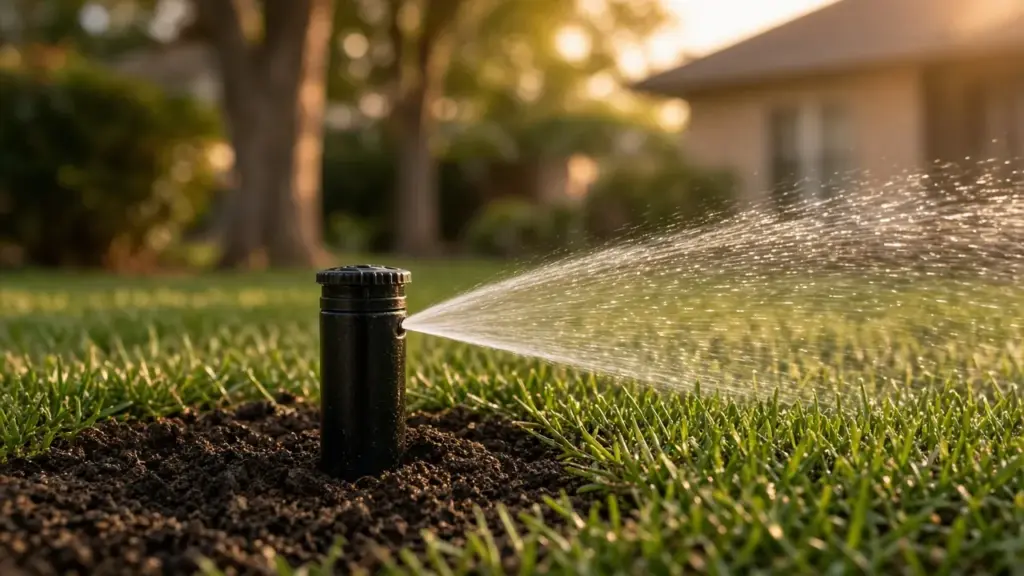
Watch a sprinkler zone run early in the morning. If the spray heads produce a fine mist or fog that drifts in the breeze, rather than distinct streams of droplets, the water pressure at those heads is likely higher than the nozzles are designed for. Much of that mist evaporates or blows onto sidewalks and driveways before it ever reaches the lawn.
Pressure-regulated spray bodies are designed to solve that problem. This guide explains what they do, when they are worth the upgrade, and how to choose them.
How Pressure Affects Spray Nozzles
Spray nozzles are designed to operate within a specific pressure range. Many standard spray nozzles perform best at around 30 psi, though you should always check the nozzle manufacturer’s specifications.
When pressure is too high:
- Water breaks into fine droplets, producing mist and fog
- Wind carries mist away from the target area
- Evaporation increases
- Spray patterns distort, and coverage becomes uneven
- Nozzles may throw farther than intended, onto hardscape
- Flow increases, using more water
When pressure is too low, heads may not pop up fully or reach their rated distance.
What a Pressure-Regulated Spray Body Does
A pressure-regulated spray body has a built-in regulator in the stem that reduces the pressure delivered to the nozzle to a set level, regardless of higher pressure in the pipe. Common models regulate to about 30 psi for standard spray nozzles, and some manufacturers offer versions regulated to higher pressures for rotary nozzles. Check the manufacturer’s specifications to match the body to the nozzle.
Because each head regulates its own pressure, heads near the valve and heads at the end of the line deliver more consistent performance.
Signs You Might Benefit
- Misting or fogging spray
- Heads close to the valve throwing farther than others
- Wind drift onto walks and drives
- Uneven coverage with dry spots despite long run times
- High static pressure measured at a hose bib or test gauge
You can check pressure with a gauge that attaches to a hose bib, giving a rough idea of static pressure. Pressure at the heads during operation will be lower, but high static pressure suggests regulation may help.
When the Upgrade Is Worth It
Pressure-regulated bodies tend to pay off when:
- The system has high water pressure
- Heads mist noticeably
- You are already replacing heads during a retrofit or repair
- Zones have significant elevation changes
- You want to improve efficiency and reduce runoff
Many water efficiency programs recommend pressure regulation for spray heads for these reasons. Our guide to upgrading to high-efficiency nozzles covers a related upgrade.
When They May Not Help
- Low pressure systems: if pressure is already low, a regulator will not help and may not have enough pressure to work properly.
- Rotor zones: rotors have different pressure needs; some rotors have their own regulation features.
- Drip zones: drip uses separate pressure regulators at the zone level.
If your problem is low pressure, see our guide to weak pressure on only one zone.
Regulating at the Valve vs. at the Head
Pressure can also be regulated at the zone valve with a pressure regulator module or by using the valve’s flow control. Regulation at the valve lowers pressure for the whole zone. Regulation at each head maintains consistent pressure at every head, which can help on zones with elevation changes or long runs. Many systems benefit from head-level regulation for spray zones.
Choosing Pressure-Regulated Bodies
- Match the regulated pressure to your nozzles.
- Choose the right pop-up height for your grass. St. Augustine often needs taller pop-ups than Bermuda.
- Consider check valve options for heads at low points. See our guide to check valves in sprinkler heads.
- Stay consistent within a zone so all heads perform similarly.
Installation Tips
- Replace heads zone by zone so each zone has consistent equipment.
- Flush lines before installing new bodies.
- Set heads flush with grade.
- Reinstall or replace nozzles, matching precipitation rates within the zone.
- Adjust arc and radius.
- Test and watch spray quality.
Our guide to matched precipitation explains why consistency within a zone matters.
Combining With Efficient Nozzles
Pressure-regulated bodies work well with high-efficiency nozzles, such as rotary nozzles, which apply water more slowly and resist wind drift. The combination can significantly improve distribution. Make sure the body’s regulated pressure matches the nozzle’s recommended operating pressure.
Adjusting Run Times After the Upgrade
Pressure-regulated heads often use less water than unregulated heads at high pressure, and coverage becomes more even. After upgrading, you may be able to shorten run times. Use a catch cup test to measure output and adjust. Our guide to how much water a Dallas lawn actually needs explains the test.
Dallas Rules Still Apply
Even with an efficient system, Dallas limits automatic sprinklers to two assigned days per week and prohibits sprinkler watering between 10 a.m. and 6 p.m. year-round. Efficient equipment helps you get more from each watering day.
Why Pressure Varies Across a Zone
Pressure is not the same at every head on a zone. Heads close to the valve see higher pressure than heads at the far end, because pressure is lost to friction as water travels through pipe and fittings. Elevation matters too: heads downhill from the valve gain pressure, while heads uphill lose it. On an unregulated zone, that means heads near the valve or at the bottom of a slope may mist while heads at the end of the line barely reach their neighbors. Pressure-regulated bodies even out those differences, so every head delivers similar performance.
Water Savings and Runoff
Mist that drifts onto pavement or evaporates is water you pay for that never reaches the lawn. By delivering larger droplets at the right pressure, regulated heads put more water where it belongs. More even coverage also means you do not have to lengthen run times to reach dry spots, which reduces overwatering elsewhere and runoff on clay soil. Water that ends up in the street can also lead to a violation under Dallas water waste rules.
Starting Small
If a full retrofit is not in your plans, start with the zones that mist the most, often those nearest the valve manifold or at low points in the yard. Replace heads on one zone, watch the difference, and continue zone by zone. Keeping equipment consistent within each zone matters more than upgrading everything at once. Our sprinkler head repair guide covers other head upgrades and repairs.
Pressure Too High for the Whole System?
Very high static pressure can stress valves, fittings, and pipe throughout the system, not just nozzles. If pressure is very high, a pressure regulator on the irrigation mainline may be worth considering in addition to regulated heads.
Frequently Asked Questions
What does a pressure-regulated spray head do?
It reduces the pressure at the nozzle to a set level, preventing misting and improving coverage.
How do I know if my water pressure is too high?
Misting or fogging spray is a common sign. A pressure gauge at a hose bib gives a rough indication of static pressure.
Are pressure-regulated heads worth it?
They often pay off on high-pressure systems, during retrofits, and on zones with misting or elevation changes.
Do I need pressure-regulated heads with rotary nozzles?
Rotary nozzles have their own recommended operating pressures. Choose a regulated body that matches the nozzle.
Get Help Upgrading Your Heads
We check pressure, upgrade spray bodies, and retrofit zones for better coverage. See our sprinkler repair service, or contact us to schedule.
Request Service or call 214-227-7444
We serve homes throughout Dallas and nearby North Texas communities.