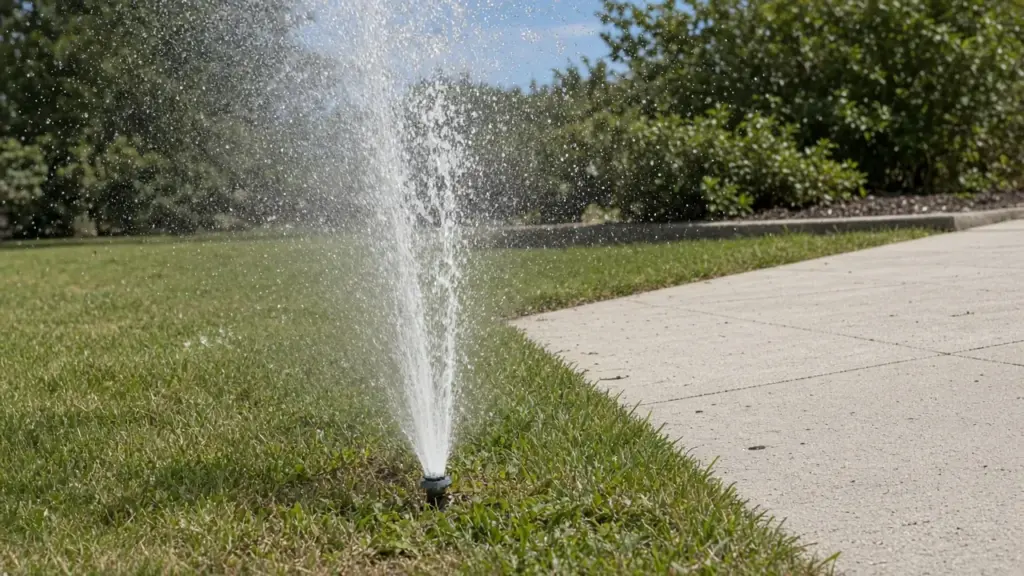
It is one of the most frustrating sprinkler repairs: a head gets broken, you buy a new one, screw it on, and turn the zone on, only to see water still shooting into the air or bubbling up around the new head. The replacement did not fix the problem because the head was never the only thing that broke.
This guide explains the most common reasons a geyser keeps coming back after a head replacement, how to diagnose each one, and how to make the repair last in Dallas clay.
What a Geyser Means
A geyser is water escaping at full pressure without passing through a nozzle. When a head works normally, the nozzle restricts and shapes the flow. When water escapes before it reaches the nozzle, it shoots straight up or boils out of the ground. The source is almost always one of these:
- A cracked riser or nipple below the head
- A cracked fitting on the lateral line (a tee or elbow)
- A head body that was not threaded on correctly or was cross-threaded
- A missing or blown-off nozzle
- A cracked new head, damaged during installation
Cause 1: A Cracked Riser Below the Head
Many older Dallas systems connect heads to the lateral line with short threaded pipes called risers or nipples. When a head is hit by a mower or vehicle, the riser often cracks or snaps below the soil line, along with the head. If the old riser is reused, the new head sits on top of a leak.
How to tell: water bubbles up from the soil around the base of the head rather than from the top.
Fix: dig around the head, remove it, and inspect the riser. Replace a cracked riser. Better yet, replace it with flexible swing pipe, which absorbs impacts and soil movement instead of cracking.
Cause 2: A Cracked Tee on the Lateral
The same impact that broke the head can crack the tee fitting where the riser connects to the lateral pipe. This break is lower, often several inches underground.
How to tell: water pools or bubbles over a wider area, and the hole fills quickly when you dig.
Fix: expose the lateral pipe, cut out the cracked tee, and replace it with a new fitting using couplings. Flush the line before reinstalling the head. Our sprinkler leak detection guide covers pipe repairs in more detail.
Cause 3: Poor Threading
Plastic threads can cross-thread easily, especially when the head is screwed onto an old riser at an angle. A cross-threaded head leaks at the connection and can crack.
How to tell: water sprays from the base of the head body when the zone runs.
Fix: remove the head, inspect both sets of threads, replace damaged parts, and thread the new head on straight and by hand. Many installers use thread tape on threaded connections to improve the seal.
Cause 4: A Missing or Loose Nozzle
A new spray head body often comes without a nozzle installed, or with a nozzle that must be pressed or screwed on. If the nozzle is missing, loose, or the wrong size, water shoots straight up in a column.
How to tell: the water column comes from the top of the riser, not the ground.
Fix: install the correct nozzle for the arc and radius, tighten it, and adjust the pattern. Our sprinkler head repair guide covers choosing the right nozzle.
Cause 5: A Damaged New Head
Heads can be cracked by overtightening, dropped, or damaged by rocks in the backfill. It is less common, but it happens.
Fix: replace it again, this time checking the body before installation and backfilling with clean soil.
Cause 6: The Break Is Somewhere Else
Sometimes the geyser near a replaced head is actually coming from a different break on the same zone, and the water is surfacing at the head because that is where the soil is loosest. In clay, water often travels along the pipe trench. Our guide to signs of a hidden leak in clay soil explains how water moves underground.
How to Diagnose It Step by Step
- Run the zone and watch closely. Is water coming from the top of the head, from around the base, or from the soil nearby?
- Turn the zone off and dig around the head. Expose the riser and the fitting below it.
- Run the zone briefly with the hole open. Watch where water appears.
- Replace every damaged part, not just the head.
- Flush the line before installing the head.
- Test before backfilling.
Making the Repair Last in Dallas Clay
- Use swing pipe between the lateral and the head. Rigid risers are far more likely to crack when clay swells and shrinks.
- Set the head at the correct height, level with the finished grade.
- Backfill firmly in layers so the head does not tilt.
- Protect heads near traffic by setting them back from curbs and driveways where possible.
Our guide to why black clay makes repair harder explains more about working in Dallas soil.
Why Heads Keep Getting Broken
If the same head breaks repeatedly, the location is part of the problem. Common culprits include heads near driveways, curbs, and sidewalks where cars and trash carts roll over them, and heads that sit too high above the turf where mowers catch them. Moving the head a short distance, lowering it to grade, or switching to a different head type may solve the recurring damage.
Choosing the Right Replacement Head
While the hole is open, it is worth making sure the new head matches the zone.
- Same type as the other heads on the zone: spray with spray, rotor with rotor, rotary nozzle with rotary nozzle.
- Correct pop-up height for your grass and mowing height.
- Correct arc and radius, so the head waters its area without soaking the sidewalk or driveway.
- A check valve if the head sits at a low point where water drains out after each cycle.
A mismatched head can fix the geyser but create a new coverage problem. Our comparison of spray heads, rotors, and rotary nozzles explains the differences.
When to Call a Professional
If you have replaced parts and water still escapes, or the break is under a driveway, near the valve, or on the mainline, a technician can locate and repair it without extensive digging. A professional repair will also check that the rest of the zone is working properly after the break.
Frequently Asked Questions
Why does water bubble up around my new sprinkler head?
The riser or fitting below the head is probably cracked. Dig around the head and inspect the connection to the lateral line.
Why does water shoot straight up from my new head?
The nozzle may be missing, loose, or the wrong type. Install and tighten the correct nozzle.
Should I reuse the old riser?
It is better to replace it, ideally with flexible swing pipe, especially after an impact.
Do I need thread tape on sprinkler heads?
Many installers use it on threaded connections to improve the seal. Always thread by hand to avoid cross-threading.
How do I stop the same head from breaking again?
Set it at the correct height, use swing pipe, and relocate it if it sits where vehicles or mowers regularly hit it.
Get a Geyser Fixed for Good
If a head keeps geysering after replacement, our team can find the hidden break and repair it properly. Learn about our sprinkler repair service, or contact us to schedule.
Request Service or call 214-227-7444
We serve homes throughout Dallas and nearby North Texas communities.