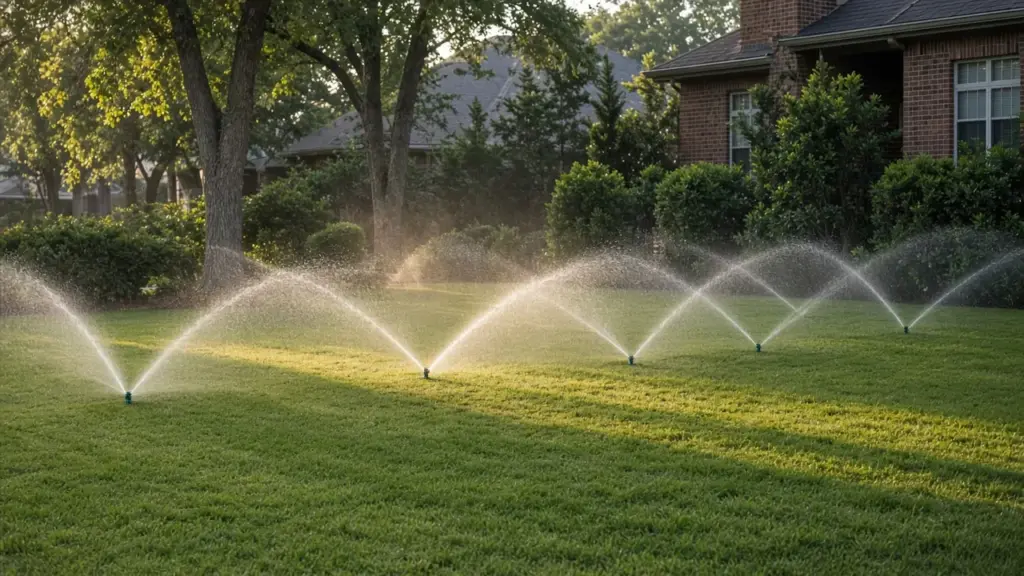
If your lawn has a pattern of dry, brown areas between sprinkler heads, while the grass right around each head looks fine, the problem may not be run time or water pressure. It may be spacing. The most important rule in sprinkler layout is head-to-head coverage, and many Dallas yards do not follow it, especially after years of repairs, additions, and landscape changes.
This guide explains what head-to-head spacing means, why it matters, and how to check and correct it.
What Head-to-Head Coverage Means
Head-to-head coverage means each sprinkler head’s spray reaches all the way to the adjacent heads. If a head throws water 12 feet, the neighboring heads should be about 12 feet away, so their spray patterns overlap completely.
Why so much overlap? Sprinklers do not apply water evenly across their spray distance. Most of the water lands in certain parts of the pattern, and less water reaches the far edge. Overlapping patterns fill in the lighter areas, creating more uniform coverage.
What Happens When Heads Are Too Far Apart
When heads are spaced farther apart than their throw distance:
- Dry areas develop between heads, often in a recognizable pattern
- Homeowners increase run times to green up dry spots, overwatering the areas near heads
- Runoff and soggy spots develop near heads while gaps stay dry
- Water is wasted trying to compensate
The classic sign is a lawn with green circles around heads and brown areas in between.
Why Many Yards Break the Rule
- Original installations sometimes stretched spacing to save on heads and pipe.
- Nozzle changes over the years may have reduced throw distance.
- Low pressure can shorten throw distance below design.
- Removed heads during landscape changes leave gaps.
- Added lawn areas without adding heads.
- Obstructions such as trees and shrubs that block spray.
Square and Triangular Spacing
Heads are typically laid out in square or triangular patterns:
- Square spacing: heads at the corners of squares. Simple, common in rectangular areas.
- Triangular spacing: heads at the corners of triangles. Can provide more uniform coverage in open areas.
In both, the spacing between heads should generally match their throw distance for head-to-head coverage. Manufacturers provide spacing recommendations for their nozzles.
Checking Your Spacing
- Run each zone and observe the spray.
- Watch whether each head’s spray reaches the neighboring heads. A simple test: stand at a head while the zone runs and see whether water from the adjacent head is landing near you.
- Measure distances between heads with a tape measure.
- Check nozzle throw distance against the manufacturer’s rating. Our guide to reading arc and radius markings explains how to identify nozzles.
Catch Cup Test
A catch cup test shows how evenly water is distributed. Place identical containers in a grid across a zone, run the zone for a set time, and compare water levels. Large differences between cups near heads and cups between heads point to spacing or pressure problems. Our guide to how much water a Dallas lawn actually needs explains the test.
Fixing Spacing Problems
Adjust Nozzles
If heads are slightly too far apart, a nozzle with a longer throw may close the gap, as long as pressure supports it. Match precipitation rates within the zone.
Add Heads
For larger gaps, adding heads is the most reliable fix. New heads must be tied into the lateral pipe and should match the zone’s head type.
Fix Pressure
If heads are not reaching their rated distance because of low pressure, fix the pressure issue first. Our guide to weak pressure on only one zone covers common causes.
Convert to Rotary Nozzles
Rotary nozzles can throw farther than traditional spray nozzles at a lower application rate, which may help in some layouts. Keep nozzle types consistent within each zone.
Redesign the Zone
For badly spaced zones, redesigning the layout may be more effective than patching. This is often part of a retrofit. Our guide to retrofitting an old system with modern heads explains the process.
Matched Precipitation Goes With Spacing
Even with correct spacing, mixing head types in a zone causes uneven watering. Spray heads and rotors apply water at very different rates. Within a zone, use heads and nozzles with matched precipitation rates. Our guide to matched precipitation explains why.
Spacing Along Edges
Heads along the edges of the lawn use partial-arc nozzles, and spacing matters there too. Gaps along sidewalks and driveways are common, and edges next to hot pavement dry out fastest. Place edge heads so their spray reaches the corners and adjacent heads.
Wind
Wind distorts spray patterns and reduces effective throw distance. Watering in the early morning, when winds are usually calmer, helps. Dallas prohibits sprinkler watering between 10 a.m. and 6 p.m. year-round, so early morning is a good choice anyway.
Obstructions That Break Coverage
Even perfectly spaced heads lose coverage when something blocks the spray. Common obstructions in Dallas yards include:
- Tree trunks and low branches that intercept spray
- Shrubs and tall perennials planted near heads
- Mailboxes, lampposts, and signs
- Tall grass around heads that sit too low
- Landscape edging that blocks low-angle spray
Each obstruction creates a shadow where water does not reach. Raising heads, trimming plants, moving heads, or adding a head on the far side of an obstruction restores coverage. As trees and shrubs grow, obstructions develop gradually, which is why coverage that once worked can decline over the years.
Coverage in Irregular Areas
Curved beds, odd-shaped lawn panels, and narrow side yards rarely fit neat square or triangular patterns. In these areas, head placement takes more care. Adjustable-arc nozzles, strip nozzles, and short-radius nozzles help fit coverage to the shape. Sometimes converting an awkward area to a bed with drip is the simplest solution.
Spacing and Clay Soil
Poor spacing is especially costly on Dallas clay. When homeowners increase run times to reach dry spots between heads, the areas near heads receive far more water than clay can absorb, and runoff results. Fixing spacing lets you shorten run times, use cycle and soak effectively, and reduce runoff. Our sprinkler head repair guide covers related head problems.
When a Few Heads Make a Big Difference
Adding just one or two heads in the right places often transforms a zone. Before a major redesign, map the dry areas, check spacing and throw, and see whether a few well-placed heads close the gaps. Stay within the zone’s flow capacity when adding heads, or pressure will drop across the whole zone.
Frequently Asked Questions
What is head-to-head sprinkler spacing?
Spacing heads so each head’s spray reaches the adjacent heads, creating overlapping coverage.
Why do I have dry spots between sprinkler heads?
Heads may be spaced too far apart, nozzles may not reach their rated distance, or pressure may be low.
Should I increase run time to fix dry spots?
Usually not. Longer run times overwater areas near heads. Fix spacing, nozzles, or pressure instead.
How do I check sprinkler coverage?
Watch whether each head’s spray reaches its neighbors, measure spacing, and use a catch cup test.
Get Help With Coverage
We check spacing, add heads, and retrofit zones for even coverage. See our sprinkler repair service, or contact us to schedule.
Request Service or call 214-227-7444
We serve homes throughout Dallas and nearby North Texas communities.