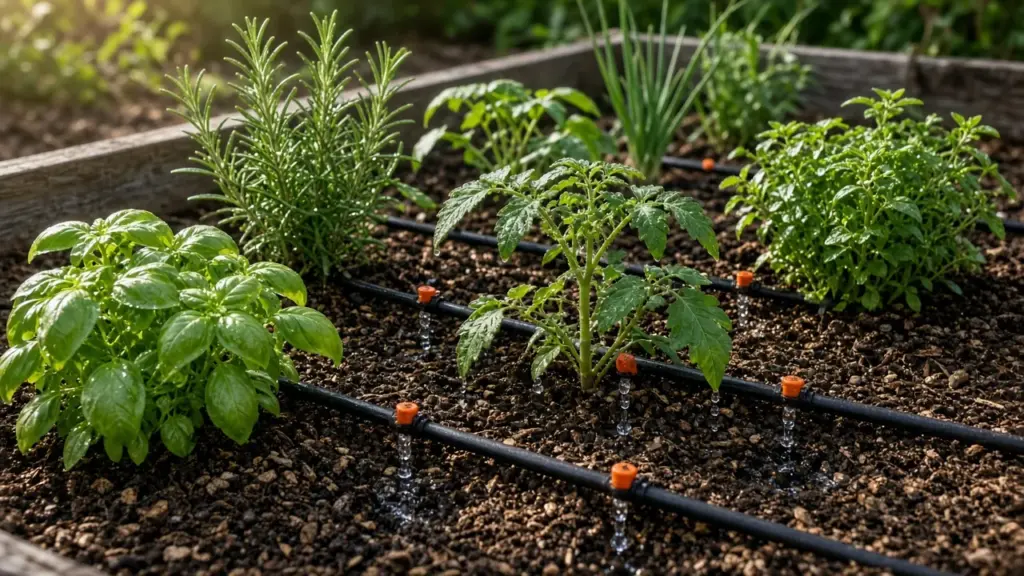
Spray heads are a poor fit for many parts of a Dallas landscape. In flower beds, shrub borders, narrow strips, and around foundations, sprays wet leaves, mulch, walls, and sidewalks while much of the water evaporates or runs off. Drip irrigation delivers water slowly and directly to the soil near plant roots. It is efficient, works well with clay soil, and under Dallas rules it can be used on any day.
This guide explains how drip systems work, where they make the most sense in Dallas yards, the problems that cause drip zones to fail, and how to repair and maintain them.
How Drip Irrigation Works
A drip zone starts at a standard irrigation valve, just like a spray zone. After the valve, water passes through two important parts:
- A filter, which catches sand and debris that would clog small emitters.
- A pressure regulator, which lowers pressure to the range drip components are designed for.
From there, water moves through tubing to emitters. There are two main approaches:
- Inline drip tubing has emitters built into the tubing at regular spacing. It is often laid in rows or loops through beds and along foundations.
- Point-source emitters are individual emitters punched into solid tubing at each plant. They are useful for shrubs, containers, and trees with different water needs.
Emitters are rated by flow, and drip applies water far more slowly than sprays. That is why drip zones need much longer run times.
Why Drip Works Well in Dallas
- Clay soil. Slow application lets heavy clay absorb water rather than shed it.
- Watering rules. Dallas allows drip irrigation, soaker hoses, and hand watering outside the twice-weekly sprinkler schedule. Foundations may be watered any day with drip. See our Dallas watering schedule guide for details.
- Less waste. Water goes to the root zone instead of onto leaves, walls, and pavement.
- Healthier plants. Dry foliage is less prone to some diseases.
Where to Use Drip in a Dallas Landscape
Flower and shrub beds
Beds are the most common drip conversion. Spray heads in beds get blocked as shrubs grow, which leaves dry patches and overspray. Drip avoids both.
Foundation beds and foundation watering
A drip line along the foundation can keep soil moisture more consistent during dry weather, which many Dallas homeowners do because of expansive clay. Our clay soil guide explains why.
Trees
Established trees benefit from occasional deep watering during long dry spells. Drip rings or bubblers placed around the drip line of the tree canopy, not against the trunk, deliver water where feeder roots are.
Narrow strips and parkways
Strips between sidewalks and curbs are hard to water with sprays without soaking the concrete. Drip or specially designed strip solutions can help.
Containers and planters
Small point-source emitters or micro-sprays can keep pots and planters watered on a schedule.
Common Drip Irrigation Problems
Clogged emitters
Sediment, mineral buildup, and soil drawn into emitters when the system drains can block flow. Symptoms include individual plants wilting while others look fine. Cleaning the filter, flushing the lines, and replacing clogged emitters usually solves it.
Damaged tubing
Shovels, edgers, aerators, pets, and rodents damage drip tubing. Leaks show up as a very wet spot, a small geyser, or low flow at the end of the line.
Missing or failed filter or regulator
A drip zone connected without a filter clogs quickly. A zone without a pressure regulator can blow fittings apart or pop emitters out of the tubing.
Fittings pulling apart
Barbed and compression fittings can separate if pressure is too high or tubing was not pushed fully onto the fitting.
Run times set like a spray zone
This is one of the most common drip problems we see. Drip applies water slowly, so a run time copied from a spray zone underwaters the bed. Drip zones need their own program. Our controller guide explains how to set separate programs.
Drip and spray on the same zone
Mixing sprays and drip on one valve means one of them gets the wrong amount of water. Each should have its own zone.
How Drip Repairs Are Done
- Clean or replace the filter and check the pressure regulator.
- Flush the lines by opening end caps and running the zone until the water runs clear.
- Walk the zone while it runs to find leaks, blowouts, and dry areas.
- Repair tubing with couplings, and replace damaged emitters.
- Check the end of each line to confirm adequate flow reaches it.
- Set a proper run time based on emitter flow, plant needs, and soil.
Choosing Emitters and Spacing for Dallas Clay
Clay spreads water sideways more than sandy soil does, so drip lines in Dallas beds can often be spaced a little wider than in sandy regions. Even so, the goal is a continuous band of moist soil through the root zone, not isolated wet dots.
- For dense beds and groundcovers, inline tubing laid in parallel rows or a grid gives even moisture across the whole bed.
- For shrubs spaced apart, point-source emitters let you give larger plants more emitters and smaller plants fewer.
- For mixed beds, group plants with similar water needs on the same zone where possible, since one zone can only have one run time.
- For slopes, pressure-compensating emitters help keep flow even from the top of the bed to the bottom.
Once the zone is running, check the soil a few inches down a few hours after a cycle. If moisture has not reached the root zone, increase run time; if the surface stays soggy, shorten it.
Deep Watering Trees Through Dallas Summers
Mature trees are among the most valuable parts of many Dallas landscapes, and lawn sprinklers alone often do not wet the soil deeply enough for them during long dry spells. A slow, deep soak under the outer canopy, using a drip ring, a set of emitters, or a soaker hose, reaches more of the feeder roots. Keep water away from the trunk itself. Because drip and soaker hoses are allowed outside the sprinkler schedule, trees can be watered on days the lawn is not.
Converting Spray Zones to Drip
Converting a bed from spray to drip usually means capping or converting spray heads, adding a filter and pressure regulator at the valve or at a conversion point, and laying tubing and emitters through the bed. Some conversions can reuse the existing valve and wiring. The key is keeping the converted zone separate from lawn spray zones. Our installation and retrofit guide covers larger redesigns.
Drip Maintenance Tips
- Clean the filter at least a few times a year.
- Flush lines at spring startup.
- Check for damage after any bed work or aeration.
- Adjust emitters as plants mature.
- Keep drip tubing covered with mulch to protect it from sun and damage.
- Protect above-ground drip components and backflow devices from hard freezes. See our maintenance calendar.
More Drip Irrigation Guides
- Converting Spray Zones in Flower Beds to Drip in Dallas
- Drip Emitters Clogging: Causes and Fixes
- Watering Trees With Drip Rings and Bubblers
- Drip Filters and Pressure Regulators Explained
- Mulch, Drip Line, and Rodent Damage
- Drip Irrigation for Foundation Beds
- Container and Planter Drip Systems
- Subsurface Drip for Narrow Turf Strips
- “Drip Line Leaks: How to Find and Fix Them”
Frequently Asked Questions
Can I run my drip system on any day in Dallas?
Dallas allows drip irrigation outside the twice-weekly sprinkler schedule. Check current rules with Dallas Water Utilities, and still avoid overwatering.
Why are some plants on my drip line dying?
Clogged emitters, a broken line, or plants with different water needs sharing one zone are common causes. Check emitters near the affected plants.
How long should a drip zone run?
Longer than a spray zone, because drip applies water slowly. The right time depends on emitter flow, soil, and plants. Check soil moisture to fine-tune it.
Can drip irrigation water my foundation?
Yes. Dallas allows foundation watering any day using drip, a soaker hose, a hand-held hose, or a bucket.
Do I need a filter and pressure regulator?
Yes. Drip emitters clog easily without filtration, and most drip components need reduced pressure.
Get Drip Irrigation Repair in Dallas
Whether your drip zone is clogged or leaking, or you want to convert thirsty spray beds to drip, our team can help. Learn about our sprinkler repair service, or contact us to schedule.
Request Service or call 214-227-7444
We serve homes throughout Dallas and nearby North Texas communities.