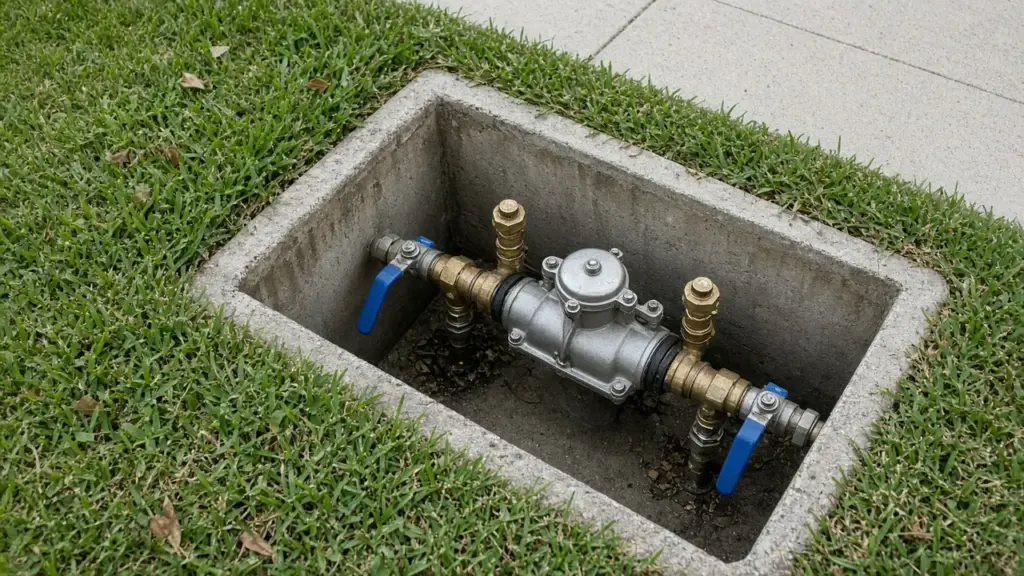
Somewhere near your house, usually by the front corner or next to the water meter line, there is a brass or bronze assembly with valves and test ports sticking out of the ground or mounted against the wall. That is your sprinkler system’s backflow preventer. It is one of the most important parts of the system, and it is the part most homeowners know the least about.
This guide explains what backflow is, the types of backflow assemblies used on Dallas irrigation systems, how Texas licensing and testing rules apply, and how to protect the device from freeze damage. It is not legal advice; for your specific property, follow the requirements of Dallas Water Utilities and the Texas Commission on Environmental Quality (TCEQ).
What Is Backflow?
Your sprinkler system is connected to the same drinking water supply as your kitchen faucet. Normally water flows one way: from the city main, through your meter, and out to the sprinkler heads. Backflow happens when water reverses direction.
That can happen two ways:
- Back-siphonage. A sudden pressure drop in the city main, such as during a main break or heavy firefighting use, can pull water backward out of your irrigation lines.
- Backpressure. If pressure on the irrigation side exceeds supply pressure, water can be pushed backward.
Irrigation water sits in pipes that are in contact with soil, fertilizer, pesticides, and animal waste. A backflow preventer keeps that water from entering the drinking water supply.
Types of Backflow Assemblies
Texas irrigation rules require backflow prevention on irrigation systems connected to a potable water supply. The common types include:
Pressure vacuum breaker (PVB)
A PVB protects against back-siphonage. It must be installed above the highest head in the system, which is why it often stands on pipes above ground. It is common on residential systems.
Double check valve assembly (DCVA)
A double check has two independent check valves in series. It can be installed below ground in a box, which some homeowners prefer for appearance. Whether it is allowed depends on the hazard level and local rules.
Reduced pressure zone assembly (RPZ)
An RPZ offers a higher level of protection, with two check valves and a relief valve between them that discharges water if a check fails. RPZs are used where a higher hazard exists, such as systems that inject fertilizer or chemicals.
The right assembly depends on the system design, site conditions, and code requirements. A licensed irrigator or backflow tester can tell you which one your system needs.
Texas Licensing: Who Can Work on Irrigation and Backflow
Texas regulates landscape irrigation through the Texas Occupations Code and TCEQ rules (Title 30, Texas Administrative Code, Chapter 344). In general:
- Anyone who designs, installs, repairs, or maintains irrigation systems for hire must hold a TCEQ license, such as a Licensed Irrigator, or work as a licensed Irrigation Technician under a Licensed Irrigator’s supervision.
- Backflow prevention assemblies must be tested by a licensed Backflow Prevention Assembly Tester where testing is required.
- Homeowners may work on irrigation at their own home, but still must follow applicable code.
Hiring licensed professionals protects you. Licensed irrigators are required to follow state design and installation standards, and their work is accountable to TCEQ.
Backflow Testing
Backflow assemblies have springs, rubber seals, and check valves that can wear, stick, or foul with debris. Testing verifies that each part holds pressure and opens at the correct point.
Testing is typically required when an assembly is first installed and may be required periodically or after repairs, depending on the water utility and assembly type. Dallas Water Utilities administers the local cross-connection and backflow program, so check with the utility for current testing requirements that apply to your property.
A test report generally includes the assembly type, size, serial number, location, test results for each check valve or relief valve, and the tester’s license information. Keep copies with your home records.
Common Backflow Problems
Leaking from the top of a PVB
A PVB that spits water from its bonnet when the system starts may have a worn poppet seal or debris under the seat. Occasional brief spitting at startup can be normal; continuous leaking is not.
Freeze damage
This is the most common backflow repair in North Texas. Water inside the assembly freezes, expands, and cracks the body or bonnet. The damage often appears when the system is turned back on in spring.
Low pressure to the whole system
A partially closed shutoff valve on the assembly, debris in a check valve, or internal wear can restrict flow to every zone. Our leak detection guide explains how to rule out mainline leaks.
Constant discharge from an RPZ relief valve
An RPZ that keeps dumping water signals a failed check or relief valve and needs service.
Freeze Protection for Backflow Preventers
Dallas freezes are usually brief, but the backflow preventer is exposed above ground and at risk.
- Insulate before hard freezes using covers or wraps designed for backflow assemblies.
- For extended hard freezes, consider shutting off the irrigation supply and draining the assembly according to the manufacturer’s instructions.
- Do not wrap it so tightly that you cannot reach the valves.
- Inspect it before restoring water after a freeze.
Our year-round maintenance calendar includes freeze-prep reminders.
Other Irrigation Code Basics in Dallas
- Rain and freeze sensors. Dallas requires automatic irrigation systems to have a working rain and freeze sensor.
- Watering schedule. Automatic systems may water up to twice weekly on assigned days, with no sprinkler watering from 10 a.m. to 6 p.m. See our Dallas watering schedule guide.
- Overspray and runoff. State design standards discourage spraying onto impervious surfaces. Keeping water on turf also avoids waste.
- Permits. New systems and significant changes may require a city permit. A licensed irrigator will know when one is needed.
- Isolation valve. Systems should have a way to shut off irrigation water without shutting off the whole house.
When Repairs Become Code Upgrades
Some repairs trigger updates. Replacing a cracked backflow assembly, adding zones, or redesigning a large portion of the system may need to meet current standards rather than whatever was in place when the system was installed. Our installation and retrofit guide covers larger upgrades, and our valve repair guide covers zone-level work.
More Backflow & Code Guides
- What a Backflow Preventer Does on Your Dallas Sprinkler System
- Backflow Testing: Who Can Test and When It Is Required
- PVB vs. RPZ vs. Double Check Assemblies
- Why Texas Requires Licensed Irrigators
- What a TCEQ Irrigation License Means for Your Repair
- “Irrigation Permits: When Work Needs One in Dallas”
- “Backflow Preventer Leaking From the Top: Causes”
- Replacing a Freeze-Cracked Backflow Assembly
- Backflow Enclosures and Freeze Covers
Frequently Asked Questions
Do I need a backflow preventer on my Dallas sprinkler system?
Yes. Texas rules require backflow prevention on irrigation systems connected to a potable water supply.
Who can test my backflow preventer?
A licensed Backflow Prevention Assembly Tester. Ask for a copy of the test report.
Can I replace my own backflow preventer?
Because the device protects the public water supply and must meet code, replacement and testing are best handled by licensed professionals.
Why did my backflow preventer crack?
Most cracks come from water freezing inside the assembly. Insulating or draining it before hard freezes helps prevent this.
What is the difference between a PVB and an RPZ?
A PVB protects against back-siphonage and must be installed above the highest head. An RPZ provides a higher level of protection for higher-hazard situations and includes a relief valve.
Get Backflow and Irrigation Code Help in Dallas
If your backflow preventer is leaking, cracked, or needs attention, our team can inspect and repair your system. Learn more about our sprinkler repair service, or contact us to schedule.
Request Service or call 214-227-7444
We serve homes throughout Dallas and nearby North Texas communities.