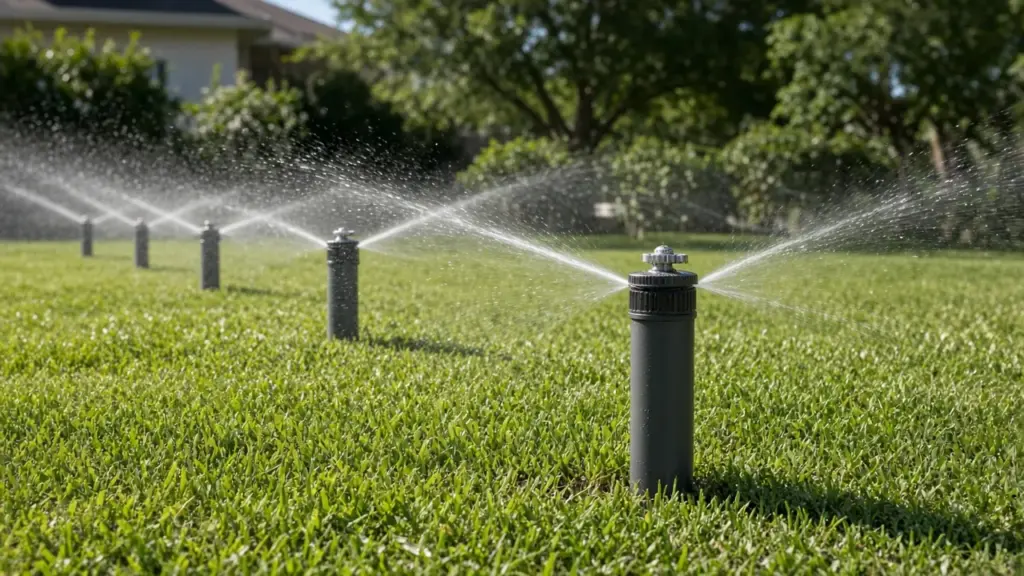
Sprinkler nozzles are small and inexpensive, but they determine how evenly water lands on your lawn and how fast it is applied. Many older Dallas systems still use standard spray nozzles that mist at high pressure, throw unevenly, and apply water faster than clay soil can absorb it. Upgrading to high-efficiency nozzles is one of the most cost-effective ways to improve an irrigation system.
This guide explains the main types of high-efficiency nozzles, how to upgrade a zone correctly, and what results to expect.
What Makes a Nozzle High-Efficiency
High-efficiency nozzles aim to:
- Distribute water evenly across the area they cover
- Apply water at a lower rate so it soaks in
- Produce larger droplets that resist wind drift and evaporation
- Match precipitation across arcs so a zone stays balanced
Different nozzle designs emphasize different benefits.
Types of High-Efficiency Nozzles
Rotary nozzles
Rotary nozzles, sometimes called multi-stream rotating nozzles, fit on standard spray bodies but deliver multiple rotating streams. They apply water much more slowly than standard sprays, which gives clay time to absorb it. Examples include Hunter’s MP Rotator and Rain Bird’s R-VAN.
Our comparison of spray heads, rotors, and rotary nozzles covers the tradeoffs.
High-efficiency fixed spray nozzles
Some manufacturers offer spray nozzles designed for better uniformity and larger droplets than older standard sprays, while still applying water faster than rotary nozzles.
Matched precipitation nozzles
Matched precipitation nozzles adjust flow with arc so quarter, half, and full circles apply water at the same rate.
Pressure-regulated bodies
Not a nozzle, but closely related. Pressure-regulating spray bodies keep pressure at the nozzle in the ideal range, reducing misting.
Why Rotary Nozzles Suit Dallas Clay
Dallas clay absorbs water slowly. Standard spray nozzles can apply water faster than clay can take it, especially on slopes. Rotary nozzles apply water more slowly, so more soaks in and less runs off. Run times are longer, but water goes where it is needed.
Our complete guide to Dallas clay soil explains how clay affects irrigation.
How to Upgrade Correctly
Upgrade a whole zone at once
The most important rule is consistency. Rotary nozzles apply water at a very different rate than standard sprays. Mixing them on one zone overwaters the spray areas and underwaters the rotary areas. Change every nozzle on a zone together.
Check pressure
Rotary nozzles and high-efficiency sprays have pressure requirements. Too little pressure shortens throw; too much causes misting. Pressure-regulated bodies help.
Check spacing
Nozzles should throw far enough to reach the next head, providing head-to-head coverage. Choose nozzles whose radius range fits your head spacing.
Adjust arcs and radius
After installation, set each nozzle’s arc to fit the area and adjust radius to reach the next head without spraying pavement.
Reset run times
Because rotary nozzles apply water slowly, run times must increase compared with standard sprays. A catch cup test helps you set new times.
The Catch Cup Test
Place several straight-sided containers across the zone. Run it for a set time. Measure the water in each container.
- Similar amounts mean even coverage
- Big differences point to coverage problems
- The average depth divided by the run time gives an application rate you can use to set run times
What to Expect After Upgrading
- Less runoff: especially on slopes and near curbs
- Less misting and drift: water lands where it should
- More even lawn color: fewer dry spots between heads
- Longer run times: rotary nozzles apply water slowly
- Possibly lower water use: because less is wasted
Results depend on your system, pressure, and how well the rest of the system is maintained.
Common Mistakes
- Replacing just a few nozzles on a zone
- Ignoring pressure
- Keeping old run times
- Mismatching nozzle series
- Installing on sunken or tilted heads without fixing them first
Our guide to raising sunken sprinkler heads covers height problems, and our guide to reading nozzle arc and radius markings helps you identify what you have.
Nozzles and Dallas Watering Rules
Dallas limits automatic irrigation to two assigned days per week and prohibits sprinkler watering between 10 a.m. and 6 p.m. year-round. Longer run times with rotary nozzles mean total zone time increases. Make sure all zones finish before 10 a.m. If needed, use multiple start times and cycle and soak, or move some zones to the evening window.
When Nozzles Are Not Enough
New nozzles cannot fix leaks, failing valves, poor zone design, or a controller that waters on the wrong days. If a zone has multiple problems, a broader retrofit may be needed. Our article on retrofitting an old system with modern heads covers that approach.
Good Candidates for an Upgrade
Some zones benefit more than others. Consider upgrading first where you see:
- Slopes with runoff: rotary nozzles give water time to soak in
- Narrow parkway strips: specialty strip or rotary nozzles keep water off pavement
- Windy, open front yards: larger droplets resist drift
- Zones with visible misting: often a pressure issue that regulated bodies and better nozzles address
- Areas with persistent dry spots between heads: better uniformity can help
Starting with problem zones gives you a visible result and helps you decide whether to upgrade the rest.
A Typical Upgrade Visit
When we upgrade a zone to high-efficiency nozzles, the work usually follows a simple order:
- Run the zone and note coverage, pressure, misting, and overspray
- Check each head for height, tilt, and condition, and fix problems first
- Measure spacing between heads to select nozzles with the right radius
- Install nozzles of the same series across the zone, sized to each arc
- Add pressure regulation where pressure is too high
- Adjust arcs and radius so water reaches the next head and stays off pavement
- Run a catch cup test to confirm even coverage and determine the application rate
- Reprogram run times for the new application rate, using cycle and soak
That last step is often overlooked. Leaving old run times in place after switching to slower nozzles can leave a lawn underwatered, while failing to use cycle and soak with standard sprays can leave it running off.
Keeping Spare Nozzles
Once a zone is upgraded, keep a few spare nozzles of the same series and sizes. When one breaks, you can replace it with an exact match instead of whatever is available, which keeps the zone balanced for years.
Nozzles and Water Pressure in Dallas Homes
Water pressure varies from home to home and even through the day. Homes with high pressure often see misting from standard sprays, which wastes water to drift and evaporation. Homes with low pressure may find that rotary nozzles do not reach their full radius. A quick pressure check at a head before choosing nozzles helps avoid disappointment.
Frequently Asked Questions
What are high-efficiency sprinkler nozzles?
Nozzles designed to distribute water more evenly, apply it more slowly, resist drift, and match precipitation across arcs.
Can I put rotary nozzles on my existing spray heads?
Usually, yes, if the spray bodies are compatible and pressure is adequate. Upgrade the whole zone at once.
Why do rotary nozzles need longer run times?
They apply water more slowly than standard sprays, which helps it soak into clay.
Will new nozzles lower my water bill?
They can reduce waste from runoff and misting, but results depend on your system and schedule.
Plan a Nozzle Upgrade
We evaluate zones, recommend nozzles, and upgrade and balance your system. Learn about our services, or contact us to schedule.
Request Service or call 214-227-7444
We serve homes throughout Dallas and nearby North Texas communities.