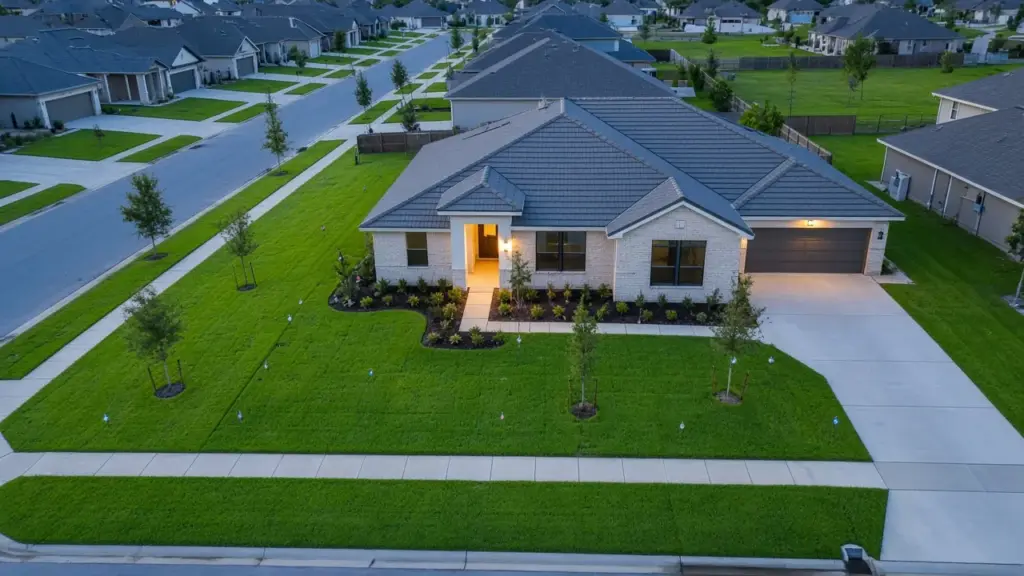
Buying a newly built home in Dallas usually means a fresh lawn, young trees, and a sprinkler system installed by the builder’s irrigation contractor. That system is designed to get the landscape established and to meet minimum requirements. It may not be set up exactly the way you would want for the long term. The first months in a new home are the best time to learn the system, catch installation issues, and make small changes before bad habits set in.
This guide covers what to check, common gaps, and early upgrades worth considering.
Get the Documentation
For new installations, Texas rules call for certain information to be provided to the property owner, such as details about the system and its maintenance. Ask the builder for whatever documentation the irrigation contractor provided, including:
- A system layout or map showing zones, valves, and heads
- The backflow preventer location and type
- The controller model and manual
- Any warranty information
If nothing was provided, ask. It is much easier to get now than years later. Our overview of why Texas requires licensed irrigators explains the standards behind new installations.
Walk Every Zone
In the first few weeks, run each zone manually and walk it.
- Do all heads pop up fully and spray cleanly?
- Does each head’s spray reach the next head?
- Is any water landing on sidewalks, driveways, or the house?
- Are any heads buried, tilted, or damaged by construction traffic?
- Do beds have drip or spray?
Construction sites are rough on new systems. Heavy equipment, fence crews, and final grading can crush heads and pipe after the system is installed.
Check the Controller
Builders often leave controllers on generic settings.
- Watering days: Set to your assigned Dallas days. Addresses ending in 0, 2, 4, 6, or 8 water on Sundays and Thursdays; 1, 3, 5, 7, or 9 on Wednesdays and Saturdays.
- Start times: All sprinkler watering must finish before 10 a.m. or start after 6 p.m. under the year-round restriction.
- Run times: Set by zone type and exposure, not one number for everything.
- Rain and freeze sensor: Confirm one is installed and connected. Dallas requires it on automatic systems.
Our guide to programming a controller for Dallas’s schedule walks through the settings.
Establishing New Sod
New sod needs more frequent watering until roots grow into the soil beneath it, then a gradual shift to deeper, less frequent watering. Dallas has provisions for new landscapes, and a variance may be available in some situations; check the city’s current rules before watering outside your assigned days. Hand watering is allowed any day and can help keep sod edges and seams from drying out.
Signs sod is rooting: gently tug a corner. If it resists, roots are growing in. Once it holds firmly, begin stretching the time between waterings.
Common Gaps in Builder Systems
- Mixed head types on one zone, which leads to uneven watering
- Spray heads in beds that wet walls and windows
- No zoning by sun and shade, especially on lots with a tall home shading one side
- Heads too close to fences or walls
- Minimal coverage in side yards and parkways
- Basic controllers without cycle and soak or weather features
None of these are necessarily wrong, but each is worth reviewing. Our guide to matched precipitation explains why mixed zones matter.
Clay and New Construction Soil
New construction lots often have compacted soil from equipment traffic and a thin layer of topsoil over clay. Water may soak in slowly, and runoff is common. Cycle and soak scheduling helps. Core aeration after the lawn is established can improve water penetration. Our complete guide to Dallas clay soil explains how clay affects watering.
Watering New Trees
Builder-planted trees are often on the lawn zone, which may not give them the deep watering young trees need. Consider bubblers or drip rings for new trees. Our guide to watering trees with drip rings and bubblers explains the options.
Foundation Watering
New homes on slab foundations benefit from consistent soil moisture around the perimeter during dry periods. Dallas allows foundations to be watered any day with drip, soaker hoses, hand-held hoses, or buckets. A dedicated foundation drip zone is a worthwhile early upgrade for many homes.
Early Upgrades Worth Considering
- Smart controller with weather adjustments and app access
- Rotary nozzles on spray zones to reduce runoff on clay
- Drip conversion for beds
- Check valves where the lot slopes
- Foundation drip zone
- Tree bubblers or rings
Our article on retrofitting an old system with modern heads covers head upgrades that also apply to newer systems.
Warranty Questions
Many builders and irrigation contractors offer a warranty period. If you find broken heads, leaks, or valves that do not work in the first months, contact the builder before hiring someone else, so you do not affect warranty coverage. Keep notes and photos of problems.
Protecting the System During Move-In Projects
New homeowners often add fences, patios, landscaping, and lighting in the first year. Each project can damage the sprinkler system. Mark heads and valves, share the system map with contractors, and walk the zones after each project.
Your First Year Calendar
- First weeks: establish sod, walk zones, fix the controller schedule
- First summer: watch for dry spots and runoff; adjust coverage
- First fall: reduce run times; consider aeration
- First winter: protect the backflow preventer before hard freezes
- First spring: full startup inspection
Understanding Your New Backflow Preventer
Every new automatic system connected to the public water supply has a backflow preventer, usually near the front of the house. Learn where it is, which shutoff valves control it, and how to turn off water to the irrigation system in an emergency. Before the first hard freeze, plan how you will protect it with an insulated cover or enclosure. Many first-year repair calls in new neighborhoods come from backflow preventers that were left exposed during a cold snap.
HOA Rules in New Communities
Many new Dallas-area communities have homeowners associations with landscape standards. HOA rules can address lawn appearance, plant choices, and sometimes irrigation equipment. City watering rules still apply regardless of HOA standards. If your HOA expects a green lawn in summer, efficient coverage and good scheduling help you meet that expectation within the twice-weekly limit.
Learning Your Zones
Label each zone on the controller with a short description, such as Front Lawn East or Back Beds Drip. It takes a few minutes and makes every future adjustment and repair easier.
Frequently Asked Questions
Should I change the builder’s controller settings?
Usually yes. Set your assigned Dallas watering days, start times that finish before 10 a.m., and run times by zone type.
How often should I water new sod in Dallas?
More often at first until roots establish, then less often and more deeply. Check current city rules for new landscapes.
Does my new home need a rain sensor?
Dallas requires rain and freeze sensors on automatic irrigation systems.
What if something breaks in the first months?
Check with your builder about warranty coverage before arranging other repairs.
Get Help With a New Home System
We review builder-installed systems, fix installation issues, and set up efficient schedules. Learn about our services, or contact us to schedule.
Request Service or call 214-227-7444
We serve homes throughout Dallas and nearby North Texas communities.