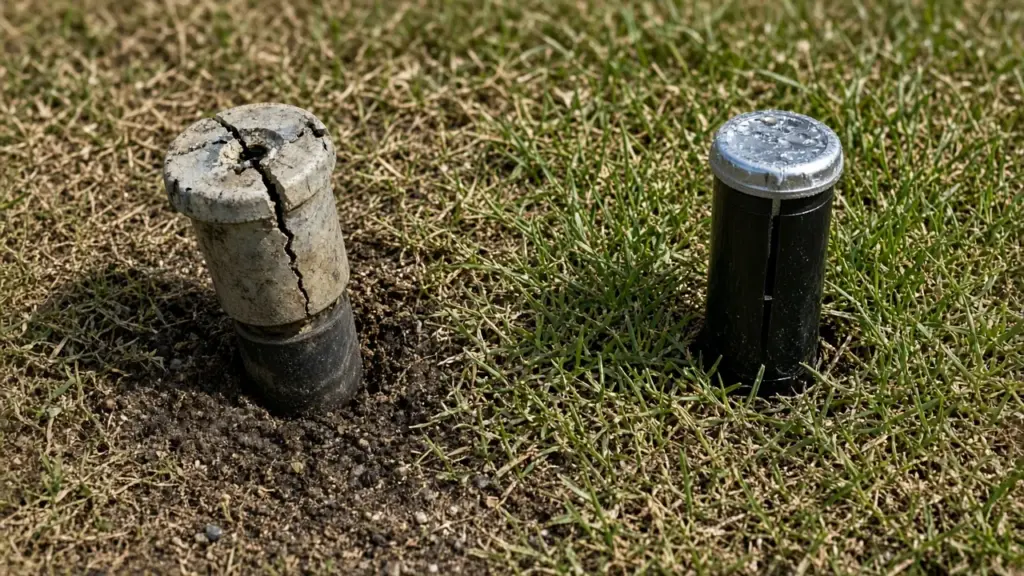
Every sprinkler system eventually reaches a point where repairs stop being the best use of money. The trick is recognizing that point. Replace too soon and you spend on a new system you did not need. Wait too long and you keep paying for repairs on a system that still waters poorly and wastes water.
This guide covers the signs that a Dallas sprinkler system may need replacement, the parts that can often be reused, and a practical way to decide between repair, retrofit, and a new installation.
Repair, Retrofit, or Replace?
It helps to think of three levels of work:
- Repair: fix what is broken, such as a head, valve, pipe, or wire.
- Retrofit: keep the useful infrastructure, such as mainline, valves, and wiring, and upgrade heads, nozzles, zones, and the controller.
- Replace: design and install a new system, reusing little or nothing.
Many systems that seem ready for replacement are actually good retrofit candidates. Our installation and retrofit guide covers retrofits in detail.
Signs Your System May Need Replacement
Leaks keep appearing in different places
One leak is a repair. Leaks that pop up in new locations every few months suggest the pipe itself is failing. Older poly pipe can become brittle, and some older systems used materials that do not hold up well in expansive clay. Our leak detection guide explains how leaks are found.
Coverage is poor almost everywhere
If most zones have dry spots even after heads are repaired and adjusted, the original design may not fit the yard. Heads may be too far apart, zones may mix different head types, or the landscape may have changed.
Valves and wiring fail repeatedly
Valves that stick, leak, or will not open, combined with wiring that fails intermittently, can make a system unreliable. When several valves in a manifold are failing, replacing the manifold may be part of a larger update.
Parts are hard to find
Discontinued heads, valves, and controllers make every repair harder and sometimes force mismatched parts onto zones.
The landscape has changed
Pools, patios, additions, new beds, removed trees, or new trees can leave heads watering the wrong areas. If most of the system no longer matches the yard, a redesign makes sense.
Water bills are high despite repairs
A system that wastes water through overspray, runoff, and mismatched zones can cost more to operate than a well-designed system, even when nothing is technically broken.
It cannot meet current requirements
Dallas requires a working rain and freeze sensor on automatic systems, and the city’s watering rules limit when you can water. An older system without a sensor input on its controller, or one that cannot finish watering before 10 a.m., may need significant upgrades. Our Dallas watering schedule guide explains the rules.
Parts That Can Often Be Reused
- Mainline pipe in good condition
- Valve locations and manifolds, sometimes with new valves
- Wiring that tests good
- Sleeves under driveways and walks
- The backflow preventer, if it is in good condition and meets requirements
A technician can pressure test lines and check wiring to determine what is worth keeping.
Parts That Usually Get Replaced
- Heads and nozzles, especially on older systems with mismatched types
- The controller, often upgraded to a model with cycle and soak, seasonal adjust, and sensor input
- Bed zones, often converted to drip
- Brittle lateral lines that leak repeatedly
A Practical Way to Decide
- Get a full system inspection. Run every zone, test pressure, check valves and wiring, and note coverage problems.
- List the problems by zone. Are they isolated or widespread?
- Compare the options. For isolated problems, repair. For widespread coverage and efficiency issues on sound pipe, retrofit. For failing pipe and a layout that no longer fits, replace.
- Consider your plans. If a major landscape project is coming, it may make sense to redesign irrigation at the same time.
Retrofit First, Replace Later
For many Dallas homes, the most practical path is staged. Start with the upgrades that make the biggest difference for the least disruption: a modern controller with cycle and soak, a working rain and freeze sensor, matched heads on each zone, and drip in the beds. If the pipe continues to leak in new places after those upgrades, you will have a clear record showing that replacement is the next step, and the new controller and many heads can often move to the new system.
What Replacement Involves
A new system in Dallas typically includes a site assessment, a design based on current landscape and water pressure, installation of pipe, valves, heads, and wiring, a rain and freeze sensor, backflow prevention, and controller programming for your watering days. Texas requires irrigation installation for hire to be performed by TCEQ-licensed professionals, and permits may be required depending on the scope. Good installers also provide a zone map. Our guide to choosing spray heads, rotors, or rotary nozzles explains the head choices that shape a new design.
Getting More Life From an Aging System
If you are not ready to replace, a few steps extend a system’s useful life:
- Fix leaks promptly to avoid saturating clay and wasting water.
- Replace mismatched heads zone by zone.
- Upgrade the controller for better scheduling.
- Convert beds to drip.
- Protect the backflow preventer before freezes.
- Schedule an annual inspection.
Questions to Ask Before Deciding
When a technician recommends replacement, it is reasonable to ask for specifics. Useful questions include:
- Which zones have the most problems, and why?
- Did the mainline and laterals pass a pressure test?
- Which valves and wires tested good?
- Can the existing backflow preventer stay?
- What would a retrofit cover compared with a full replacement?
- How would the new design handle clay soil, shade, and the watering schedule?
Clear answers help you compare options and avoid replacing parts that still have years of service left. They also give you a written record of your system’s condition, which is useful if you sell the home.
Replacement and Home Sales
Buyers and inspectors in Dallas increasingly ask about irrigation systems. A system with documented zones, a working rain and freeze sensor, and recent repair records is easier to explain than one with unknown history. If you plan to sell in the next few years, a retrofit or replacement with good documentation can be a practical investment.
Frequently Asked Questions
How long do sprinkler systems last?
It depends on materials, installation quality, soil, and maintenance. Components wear at different rates, which is why many systems are repaired or retrofitted in stages rather than replaced all at once.
Can I replace just part of my system?
Yes. Many projects replace heads, controllers, or bed zones while keeping sound mainline and wiring.
Is it worth replacing a system that still works?
If it waters poorly, wastes water, or needs frequent repairs, a retrofit or replacement can be worthwhile even if it technically still runs.
Will replacement damage my lawn?
There will be some disturbance, but careful installation methods and restoration minimize it.
How do I know if my pipe is failing?
Repeated leaks in different locations, brittle or cracked pipe found during repairs, and failed pressure tests are common signs.
Get an Honest System Assessment
Our team can inspect your system, explain what is worth keeping, and recommend repair, retrofit, or replacement. Learn about our irrigation services, or contact us to schedule.
Request Service or call 214-227-7444
We serve homes throughout Dallas and nearby North Texas communities.