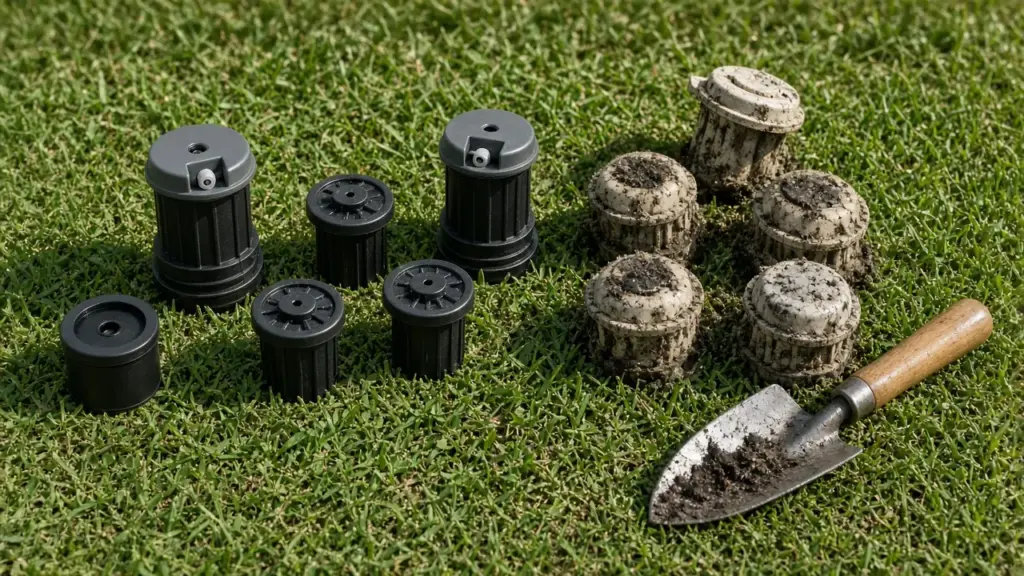
Many Dallas sprinkler systems were installed decades ago. The pipe underground may still be sound, but the heads on top reflect older technology: mismatched brands, worn nozzles, heads without check valves, and sprays that mist in the wind. Replacing an entire system is a big project. A head retrofit, where you keep the pipe and valves but upgrade what sits on top, is often a smarter first step.
This guide explains what a head retrofit involves, which upgrades make the biggest difference, and when a retrofit is not enough.
Signs Your Heads Are Due for an Upgrade
- Dry patches and wet spots that do not go away with longer run times
- Heads that mist or fog instead of spraying clean streams
- Puddles at low heads after zones shut off
- Mismatched head brands and nozzle types within the same zone
- Heads that stick up, stay down, or leak at the base
- Frequent broken heads from mowers or foot traffic
If several of these sound familiar, your heads are probably costing you water and lawn health. Our article on whether it is time to replace your sprinkler system covers the bigger picture.
Step 1: Evaluate What You Have
A good retrofit starts with a walk-through of each zone while it runs. The goal is to learn:
- Which head types are on each zone: sprays, rotors, or a mix
- Nozzle types and whether they match
- System pressure at the heads
- Coverage gaps and overspray
- Head height, tilt, and condition
- Whether the pipe and valves are sound
This evaluation determines what to change and in what order. Our complete guide to sprinkler head repair covers common head problems in more detail.
Step 2: Choose the Right Head Types
Spray heads
Spray heads cover smaller areas with a fixed fan of water. Modern spray bodies are sturdier, pop up more reliably, and many include built-in pressure regulation and check valves.
Rotors
Rotors throw rotating streams over longer distances and apply water more slowly. They suit larger open lawn areas.
Rotary nozzles
Rotary nozzles fit on spray bodies but deliver rotating streams at a lower application rate. On Dallas clay, where water soaks in slowly, that slower rate can reduce runoff. Our comparison of spray heads, rotors, and rotary nozzles goes into the tradeoffs.
Step 3: Keep Zones Consistent
The most common problem in older systems is mixed heads on one zone. Sprays apply water much faster than rotors, so a zone that mixes them overwaters the spray areas while underwatering the rotor areas. A retrofit should group similar heads on each zone, or convert a whole zone to one type.
Matched-precipitation nozzles help too. These nozzles adjust flow to arc, so a quarter-circle and a full-circle nozzle apply water at the same rate.
Step 4: Add Pressure Regulation and Check Valves
- Pressure-regulating bodies or nozzles reduce misting from high pressure, which improves coverage and reduces drift.
- Check valves in heads stop low-head drainage, which prevents puddles and keeps lines full so the next cycle starts evenly.
Step 5: Fix Height and Alignment
Heads should sit level with finished grade and stand straight. Sunken heads get blocked by turf. High heads get hit by mowers. Tilted heads spray unevenly. A retrofit is a good time to reset them all.
What a Retrofit Does Not Fix
- Leaking or undersized pipe. New heads cannot fix a cracked lateral or a mainline too small for the zones.
- Failing valves. Valves that weep or stick need repair or replacement.
- An outdated controller. Consider a controller upgrade alongside the retrofit. Our guide to controller repair and upgrades covers the options.
- Poor zone design. If zones cross sun and shade or lawn and beds, a redesign may be needed.
Retrofit vs. Replacement
A retrofit makes sense when the pipe and valves are sound and the main problems are coverage and efficiency. A replacement or partial replacement makes more sense when:
- Pipe breaks are frequent
- Much of the pipe is old poly or brittle PVC
- Zones need to be completely reorganized
- Major landscaping changes have left the system out of step with the yard
Working Within Dallas Watering Rules
Better heads help your lawn stay healthy within Dallas’s twice-weekly schedule and the year-round 10 a.m. to 6 p.m. restriction. Efficient heads apply water more evenly, so you can often water less while getting better results. Pair a retrofit with cycle and soak scheduling so water soaks into clay instead of running off.
Licensing and Code
In Texas, installing and significantly modifying irrigation systems falls under state irrigation rules, and much of that work must be performed by or under the supervision of a licensed irrigator. Local permits may also apply. Ask any contractor how they handle licensing and permits for your project.
Budgeting a Retrofit in Phases
A retrofit does not have to happen all at once. Many homeowners upgrade one zone at a time, starting with the zone causing the most trouble. A phased approach spreads out cost and lets you see results before moving on. Start with front yard zones that are most visible or back yard zones with the worst dry spots. Keep notes on what was changed on each zone so future work stays consistent.
We do not publish flat prices because every system is different, but a clear evaluation up front helps you decide what to do first.
What to Expect Afterward
After a retrofit, walk each zone during a manual run. Heads should pop up fully, spray cleanly, and reach the next head. Puddles at low heads should be gone. Over the next few weeks, dry spots should green up. You may also be able to reduce run times, since better coverage means less water is needed to reach every part of the lawn.
A Typical Front Yard Example
Consider a common Dallas front yard: a rectangular lawn, a parkway strip between the sidewalk and street, and beds along the foundation, all watered by a system installed many years ago. The front lawn zone may have a few older rotors in the middle and spray heads along the edges. The parkway strip may share that zone, and the beds may have spray heads that hit the brick.
A retrofit for that yard might look like this:
- Convert the mixed front lawn zone to all rotary nozzles on modern spray bodies, so application rates match across the zone.
- Use strip nozzles or rotary nozzles sized for the narrow parkway so water stays off the sidewalk and street.
- Convert the foundation beds to drip, keeping water off the wall and concentrating it at plant roots.
- Add check valves where the yard slopes toward the curb.
- Reset each head to grade and adjust arcs and radius.
Each step is modest on its own. Together, they can turn an inefficient zone into one that waters evenly with less runoff. Our guide to drip irrigation repair and design explains bed conversions in more depth.
Frequently Asked Questions
Can I upgrade my sprinkler heads without replacing the system?
Often, yes. If the pipe and valves are sound, replacing heads and nozzles can improve coverage and efficiency without a full replacement.
Should I mix spray heads and rotors on one zone?
No. They apply water at very different rates. Keep each zone to one type.
What are rotary nozzles?
They fit on spray bodies but deliver rotating streams at a lower rate, which can help water soak into clay soil.
Do new heads fix pressure problems?
Pressure-regulating heads help with high pressure. Low pressure usually comes from leaks, valves, or undersized pipe, which heads cannot fix.
Plan Your Retrofit
We evaluate older systems, recommend upgrades zone by zone, and handle the work. Learn about our services, or contact us to schedule an evaluation.
Request Service or call 214-227-7444
We serve homes throughout Dallas and nearby North Texas communities.