Trees are among the most valuable parts of a Dallas landscape. They shade homes, cool yards, and take decades to replace. Yet most irrigation systems are designed for lawns, not trees. Lawn zones apply shallow water across turf, while trees benefit from slow, deep water over a wide root area during extended dry periods.
Drip rings and bubblers are two simple ways to give trees the water they need. This guide explains how each works, how to place them, and how to keep them working.
How Tree Roots Take Up Water
Most of a tree’s water-absorbing roots are in the top foot or so of soil, and they spread well beyond the canopy edge, often far wider than people expect. Water applied only at the trunk misses most of those roots. The goal is to wet a broad area under and beyond the canopy, slowly enough that water soaks in rather than running off.
In Dallas clay, slow application is especially important, since clay absorbs water slowly.
Drip Rings
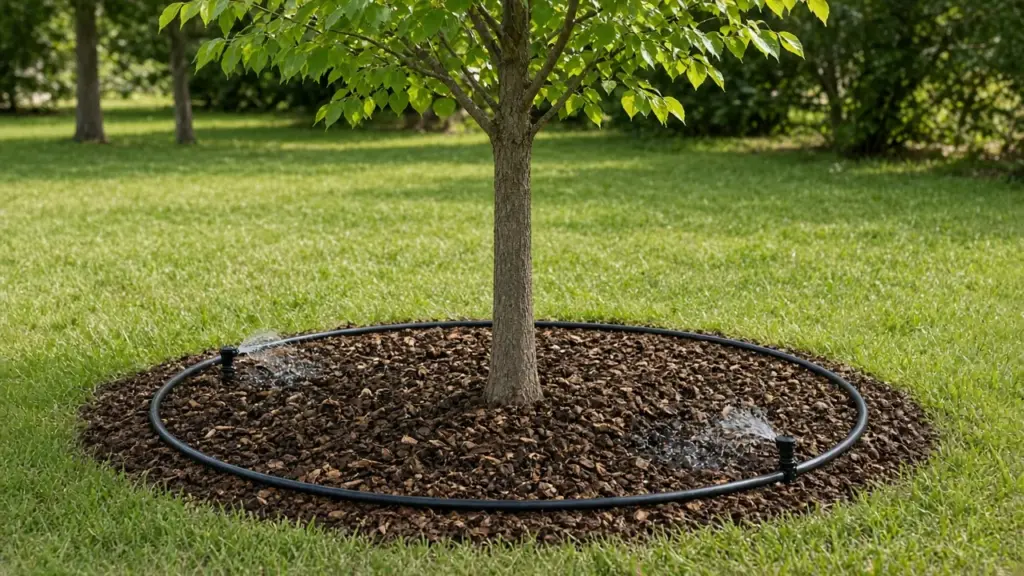
A drip ring is a loop of drip tubing, often inline emitter tubing, placed around a tree. It connects to a drip zone or a dedicated tree zone.
Placement
- Place the ring away from the trunk, generally out toward the drip line of the canopy, rather than against the trunk
- For larger trees, use multiple concentric rings or a spiral pattern to cover more root area
- Keep tubing under mulch to protect it from sun and damage
Advantages
- Delivers water slowly and evenly
- Covers a wide root area
- Little loss to evaporation or runoff
Considerations
- Must be expanded as the tree grows
- Needs a filter and pressure regulator like any drip zone
- Can be damaged by digging, aeration, or rodents
Bubblers
Bubblers are small devices that release water in a gentle flow or short umbrella pattern. They are often used for newly planted trees, where water is directed into a basin around the root ball.
Placement
- For new trees, place bubblers over the root ball area at first
- Move or add bubblers outward as roots grow
- Use a shallow basin to hold water in place
Advantages
- Delivers a lot of water to a small area quickly
- Easy to see working
- Good for establishing new trees
Considerations
- Can apply water faster than clay can absorb, leading to runoff if the basin is not adequate
- Less suited for large, established trees with spreading roots
Choosing Between Them
- New trees: bubblers or a small drip ring over the root ball
- Young trees: a drip ring expanding outward
- Established trees: multiple drip rings or a grid of drip tubing across a wide area
Our drip irrigation repair and design guide covers drip zone components in detail.
Put Trees on Their Own Zone
Trees need water less often but more deeply than lawns. Putting trees on the same zone as lawn or beds forces a compromise. A dedicated tree zone lets you water deeply and infrequently. If a separate zone is not possible, drip rings on a bed zone are better than relying on lawn sprinklers alone.
How Much and How Often
Water needs depend on tree species, size, age, soil, and weather. As a general approach, established trees benefit from deep watering during extended dry periods, rather than frequent light watering. New trees need more frequent watering during establishment. Local extension resources offer species-specific guidance. Watch for signs of drought stress such as wilting, leaf scorch, and early leaf drop.
Watering Rules
Dallas watering rules may treat drip irrigation and hand watering differently from spray irrigation. Rules can change, so check current City of Dallas guidance before assuming a drip tree zone can run outside your assigned days. Our Dallas watering schedule guide summarizes the current rules.
Keeping Drip Rings Working
- Clean the filter a few times a year
- Flush lines in spring
- Check for clogged emitters
- Expand rings as the tree grows
- Repair damage promptly
Our guide to drip emitters clogging explains how to find and clear clogs.
Avoid These Mistakes
- Watering only at the trunk. Most absorbing roots are farther out.
- Mulch against the trunk. Keep mulch pulled back from the trunk.
- Spraying tree trunks with sprinklers. Constant wetting of the trunk is not good for the bark.
- Frequent shallow watering. Encourages shallow roots.
- Letting rings girdle the trunk. Keep tubing loose and away from the trunk.
Converting Existing Spray Heads
If spray heads in a bed around a tree hit the trunk and foliage, converting that area to drip can help both the tree and the plants beneath it. Our guide to converting spray zones in flower beds to drip walks through the conversion.
Trees in Lawns
Trees growing in lawns share water with turf. During drought, lawn sprinklers may keep turf alive while the tree still lacks deep moisture. Drip rings under the canopy, beneath a mulched ring, can supplement the lawn zone. A wide mulched ring also reduces root competition from turf.
Trees and Sprinkler Pipe
Large tree roots can grow around and damage sprinkler pipe, especially near slow leaks. When installing drip rings, route supply tubing carefully to minimize root damage. Our guide to Preston Hollow irrigation on large wooded lots discusses trees and pipe on larger properties.
Signs a Tree Needs More Water
Trees do not show stress as quickly as lawns, which makes drought damage easy to miss. Look for:
- Leaves that wilt in the afternoon and do not recover overnight
- Brown, crispy leaf edges, often called leaf scorch
- Early fall color or leaf drop in summer
- Thin canopy compared with previous years
- Dead twigs at branch tips
If you see these signs during a dry stretch, deep watering over the root zone can help. For serious decline, consult a certified arborist.
Planning for Growth
A drip ring that fits a young tree will be too small in a few years. Plan the supply line with room to add more tubing, and set a reminder each spring to check whether the ring still reaches out toward the canopy edge.
A Simple Tree Zone Layout
For a typical Dallas front yard with one or two established shade trees, a practical tree zone might look like this:
- A supply line from a dedicated valve, with a filter and pressure regulator at the start
- Solid distribution tubing running under mulch to each tree
- Two or three rings of inline emitter tubing around each tree, spaced outward from a comfortable distance off the trunk toward the canopy edge
- Flush caps at the end of each ring for spring cleaning
Run times for tree zones are usually longer than for lawn zones, but they run less often. Because clay absorbs slowly, even a long drip cycle rarely produces runoff when emitters are spaced properly.
Frequently Asked Questions
Where should I place a drip ring around a tree?
Away from the trunk, out toward the canopy edge, with additional rings for larger trees.
Are bubblers or drip rings better for trees?
Bubblers work well for new trees. Drip rings or grids are better for established trees with spreading roots.
Should trees be on their own irrigation zone?
Ideally yes, so they can be watered deeply and infrequently without overwatering the lawn or beds.
Do lawn sprinklers water trees enough?
Often not during drought. Lawn zones apply shallow water, while trees benefit from deeper, slower watering.
Get Help Watering Your Trees
We design and install drip rings, bubblers, and tree zones, and repair drip systems. See our sprinkler repair service, or contact us to schedule.
Request Service or call 214-227-7444
We serve homes throughout Dallas and nearby North Texas communities.