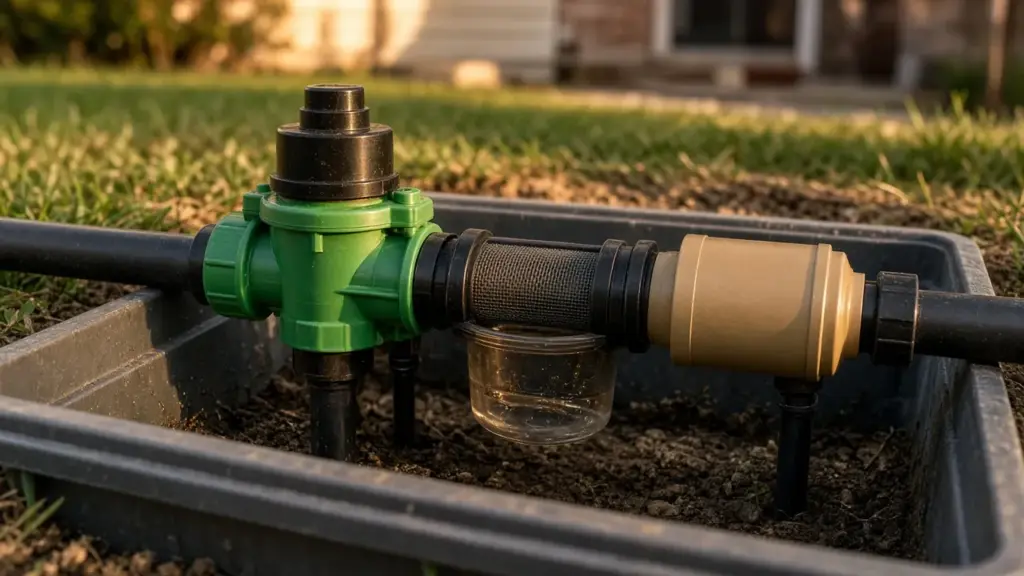
Drip irrigation is efficient because it delivers small amounts of water through tiny passages right at plant roots. Those tiny passages are also why drip needs two components at the start of every zone: a filter to keep debris out and a pressure regulator to keep pressure in the range drip parts are designed for. Skip either one and a drip zone is likely to clog, leak, or blow apart.
This guide explains what filters and pressure regulators do, how to choose them, and how to maintain them.
The Head of a Drip Zone
A typical drip zone starts with a sequence of parts, often called the zone kit or head assembly:
- Valve: turns the zone on and off
- Filter: removes debris
- Pressure regulator: reduces pressure
- Adapter: connects to drip tubing
Some products combine the filter and regulator in one unit. The order matters: the filter usually comes before the regulator so debris does not damage the regulator. Follow the manufacturer’s instructions for your parts.
Our drip irrigation repair and design guide covers the full drip system.
Why Drip Needs a Filter
Drip emitters have narrow flow paths. Sand, sediment, pipe shavings from repairs, scale, and organic debris can clog them. A filter catches particles before they reach emitters.
Types of filters
- Screen filters: a mesh screen in a housing. Common in residential drip.
- Disc filters: a stack of grooved discs that trap particles. Handle more debris before clogging.
Mesh size
Filters are rated by mesh or micron size. Emitter manufacturers specify the filtration their emitters need. Using a filter that matches or exceeds that requirement protects the emitters.
Why Drip Needs a Pressure Regulator
Household water pressure in many Dallas homes is higher than drip components are designed for. Drip tubing, fittings, and emitters generally work in a lower pressure range than spray heads. Too much pressure can:
- Blow fittings apart
- Cause emitters to pop out
- Make tubing balloon or split
- Cause uneven flow in non-pressure-compensating emitters
A pressure regulator reduces incoming pressure to a set level suited to drip. Many residential drip regulators are preset to a fixed pressure.
Choosing a Regulator
- Match the flow range. Regulators are rated for a range of flow. A regulator that is too large for a small zone may not regulate properly; one that is too small restricts flow.
- Match the pressure. Choose a pressure suited to your drip components.
- Consider combination units. Filter-regulator combos save space.
Pressure-Compensating Emitters Still Need a Regulator
Pressure-compensating emitters keep flow even across a range of pressures, but that range has an upper limit. Tubing and fittings still need protection from high pressure. A regulator is still needed.
Installing Filters and Regulators
- Install after the zone valve so they are only pressurized when the zone runs, unless the manufacturer specifies otherwise
- Follow flow direction arrows on each part
- Install where you can reach the filter for cleaning
- Use a valve box large enough for access
- Wrap threaded connections as recommended
Cleaning the Filter
- Turn off the zone and relieve pressure
- Unscrew the filter housing
- Remove the screen or disc stack
- Rinse under water, using a soft brush if needed
- Check for tears or damage
- Reassemble, making sure seals are seated
- Run the zone and check for leaks
Clean filters at least a few times a year, during spring startup, and after any repair on the zone. If a filter clogs quickly, the water source may be carrying more debris, or a line upstream may be damaged.
Signs of Filter or Regulator Problems
- Weak flow across the whole zone: clogged filter
- Emitters clogging repeatedly: torn screen, missing filter, or filter too coarse
- Fittings blowing apart: missing or failed regulator
- Tubing bulging: excessive pressure
- Leaking housing: cracked housing or damaged seal
Our guide to drip emitters clogging covers emitter problems in more depth.
Freeze Protection
Filter and regulator housings are often plastic and can crack in freezes if water remains inside. In valve boxes below ground, they are somewhat protected, but above-ground installations are vulnerable. Before hard freezes, some homeowners drain or insulate exposed drip components. Check after freezes for cracks.
Checking Pressure
A pressure gauge that attaches downstream of the regulator can confirm the zone is at the right pressure. Some technicians check pressure at the end of the longest run to make sure it is adequate throughout.
Common Mistakes
- Leaving out the filter because the water supply seems clean
- Using a spray zone valve without a regulator for drip conversion
- Installing the regulator backward
- Burying the filter where nobody can reach it
- Never cleaning the filter
Converting Spray Zones
When converting a spray zone to drip, a filter and regulator must be added. Some conversion kits install at a spray head riser, but for a whole zone, installing at the valve is usually better. Our guide to converting spray zones in flower beds to drip explains the process.
Trees and Foundations
Tree drip rings and foundation drip lines are drip zones too, with the same filter and regulator needs. Our guides to watering trees with drip rings and foundation watering with drip lines cover those applications.
Replacing Worn Components
Filter screens tear, seals flatten, and regulator springs weaken over the years. If a zone that once worked well starts to clog more often or leak at fittings, the filter or regulator may be worn. Replacement parts are usually inexpensive compared with the cost of replacing clogged emitters and blown fittings throughout a zone. When replacing, match the flow range and pressure to the zone.
Keeping Records
Note the filter mesh size, regulator pressure, and the brand of each head assembly in your system records. When a part fails, you can replace it with the right component. Also record when filters were last cleaned. A simple note on the controller or in your phone is enough.
A Quick Service Routine
Twice a year, take ten minutes to service each drip zone head:
- Open the valve box and clear soil, roots, and insects
- Turn off the zone and remove the filter screen or discs
- Rinse and inspect; replace if torn or deformed
- Check the regulator and fittings for cracks or leaks
- Reassemble and run the zone
- Open a flush cap at the end of each run until water runs clear
- Walk the zone and look for dry plants or spraying fittings
A few minutes of routine care prevents most drip failures.
When a Filter Clogs Unusually Fast
If a filter that normally stays clean for months suddenly clogs in weeks, look upstream. A recent repair may have left debris in the lateral, a break may be pulling in soil, or the valve may be passing debris from the supply. Flush the zone thoroughly with the filter screen removed and the ends open, then reinstall the screen and watch whether the problem continues.
Frequently Asked Questions
Does every drip zone need a filter?
Yes. Emitters have narrow flow paths that clog easily without filtration.
Why do I need a pressure regulator for drip?
Household pressure is often higher than drip components can handle. A regulator prevents blowouts and uneven flow.
How often should I clean my drip filter?
At least a few times a year, at spring startup, and after any repair on the zone.
Do pressure-compensating emitters need a regulator?
Yes. They work within a pressure range, and tubing and fittings still need protection from high pressure.
Get Drip Zone Help
We install and service drip filters and regulators and repair drip zones. See our sprinkler repair service, or contact us to schedule.
Request Service or call 214-227-7444
We serve homes throughout Dallas and nearby North Texas communities.