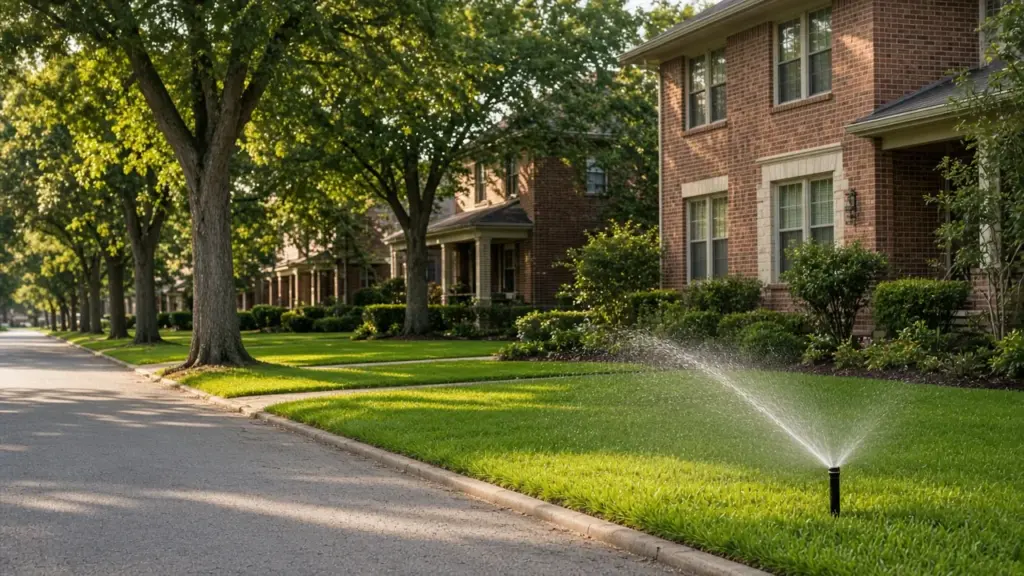
Dallas is a big city with very different kinds of yards. A 1920s cottage on a narrow M Streets lot, a hillside home in Kessler Park, a wooded Preston Hollow property, and a 1980s house in Far North Dallas can all have sprinkler systems, but the problems they run into are not the same. Lot size, tree canopy, terrain, soil, and the age of the system all change what breaks and how it should be fixed.
This guide explains the main factors that vary from one Dallas neighborhood to another and how they affect irrigation repair. It is the starting point for our neighborhood series, and it links to the core repair guides that apply everywhere in the city.
Why Neighborhood Matters for Irrigation
The basics of a sprinkler system are the same citywide: a backflow preventer, valves, pipe, heads, and a controller. The same city rules apply too, including the twice-weekly watering schedule, the year-round ban on sprinkler watering between 10 a.m. and 6 p.m., and the requirement for a working rain and freeze sensor. Our Dallas watering schedule guide covers those rules.
What changes from place to place is the environment the system lives in.
Age of the home and the system
Many homes in older central and East Dallas neighborhoods were built long before automatic irrigation was common. Systems in those areas were often added later, sometimes more than once, by different installers. That can mean mixed parts, undocumented zones, and pipe routes that do not follow any obvious pattern. Newer subdivisions in the northern part of the city are more likely to have a single original system, though it may be reaching the age where valves and heads wear out together.
Tree canopy
Mature trees are one of the best things about neighborhoods like Lakewood, Preston Hollow, and Lake Highlands. They also shade lawns, drop leaves into heads and valve boxes, and send roots into irrigation lines. Shaded turf needs less water than turf in full sun, so a system designed before the trees grew often overwaters the shade and underwaters the sunny areas.
Terrain
Most of Dallas is fairly flat, but parts of Oak Cliff, Kessler Park, and areas along creeks have real slopes. Sloped yards shed water quickly, and low heads on a slope can drain the lateral line after every cycle.
Lot size and layout
Small urban lots in Uptown, the M Streets, and Bishop Arts area leave little room between heads, walls, fences, and sidewalks. Overspray is the most common complaint. Large lots need more zones and longer runs of pipe and wire, which means more places for leaks and wire breaks.
Soil
Much of Dallas has heavy, expansive clay. It absorbs water slowly and moves as it wets and dries, which sinks heads and stresses fittings. Our Dallas clay soil guide explains how to water and repair systems in it.
Common Patterns by Type of Neighborhood
Historic and older central neighborhoods
Places such as Lakewood, the M Streets, Swiss Avenue, Winnetka Heights, and parts of Oak Cliff often have:
- Systems added long after the house was built
- Older pipe and fittings, sometimes mixed materials
- Heads that sank or were buried as lawns were top-dressed over decades
- Tight side yards and parkway strips where sprays hit walls and sidewalks
- Tree roots near lines
Repairs here often start with mapping. Knowing where the valves are and what each zone waters saves time on every future visit. Our valve repair guide explains how zones and valves are traced.
Wooded North Dallas neighborhoods
Preston Hollow, Bluffview, and nearby areas tend to have large lots and heavy canopy. Typical issues include:
- Long pipe and wire runs with more failure points
- Leaves and debris clogging heads
- Shade zones that need much less water than sun zones
- Root damage to lines near large trees
- Beds and foundation plantings that do better on drip
Our drip irrigation guide covers converting beds and watering trees efficiently.
Mid-century neighborhoods
Lake Highlands, Casa Linda, Midway Hollow, and many areas built after World War II often have systems that have been repaired many times. Common findings include mismatched heads on the same zone, controllers that have been replaced but never fully reprogrammed, and valves that are near the end of their service life.
Newer subdivisions in Far North Dallas
Neighborhoods built later, such as Prestonwood and Bent Tree area subdivisions, are more likely to have original systems that were designed as a unit. Here the work often involves updating controllers, adjusting zones that were set up for young landscaping, and replacing heads that have worn out together.
Urban lots and townhomes
In Uptown and other dense areas, irrigation may be small, shared with an HOA, or limited to beds and a strip of turf. Precise nozzles, drip, and careful adjustment matter more than coverage over large areas.
Repairs That Apply Everywhere
No matter the neighborhood, the most common repairs in Dallas are the same:
- Broken, sunken, or clogged heads, covered in our sprinkler head repair guide
- Valve and wiring failures
- Hidden leaks, covered in our leak detection guide
- Controller programming problems
- Freeze damage to backflow preventers
Parkways, Alleys, and Shared Spaces
Many Dallas neighborhoods have features that complicate irrigation no matter the age of the house.
- Parkway strips between the sidewalk and the street are narrow, get hit by car doors and trash carts, and are hard to water without soaking concrete. Strip nozzles, low-angle nozzles, or drip-style solutions work better than standard sprays.
- Alley-access lots, common in older parts of the city, often have irrigation running along the back fence and garage apron, where utility work and vehicles damage lines.
- HOA-maintained areas in some newer subdivisions and townhome communities share irrigation between properties. Before changing anything, confirm which heads and valves belong to you and which belong to the association.
- Historic district rules in some neighborhoods govern visible changes to front yards. Irrigation itself is mostly underground, but new controllers, backflow placement, and landscape changes may deserve a quick check.
Matching the Fix to the Yard
The same symptom can have different best fixes depending on the neighborhood. A dry strip along a sidewalk in a small central Dallas yard may call for a precise strip nozzle. The same dry strip on a large wooded lot may be caused by a root-damaged lateral or a head blocked by a shrub that has grown for twenty years. That is why good repair starts with walking every zone while it runs, not just replacing the part that looks broken.
Questions to Answer Before a Repair
Whatever part of Dallas you live in, a technician will work faster if you can answer a few questions:
- When was the system installed, and has it been expanded?
- Where is the backflow preventer and the irrigation shutoff?
- Where are the valve boxes, and how many zones are there?
- Which areas look dry or soggy, and when did it start?
- Has there been recent construction, fencing, or tree work?
More Dallas Neighborhoods Guides
- Lakewood Sprinkler Systems: Mature Trees and Older Lines
- Preston Hollow Irrigation on Large Wooded Lots
- Lake Highlands Sprinkler Repair Tips
- Oak Cliff Irrigation in Hilly Yards
- Kessler Park Sloped Yard Watering
- M Streets Irrigation in Tight Historic Lots
- Uptown Townhome and Small-Space Irrigation
- Far North Dallas Sprinkler System Maintenance
- White Rock Area Irrigation and Clay Soil
Frequently Asked Questions
Do older Dallas neighborhoods have more sprinkler problems?
Not necessarily more, but different ones. Older homes are more likely to have systems added later, mixed parts, and undocumented zones, which makes careful diagnosis important.
Do the same watering rules apply in every Dallas neighborhood?
Yes. The City of Dallas watering schedule and time-of-day rules apply citywide, based on your address.
How do big trees affect my sprinkler system?
They shade turf, clog heads with debris, and send roots into lines. Zones may need to be adjusted or split so shaded areas get less water than sunny ones.
My yard is small. Do I still need a full system?
Small lots often do well with a few precise spray or rotary zones for turf and drip for beds. The goal is to keep water off walls, fences, and sidewalks.
Is a sloped yard harder to irrigate?
Slopes shed water faster and can drain lines through low heads. Cycle and soak programming and heads with check valves help.
Get Sprinkler Repair Anywhere in Dallas
From historic East Dallas homes to wooded North Dallas lots, our team repairs sprinkler systems across the city. See our Dallas service area page, or contact us to schedule a visit.
Request Service or call 214-227-7444
We serve homes throughout Dallas and nearby North Texas communities.