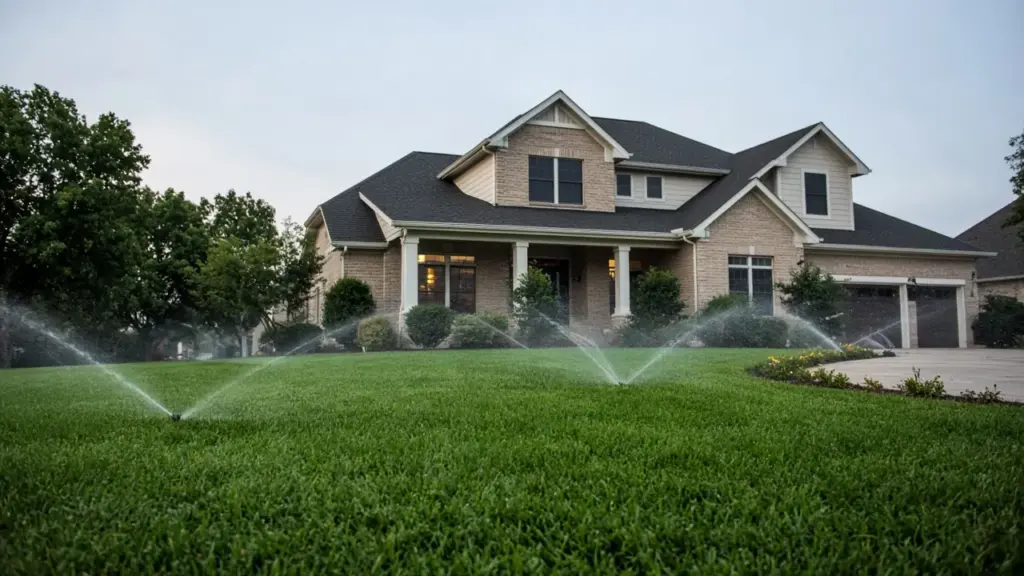
Far North Dallas is a large area of the city of Dallas, generally north of the LBJ Freeway (I-635), extending toward the city’s northern limits. Much of it developed in the 1970s and 1980s, with established neighborhoods of single-family homes, many of which were built with in-ground sprinkler systems or had them added in the years that followed.
That history shapes irrigation today. Many Far North Dallas systems have decades of service behind them, with original pipe, older heads, patched repairs, and controllers from an earlier era. This guide covers maintenance priorities for systems in this part of Dallas.
Confirm You Are in the City of Dallas
The Far North Dallas area borders several other cities, including Addison, Richardson, Plano, Carrollton, and Farmers Branch, and some homes near those borders have Dallas mailing addresses while being in another city. Watering rules differ by city. Check your water bill: if Dallas Water Utilities serves your home, Dallas rules apply. This guide focuses on homes within the city of Dallas.
Dallas Watering Rules
- Automatic sprinklers and hose-end sprinklers: no more than two assigned days per week.
- Even addresses: Sundays and Thursdays. Odd addresses: Wednesdays and Saturdays.
- No sprinkler watering between 10 a.m. and 6 p.m., year-round.
- Hand watering, soaker hoses, and drip: allowed any day.
- Foundations may be watered any day and time with a hand-held hose, soaker hose, drip irrigation, or bucket.
- Rain and freeze sensors are required on automatic systems.
Our guide to even and odd address watering days explains the schedule.
Aging Systems: What to Look For
Systems that have been in the ground for decades tend to develop predictable problems:
- Brittle pipe and fittings that crack when disturbed
- Heads that have sunk below grade as turf and soil built up
- Obsolete heads and nozzles that apply water unevenly
- Valves with worn diaphragms and corroded solenoids
- Wiring splices that have corroded underground
- Controllers without modern features such as weather adjustment
Our guide to whether it is time to replace your sprinkler system can help you decide between repairs and replacement.
Retrofitting Older Heads
Replacing old heads and nozzles with modern equipment can improve coverage and efficiency without replacing the entire system. Pressure-regulated spray heads, matched-precipitation nozzles, and rotary nozzles all help. Our guide to retrofitting an old system with modern heads explains the options.
Mature Trees
Established Far North Dallas neighborhoods often have mature trees. Trees shade lawns, change water needs, and send roots into irrigation lines. When repairing near trees, hand dig and avoid cutting major roots. Shaded lawn areas need less water than sunny ones; separate zones or adjusted run times help.
Clay Soil
Like most of Dallas, Far North Dallas has clay soils that shrink and swell. Soil movement stresses older pipe. Deep, infrequent watering with cycle and soak works well. Our clay soil sprinkler guide covers clay-specific strategies.
Updating the Controller
Older controllers can be hard to program and lack features such as multiple start times, seasonal adjust, or weather-based adjustment. A modern controller or smart controller can make following Dallas rules easier and save water. Our irrigation controller repair guide explains options.
Backflow Preventers
Older systems may have older backflow preventers, some of which may be worn or damaged by past freezes. Check for leaks, damage, and whether testing is current. Our guide to backflow testing explains requirements.
Seasonal Maintenance Checklist
Spring
- Inspect each zone for broken, sunken, or misaligned heads
- Check the controller clock and programs
- Test the rain and freeze sensor
- Check the backflow preventer for winter damage
Summer
- Watch for dry spots and fix coverage
- Use cycle and soak
- Check that watering ends before 10 a.m.
Fall
- Reduce run times
- Repair damage from summer
- Prepare for freezes
Winter
- Reduce or pause watering during dormancy
- Protect the backflow preventer before hard freezes
Common Repairs in Established Neighborhoods
- Raising sunken heads
- Replacing cracked risers and fittings
- Repairing lateral breaks from tree roots and soil movement
- Replacing valve diaphragms and solenoids
- Fixing corroded wiring splices
- Uncovering buried valve boxes
Our guide to finding buried valve boxes helps when boxes have disappeared under turf.
Understanding Your System Before Repairs
Many Far North Dallas homes have changed hands several times since their sprinkler systems were installed, and system maps rarely survive. Before tackling repairs, spend some time learning the system:
- Find the controller and note how many stations are in use.
- Run each zone and flag the heads it controls.
- Locate valves and note which zone each serves.
- Find the backflow preventer and shutoff.
- Sketch the layout with zone numbers and valve locations.
That map makes every future repair faster and helps you spot coverage gaps and zones that mix different head types.
Mixed Equipment From Past Repairs
Decades of repairs often leave a zone with a mix of head brands, nozzle types, and heights. A zone that mixes old and new spray heads, or spray heads and rotors, applies water unevenly, leaving some areas soggy and others dry. Bringing each zone back to consistent equipment is one of the most effective improvements for an older system. Our guide to matched precipitation explains why it matters.
Landscape Changes Over Time
Over the years, homeowners add patios, expand beds, plant trees, and remove lawn. The irrigation system often was not updated to match. Heads end up in beds, spraying fences, or blocked by shrubs, while new areas get no coverage. A walk-through comparing the current landscape with the irrigation layout usually reveals several quick fixes, such as capping heads in beds and converting them to drip.
Pressure in Older Systems
Water pressure and flow available to a system can change as neighborhoods age and water use changes. Zones that once performed well may now show weak coverage. Pressure-regulated heads help maintain consistent spray. If an entire system has low pressure, the cause may be at the backflow preventer, a partially closed shutoff, or a mainline leak.
Planning Upgrades in Phases
Not every improvement has to happen at once. Many homeowners with older systems upgrade in phases: first fixing leaks and broken heads, then updating the controller, then retrofitting nozzles zone by zone. Phasing spreads out cost and lets you see the effect of each change on water use and lawn health.
Keep a Repair Log
Record each repair with the date, zone, and what was fixed. Patterns emerge quickly in older systems, such as a lateral that breaks every summer near the same tree, and they help you decide when a section should be replaced rather than patched again.
Frequently Asked Questions
Is Far North Dallas in the city of Dallas?
Far North Dallas is an area of the city of Dallas. Some nearby homes with Dallas mailing addresses are in other cities, so check your water bill to confirm.
What are common problems with older sprinkler systems?
Brittle pipe and fittings, sunken heads, worn valves, corroded wiring, and outdated controllers.
Should I replace or repair an older sprinkler system?
It depends on the system’s condition and how often repairs are needed. Retrofitting heads and updating the controller often extends system life.
What watering days apply in Far North Dallas?
For homes in the city of Dallas, even addresses water on Sundays and Thursdays, odd addresses on Wednesdays and Saturdays.
Get Help in Far North Dallas
We repair, retrofit, and maintain sprinkler systems throughout Dallas. See our Dallas service area, or contact us to schedule.
Request Service or call 214-227-7444
We serve homes throughout Dallas and nearby North Texas communities.