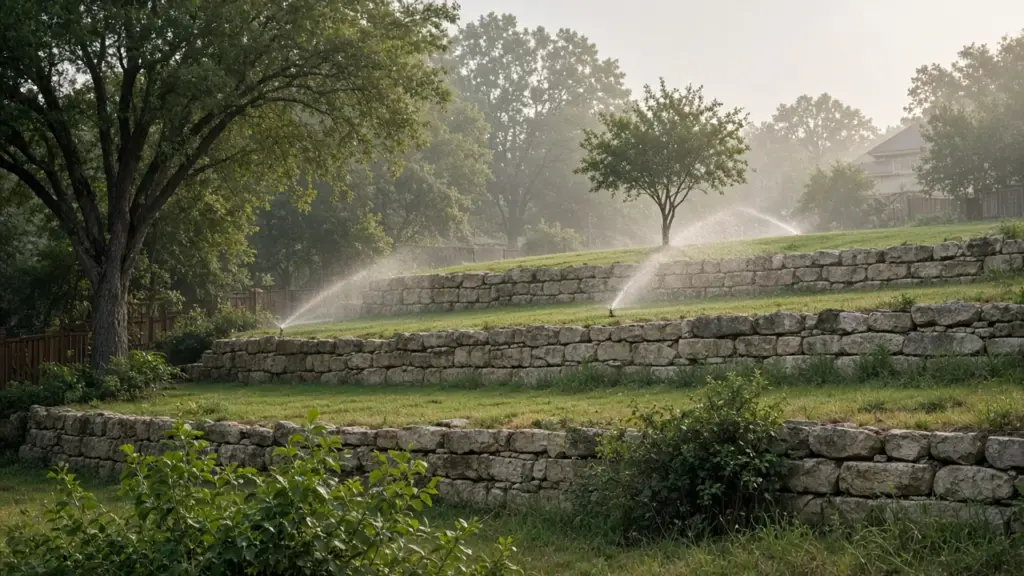
Kessler Park, in north Oak Cliff, is one of the Dallas neighborhoods most associated with dramatic topography. Homes sit on hillsides, front lawns drop toward winding streets, and many lots back up to wooded slopes and creek areas. Historic architecture and mature trees make it one of the city’s most distinctive places to live. They also make it one of the more challenging places to water a lawn.
This guide focuses on the watering problems that come with steep, wooded lots like those in Kessler Park, and practical ways to solve them. Our broader article on Oak Cliff irrigation in hilly yards covers the surrounding area.
The Core Problem: Water Moves Downhill
On a steep lawn, water that does not soak in immediately runs downhill. Clay soil, common across much of Dallas, absorbs water slowly. The combination means that a standard spray zone running for a long stretch sends a lot of its water to the bottom of the slope, the sidewalk, or the street.
You can usually see it happening: the top of the slope browns first in summer, the bottom stays soft, and a stream of water runs along the curb after every cycle.
Step 1: Break Watering Into Short Cycles
Cycle and soak is the most important tool for slopes. Instead of one long run, split each zone into several short cycles with soak periods in between. Each short cycle wets the surface; the pause lets water move into the soil before the next cycle adds more.
Start by watching a zone run and noting how many minutes pass before water begins to run off. Set each cycle a little shorter than that. Our guide to programming a controller for Dallas’s schedule explains multiple start times and cycle and soak.
Step 2: Lower the Application Rate
Standard spray nozzles apply water quickly. Rotary nozzles, which fit on the same spray bodies, apply water much more slowly in rotating streams. On slopes, that slower rate gives the soil a chance to keep up. When you convert, change every nozzle on the zone so the application rate stays consistent. Our guide to upgrading to high-efficiency nozzles explains how.
Step 3: Stop Low-Head Drainage
When a zone on a slope shuts off, water in the pipe drains out through the lowest heads. On a steep lot, that can leave the bottom of the lawn soggy and flood nearby valve boxes. Heads with built-in check valves hold water in the pipe after shutoff.
Step 4: Zone by Elevation and Exposure
Pressure changes with elevation, and steep lots can have big differences between the top and bottom of a zone. Heads uphill may spray weakly while heads downhill mist. Pressure-regulated spray bodies help even this out. Where possible, zones should group heads at similar elevations.
Slopes also create sun and shade differences. A south- or west-facing slope bakes in the afternoon, while a north-facing slope under trees stays cool. Those areas need very different amounts of water.
Terraces and Retaining Walls
Many hillside lots use terraces and retaining walls. A few guidelines:
- Keep spray off the walls, which stains masonry and wastes water
- Avoid saturating soil behind retaining walls
- Use drip in terraced planting beds
- Watch for water weeping from wall faces, which can indicate overwatering or a leak above
Wooded Slopes and Natural Areas
Lots that back up to wooded slopes often have natural areas that do not need regular irrigation once plants are established. Spraying those areas wastes water and can contribute to erosion. Consider capping heads in natural areas and focusing irrigation on lawn and planted beds.
Large trees on slopes compete with turf for water and create deep shade. Lawns under dense canopy may never thrive no matter how much water they get. Our guide to shade lawns and irrigation adjustments covers alternatives.
Older Systems in Historic Homes
Many homes in the area are decades old, and sprinkler systems were added and altered over time. It is common to find mixed head brands, valves in unexpected places, and pipe routed around old landscape features. A zone-by-zone evaluation often reveals easy improvements, such as matching nozzles and raising sunken heads.
Erosion Control
Runoff carries soil and mulch downhill. Over time, it can expose roots, undercut walkways, and fill drains. Keeping water on the landscape with short cycles and slow nozzles is the first step. Groundcovers, mulch, and drip in beds help hold soil in place.
Street-Side Parkways
Parkway strips along sloped streets are especially hard to water. Water sprayed on a narrow, sloped strip runs straight into the gutter. Low-flow strip nozzles, short cycles, and in some cases converting the strip to a drought-tolerant planting on drip can help.
Scheduling Within Dallas Rules
Kessler Park is within the City of Dallas, so the city’s rules apply: automatic irrigation no more than twice a week on assigned days, no sprinkler watering between 10 a.m. and 6 p.m. year-round, and a working rain and freeze sensor. Cycle and soak adds cycles, so plan start times carefully to finish before 10 a.m. Our article on the year-round watering ban explains the time-of-day rule.
A Sample Hillside Setup
For a steep front lawn above a winding street, a practical setup might include:
- Rotary nozzles on pressure-regulated bodies across the lawn zone
- Check-valve heads at the lowest row
- Three short cycles per watering day, spaced about an hour apart, all finishing before 10 a.m.
- Arcs trimmed so spray stops short of the sidewalk
- Drip in foundation beds and terraces
- Natural wooded areas left off irrigation once established
Walking the Yard
The most useful habit on a hillside lot is watching a cycle. Note when runoff begins, which heads leave dry spots, and where water collects afterward. Those observations guide nozzle choices and run times better than any chart.
Signs Your Hillside System Needs Attention
- Water running along the curb within minutes of a cycle starting
- Mulch or soil washed onto walkways after watering
- A soggy strip along the bottom of the lawn that never dries
- Valve boxes at the low end of the yard full of water
- Heads at the top of the slope that barely reach the next head
Each of these points to a specific fix, from shorter cycles to check valves to pressure regulation.
Frequently Asked Questions
How do I stop water from running off my sloped lawn?
Use short cycles with soak time between them, rotary nozzles with lower application rates, and arcs that stay off pavement.
Why is the top of my slope brown and the bottom soggy?
Water runs downhill before soaking in, and the lowest heads drain the pipe after each cycle. Cycle and soak and check valves help.
Should I irrigate wooded natural areas?
Established natural areas often need little or no irrigation outside of extended drought. Focus water on lawn and planted beds.
Do Dallas watering rules apply in Kessler Park?
Yes. Kessler Park is within the City of Dallas.
Get Help With a Sloped Yard
We tune sprinkler systems for hillside lots throughout Kessler Park, Oak Cliff, and the rest of Dallas. Learn about our service in Dallas, or contact us to schedule. For more on local conditions, see our Dallas neighborhood sprinkler repair guide.
Request Service or call 214-227-7444
We serve homes throughout Dallas and nearby North Texas communities.