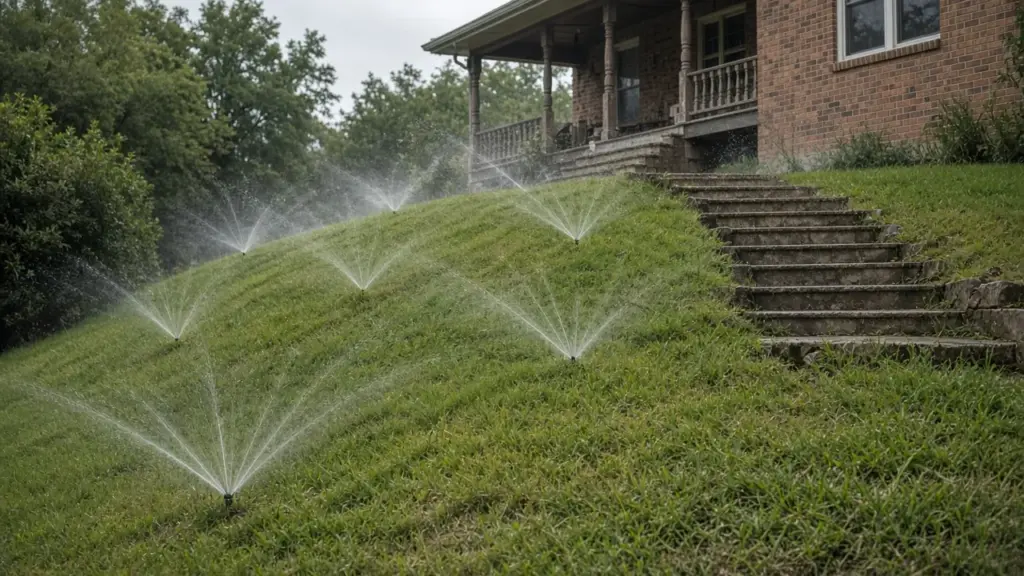
Oak Cliff stands out among Dallas neighborhoods for its rolling terrain, older homes, tree-lined streets, and historic districts. Many yards slope toward the street, drop off behind the house, or sit on terraces. That topography is a big part of the neighborhood’s character, and it makes irrigation more challenging than on a flat suburban lot.
This guide covers the irrigation issues that come up most often in hilly Oak Cliff yards and how to manage them. The same principles apply to sloped yards anywhere in Dallas.
Why Slopes Are Hard to Water
On a flat lawn, water soaks in roughly where it lands. On a slope, water that is not absorbed quickly runs downhill. The top of the slope dries out, the bottom stays wet, and some water leaves the property entirely, running onto sidewalks and into the street.
In parts of Dallas, heavy clay makes this worse because it absorbs water slowly. In some hilly areas, soil can also be shallower over rock, which holds less water and dries out faster. Either way, slopes need a gentler approach.
Our complete guide to Dallas clay soil explains how soil type affects watering.
Problem 1: Runoff
Signs
- Water flowing down the sidewalk or into the street during watering
- Dry turf at the top of slopes and lush or soggy turf at the bottom
- Soil or mulch washing downhill
Fixes
- Cycle and soak: split each zone’s run time into shorter cycles with soak periods in between. This is the single most important change for slopes.
- Lower application rate nozzles: rotary nozzles apply water slowly and give soil time to absorb it.
- Adjust arcs: keep spray off sidewalks and driveways.
Our guide to upgrading to high-efficiency nozzles explains rotary nozzles.
Problem 2: Low-Head Drainage
When a zone shuts off, water remaining in the pipe drains out through the lowest heads. On a slope, that can be a lot of water, creating a soggy spot at the bottom after every cycle and even flooding valve boxes.
Fixes
- Check valves in heads stop drainage by holding water in the pipe.
- Separate zones for the top and bottom of long slopes reduce the amount of water that can drain.
Our guide to standing water after watering helps sort out whether a wet spot is irrigation or drainage.
Problem 3: Pressure Differences
Elevation affects water pressure. Heads at the top of a slope have lower pressure than heads at the bottom. On a steep yard, heads uphill may not reach their full radius, while heads downhill mist from high pressure.
Fixes
- Pressure-regulated bodies even out pressure at each head
- Zone by elevation so heads at similar heights share a zone
- Check pressure at the top and bottom of zones
Problem 4: Mixed Exposure
Hills create sun and shade differences. South- and west-facing slopes bake in the afternoon, while north-facing slopes stay cooler. A zone that crosses both is hard to schedule.
Fixes
- Zone by exposure where possible
- Adjust nozzle sizes to deliver less water to shaded areas
- Consider drip or low-water plantings for the hottest slopes
Terraces and Retaining Walls
Terraced yards and retaining walls are common on hilly lots. Irrigation near walls should keep water from saturating soil behind the wall. Spray aimed at walls stains masonry and wastes water. Drip in terraced beds usually works better than spray.
Older Systems in an Older Neighborhood
Many Oak Cliff homes are decades old, and sprinkler systems may have been added and expanded over time. Common issues include mixed head brands, undocumented valve locations, aging pipe, and heads that no longer match the landscape. Our article on retrofitting an old system with modern heads covers upgrades that help.
Trees on Slopes
Mature trees on slopes add shade, root competition, and leaf litter. Roots can lift heads and crack pipe. Trees on slopes also lose water to runoff, so deep, slow watering with drip rings may help during drought. Our guide to watering trees with drip rings and bubblers explains how.
Scheduling Within Dallas Rules
Oak Cliff is within the City of Dallas, so city rules apply: automatic irrigation no more than twice a week on assigned days, no sprinkler watering between 10 a.m. and 6 p.m. year-round, and a working rain and freeze sensor. Cycle and soak on slopes adds cycles, so plan start times so everything finishes before 10 a.m.
A Practical Example
Picture a front yard that slopes from the house down to the sidewalk, with a parkway strip beyond. The zone runs 20 minutes straight with standard sprays. Water runs down the sidewalk, the top of the lawn browns, and the bottom stays soft.
A better setup:
- Replace sprays with rotary nozzles on pressure-regulated bodies
- Add check valves to the lowest heads
- Split the run into three shorter cycles with soak time between
- Adjust arcs away from the sidewalk
- Use strip nozzles or rotary nozzles sized for the parkway
The result is more even color, less runoff, and less water wasted.
Erosion and Mulch
On slopes, runoff carries soil and mulch downhill. Keeping water on the landscape reduces erosion. Groundcovers and mulch help hold soil. In beds on slopes, drip under mulch keeps water where plants need it.
Walking the Yard After a Cycle
The best diagnostic tool for a hilly yard is your own eyes during and right after a cycle. Watch for the first sign of runoff, note how many minutes into the cycle it starts, and set each cycle shorter than that. Then check the bottom of each slope a half hour after the zone stops. If water is still seeping out of a head, low-head drainage is at work. These simple observations tell you more than any chart.
Parkway Strips on Sloped Streets
Many Oak Cliff streets have parkway strips between the sidewalk and the curb, and on hilly streets those strips slope too. Narrow sloped strips are among the hardest areas in Dallas to water well. Water sprayed on them tends to run straight into the gutter. Low-flow strip nozzles, rotary nozzles sized for narrow areas, and short cycles help. In some cases, converting a steep parkway to a drought-tolerant planting on drip, where allowed, is simpler than trying to keep turf green there.
Valve Boxes at the Bottom of Slopes
Valve boxes placed at the low point of a yard often fill with water from low-head drainage and surface runoff. Standing water in a box corrodes wire splices and lets soil into valves. Adding gravel beneath the box, raising it slightly, and stopping drainage with check valves keeps boxes drier and valves working longer.
Frequently Asked Questions
How do I stop sprinkler runoff on a slope?
Use cycle and soak scheduling, lower application rate nozzles, and adjust arcs away from pavement.
Why is the bottom of my sloped yard always wet?
Often low-head drainage, where water drains out of the lowest heads after the zone shuts off. Check valves in heads help.
Why do heads at the top of my yard spray weakly?
Elevation reduces pressure uphill. Zoning by elevation and pressure-regulated bodies can help.
Do Dallas watering rules apply in Oak Cliff?
Yes. Oak Cliff is within the City of Dallas.
Get Help With a Hilly Yard
We design and tune irrigation for sloped yards throughout Oak Cliff and the rest of Dallas. Learn about our service in Dallas, or contact us to schedule.
Request Service or call 214-227-7444
We serve homes throughout Dallas and nearby North Texas communities.