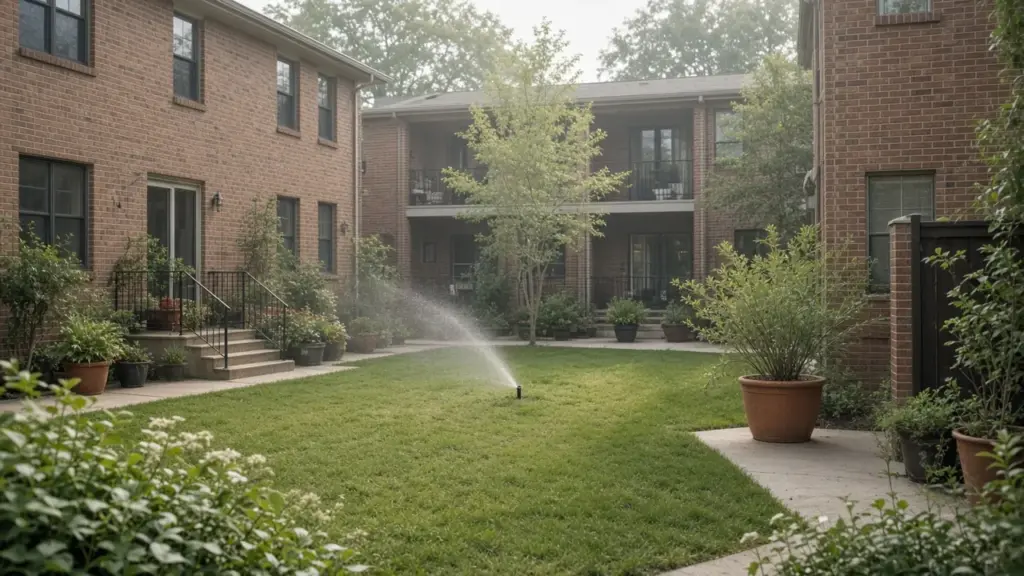
Uptown is one of the densest neighborhoods in Dallas, located just north of downtown within the city of Dallas. Its mix of townhomes, condominiums, and apartments means outdoor space is often limited: a small front lawn, a strip of beds along the entry, a courtyard, a rooftop terrace, or a few planters on a patio.
Small spaces are not necessarily simple to water. Standard sprinkler heads are designed for larger areas, and in a tight space, overspray onto walls, walkways, windows, and neighbors’ property is common. This guide covers practical ways to irrigate townhome and small-space landscapes in Uptown and similar parts of Dallas.
The Small-Space Challenge
Typical Uptown townhome landscapes include:
- Narrow front beds along the entry or foundation
- Tiny lawn panels, sometimes just a few feet wide
- Parkway strips between sidewalk and street
- Courtyards surrounded by walls
- Containers and planters on patios, balconies, and rooftops
- Shared landscaping managed by an HOA
Each of these areas is small, and many are surrounded by hard surfaces. That makes overspray and runoff the main problems to solve.
Who Controls the Irrigation?
Before making changes, find out who owns and manages the irrigation. In many townhome communities, the HOA maintains front landscaping and a shared irrigation system, while owners handle private patios and courtyards. Some systems serve multiple units from one controller. Check your HOA documents and talk to the management company before modifying shared components.
Tiny Lawns
Small lawn panels are difficult to water with standard spray heads, which can throw water well beyond the grass. Options include:
- Short-radius nozzles sized to the space
- Strip nozzles designed for narrow rectangular areas
- Rotary nozzles with lower application rates, which help clay absorb water
- Subsurface drip for very narrow strips
Some owners replace tiny lawns with beds or low-maintenance groundcovers. Our guide to spray heads, rotors, and rotary nozzles explains the head options.
Beds and Foundation Plantings
Narrow beds along a townhome’s front are ideal for drip irrigation. Drip keeps water in the bed and off walls, windows, and walkways. Inline drip tubing works well for dense plantings, and point-source emitters suit individual shrubs. Our guide to drip irrigation for foundation beds covers layouts.
Courtyards
Walled courtyards trap heat and limit airflow. Plants in courtyards may need more water in summer than similar plants in open areas, but spray heads in courtyards almost always hit walls and pavers. Drip, container drip, and hand watering usually make more sense.
Containers, Balconies, and Rooftops
Containers dry out fast in Uptown’s heat, especially on rooftops and balconies exposed to sun and wind. Container drip systems keep plants watered without daily hand watering. Our guide to container and planter drip systems explains setups, including battery-powered hose timers for spaces without irrigation lines.
On balconies and rooftops, make sure water drains properly and does not drip onto neighbors below. Follow building and HOA rules.
Parkways
Parkway strips between the sidewalk and street are hard to water without runoff. Short-radius and strip nozzles help, as does drip beneath mulch or groundcover. Check with your HOA before changing parkway landscaping.
Following Dallas Watering Rules
Uptown follows the same rules as the rest of Dallas:
- Automatic sprinklers and hose-end sprinklers are limited to two assigned days per week.
- Even addresses water on Sundays and Thursdays; odd addresses on Wednesdays and Saturdays.
- No sprinkler watering between 10 a.m. and 6 p.m., year-round.
- Drip irrigation, soaker hoses, and hand watering are allowed on any day.
- Automatic systems must have working rain and freeze sensors.
Shared systems serving multiple units with different addresses may be set up by the HOA according to city guidance. If you are unsure which days apply, ask your HOA or contact Dallas Water Utilities. Our guide to even and odd address watering days explains the basics.
Avoiding Runoff in Dense Neighborhoods
In dense neighborhoods, runoff from one property often ends up on sidewalks and streets. Water running into the street can be a violation under Dallas water waste rules. To limit runoff:
- Use cycle and soak to split run times
- Adjust nozzles to keep spray on landscape
- Convert beds to drip
- Fix broken heads promptly
Small Controllers and Smart Options
A small townhome system might have just a few zones. Compact controllers work well, and smart controllers can adjust watering based on weather. For owners with only containers, battery hose timers may be all that is needed.
Common Small-Space Problems
- Heads spraying walls, windows, and doors
- Water pooling on walkways
- Dry planters in summer
- Shared systems with zones covering several units
- Heads damaged by foot traffic and pets
Adjusting arcs and radius, or switching nozzles, fixes most overspray in tight spaces.
Foundation Watering
Townhomes sit on Dallas clay like single-family homes. Dallas allows foundation watering on any day and at any time using a hand-held hose, soaker hose, drip irrigation, or bucket. A drip line in foundation beds helps keep soil moisture more consistent.
Pets and Small Yards
Many Uptown residents have dogs, and small yards take heavy wear. Heads in dog areas are often chewed or stepped on. Consider drip in beds, sturdy head models in high-traffic areas, and artificial turf or hardscape in dog runs. Our guide to irrigation planning for artificial turf areas covers conversions.
Shade From Buildings
Tall buildings and closely spaced townhomes cast long shadows. A bed on the north side of a building may get little direct sun, while a bed facing south or west bakes in the afternoon. Those differences matter for watering. Shaded beds and lawns need far less water than sunny ones, and putting them on the same zone often leaves one too wet and the other too dry. Where possible, separate sunny and shaded areas into different zones or give them different emitter flows on drip. Our guide to shade lawns and irrigation adjustments explains why shade changes water needs.
Reflected Heat
Glass, light-colored walls, and pavement reflect heat onto nearby plants. Beds along a west-facing glass wall or next to a driveway can dry out much faster than beds in open ground. If a particular bed struggles every summer while others do fine, reflected heat may be the reason. Adding emitters, mulching thoroughly, or choosing heat-tolerant plants can help.
Seasonal Tune-Ups for Small Systems
Small systems still benefit from seasonal checks. In spring, run each zone and confirm heads and emitters work. In summer, watch containers and sunny beds closely. In fall, cut run times as temperatures drop. Before winter, protect exposed components such as the backflow preventer and container drip timers. A short checklist a few times a year keeps a small system working well.
Frequently Asked Questions
Is Uptown part of the city of Dallas?
Yes. Uptown is a neighborhood within the city of Dallas, so Dallas watering rules apply.
What is the best way to water a tiny lawn?
Use short-radius, strip, or rotary nozzles sized to the space, or consider subsurface drip.
Can I water my patio containers any day?
Yes. Drip irrigation and hand watering are allowed on any day in Dallas.
Who maintains irrigation in a townhome community?
It varies. Many HOAs maintain front landscaping and shared systems, while owners handle private areas. Check your HOA documents.
Get Help With Small-Space Irrigation
We adjust heads, convert beds to drip, and repair small systems across Dallas. See our Dallas service area, or contact us to schedule.
Request Service or call 214-227-7444
We serve homes throughout Dallas and nearby North Texas communities.