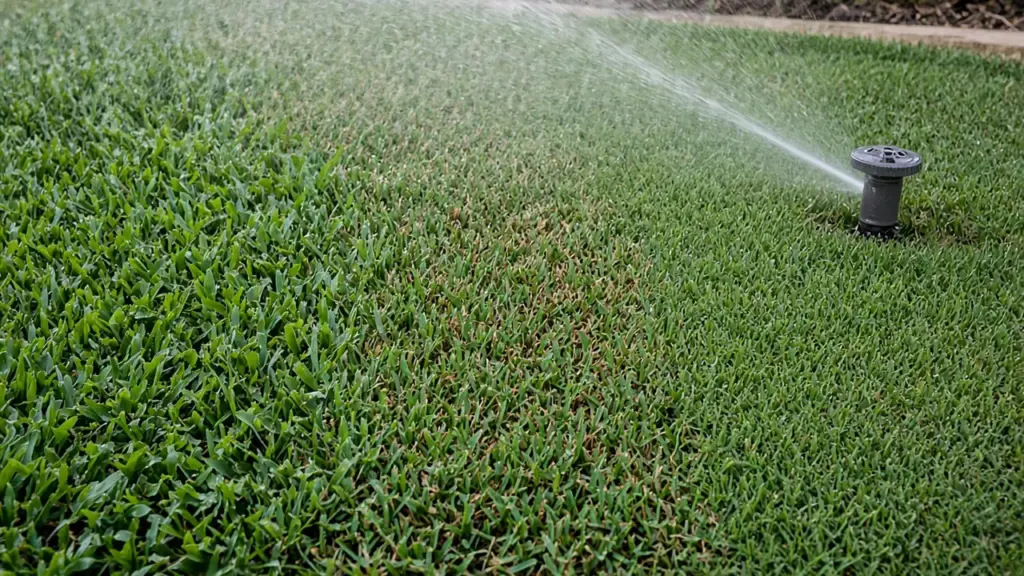
Walk down almost any Dallas street and you will see a few different grasses. St. Augustine fills shaded front yards. Bermuda covers sunny lawns and parkways. Zoysia shows up in newer landscapes, and buffalo grass appears in low-water yards. Each of these warm-season grasses handles heat, shade, and drought differently, and each responds differently to how your sprinkler system is set.
This guide explains how the common Dallas grass types use water, how to set up irrigation for each, and how to handle lawns that mix more than one type. It is the pillar for our lawn and turf series.
Warm-Season Grass Basics
The grasses that do well in Dallas are warm-season grasses. They grow actively from spring through fall and slow down or go dormant in winter. Their water needs follow that cycle: highest in the heat of summer, much lower in spring and fall, and minimal in winter dormancy.
No matter the grass type, a few principles apply:
- Water deeply and less often. Deep watering encourages deeper roots.
- Water early in the morning. It reduces evaporation and lets blades dry during the day.
- Respect clay soil. Use cycle and soak so water soaks in rather than running off.
- Follow the city schedule. Dallas allows automatic irrigation up to twice a week on assigned days, with no sprinkler watering between 10 a.m. and 6 p.m. See our Dallas watering schedule guide.
St. Augustine
St. Augustine is the most common grass in shaded Dallas yards. It has wide blades, spreads by above-ground runners, and tolerates more shade than Bermuda.
Irrigation needs
St. Augustine generally needs more water than Bermuda in full sun and shows drought stress quickly, with blades that fold and a dull, bluish color. In shade, though, it needs noticeably less water, and overwatering shaded St. Augustine is one of the most common irrigation mistakes in Dallas.
Tips
- Separate sunny and shaded St. Augustine into different zones where possible.
- Avoid evening watering that leaves the turf wet overnight; persistently wet leaves favor fungal disease such as brown patch.
- Mow at a taller height, which helps shade the soil and reduce water loss.
- Taller pop-up heads help clear the grass.
Bermuda
Bermuda grass thrives in full sun and heat. It spreads by both runners above ground and rhizomes below ground and is common on sunny lawns, parkways, and sports fields.
Irrigation needs
Bermuda is relatively drought tolerant. It can go semi-dormant and turn brown during extended dry periods, then recover when water returns. In Dallas summers it still benefits from regular deep watering on assigned days to stay green.
Tips
- Bermuda does poorly in shade, so shaded Bermuda areas often thin out regardless of water.
- Because it is often mowed short, standard pop-up heights usually work.
- Do not try to fix shade thinning with extra water; it will not help.
Zoysia
Zoysia forms a dense, fine to medium-textured turf. Some varieties tolerate moderate shade better than Bermuda, and it handles heat well.
Irrigation needs
Zoysia has moderate water needs. It can tolerate some drought but may go dormant and brown during long dry spells. Because the turf is dense, water can have a harder time penetrating if thatch builds up.
Tips
- Watch for thatch, which can keep water from reaching the soil.
- Water deeply and allow the surface to dry between cycles.
- Check coverage carefully; dense turf can hide low heads.
Buffalo Grass
Buffalo grass is a native prairie grass with fine, gray-green blades. It is known for low water needs once established and is used in low-input and water-wise landscapes.
Irrigation needs
Established buffalo grass often needs far less supplemental water than other lawn grasses. Overwatering can actually encourage weeds and other grasses to invade.
Tips
- Set buffalo grass zones separately from thirstier turf.
- Water deeply but infrequently, and let it go dormant in dry spells if you prefer a lower-water look.
- It does not tolerate heavy shade or heavy traffic as well as some other grasses.
Lawns With More Than One Grass
Many Dallas lawns are mixed. Bermuda may invade sunny edges of a St. Augustine lawn, or a front yard may have St. Augustine under trees and Bermuda in the open. Since each zone can only have one run time, the best approach is to zone by exposure and grass type where possible. If zones cannot be changed easily, set run times for the dominant grass and use nozzle and head adjustments to fine-tune coverage.
Irrigation Problems That Look Like Grass Problems
Before blaming the grass, rule out the system. Many brown spots in Dallas lawns turn out to be:
- Broken, sunken, or clogged heads, covered in our sprinkler head repair guide
- Poor coverage from heads spaced too far apart or mismatched nozzles
- Leaks that starve the rest of the zone; see our leak detection guide
- Controller programming that does not match the season
And some wet, unhealthy areas are the result of overwatering or poor drainage in clay soil. Our Dallas clay soil guide explains how to tell.
Reading What Your Grass Is Telling You
Each grass type gives you clues about whether the watering is right.
- Footprints that stay pressed down after you walk across the lawn usually mean the grass is short on water.
- A dull, blue-gray color in St. Augustine or Bermuda is an early drought signal.
- Folded or rolled blades are another sign of water stress, common in the afternoon heat.
- Mushrooms, soft spongy turf, or circular brown patches in cooler weather can point to too much water, especially in shade.
- Weeds taking over buffalo grass can mean it is getting more water than it needs.
Check the soil too. A screwdriver or soil probe should push several inches into moist soil the day after watering. If it stops near the surface, water is not reaching the root zone; if the soil is soggy for days, the lawn is getting more than it can use.
Adjusting Through the Seasons
Set run times for peak summer demand, then use your controller’s seasonal adjust to reduce watering in spring and fall. In winter, dormant warm-season grass needs very little supplemental water. Our year-round maintenance calendar lays out when to make these changes.
More Lawn & Turf Care Guides
- St. Augustine Watering and Irrigation Needs in Dallas
- Bermuda Grass Watering in DFW Heat
- Zoysia Irrigation Tips
- Shade Lawns and Irrigation Adjustments
- Brown Patch and Overwatering in St. Augustine
- Chinch Bugs vs. Dry Spots
- Fertilizing and Irrigation Timing
- Mowing Height and Watering Needs
- Lawn Recovery After Drought
Frequently Asked Questions
Which grass uses the least water in Dallas?
Established buffalo grass generally needs the least supplemental water. Bermuda is also relatively drought tolerant, though it may brown during long dry spells.
Why is my St. Augustine turning brown in the shade?
Shaded St. Augustine often gets too much water, which encourages fungal disease. Check whether shaded areas share a zone with sunny areas and reduce watering there.
Can I water different grasses on the same zone?
You can, but results are usually better when zones are grouped by grass type and sun exposure, since each zone has one run time.
Should I water dormant grass in winter?
Dormant warm-season grass needs very little water. Occasional watering during long dry spells can help, within the city schedule and not before a freeze.
How do I know if brown spots are the grass or the sprinklers?
Run the zone and watch the heads. If spots line up with low, broken, or misaligned heads, it is an irrigation problem.
Get Your Irrigation Matched to Your Lawn
We can adjust heads, rezone sunny and shaded areas, and program your controller for your grass type. Learn about our sprinkler repair service, or contact us to schedule.
Request Service or call 214-227-7444
We serve homes throughout Dallas and nearby North Texas communities.