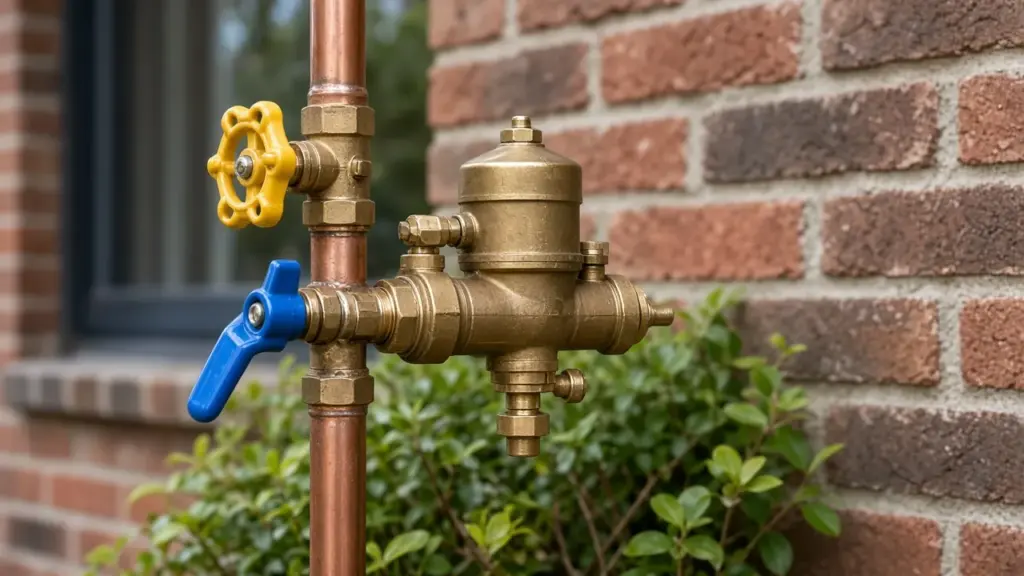
Most Dallas homeowners walk past their backflow preventer every day without thinking about it. It is the assembly of brass or bronze valves, often standing on pipes near the front corner of the house or beside the path from the water meter. It does not water anything, and when it works you never notice it. But it has one of the most important jobs in the whole irrigation system: keeping sprinkler water out of the drinking water supply.
This guide explains, in plain terms, what a backflow preventer does, how its parts work, what can go wrong, and how to care for it. For code and testing details, see our backflow prevention and irrigation code guide.
Why Sprinkler Systems Need Backflow Protection
Your irrigation system connects to the same water line that supplies your kitchen and bathrooms. Normally, water flows one way: into the sprinkler system and out through the heads. But the water sitting in your irrigation pipes is not clean drinking water. Heads sit in soil. Pipes can draw in water that has contacted fertilizer, pesticides, and animal waste. Stagnant water sits in lines between cycles.
If pressure in the public water main drops suddenly, for example during a main break or heavy firefighting demand, water can be pulled backward from your irrigation lines. That is called back-siphonage. Backpressure, where irrigation-side pressure exceeds supply pressure, can push water backward as well. The backflow preventer stops either from happening.
How It Works
Different assembly types work in slightly different ways, but they share the same basic idea: allow water to flow forward into the irrigation system and block it from flowing back.
Check valves
Check valves are spring-loaded valves that open when water flows forward and close when flow stops or reverses. Many assemblies use one or two check valves in series.
Air inlet (on pressure vacuum breakers)
A pressure vacuum breaker (PVB), common on Dallas homes, has an air inlet valve at the top. If pressure on the supply side drops, the air inlet opens and lets air in, breaking any vacuum that could siphon water backward. This is why a PVB must sit higher than the highest sprinkler head.
Relief valve (on reduced pressure zone assemblies)
A reduced pressure zone assembly (RPZ) adds a relief valve between two check valves. If a check valve fails, the relief valve discharges water to the outside rather than letting it flow back.
Shutoff valves and test cocks
Most assemblies have two shutoff valves, one on each side, and several small test cocks. The shutoffs isolate the assembly for testing and repair. Test cocks let a licensed tester attach gauges to verify each part is working.
Parts You Can See
On a typical above-ground PVB you will see:
- Inlet shutoff valve, usually a quarter-turn ball valve with a handle.
- The body, containing the check valve.
- The bonnet and canopy on top, covering the air inlet.
- Outlet shutoff valve.
- Test cocks, small valves with slotted heads used during testing.
Handles that are parallel to the pipe are usually open; handles perpendicular to the pipe are usually closed. If your whole system has no water, check that both shutoff handles are open.
What Can Go Wrong
Freeze damage
The most common problem in North Texas. Water inside the assembly freezes, expands, and cracks the body or bonnet. Our guide to winterizing a Dallas sprinkler system covers protection steps.
Spitting or leaking from the top
A PVB may spit a little water when the system first pressurizes, which can be normal. Continuous leaking from the canopy usually means a worn seal or debris under the air inlet.
Low pressure to every zone
A partly closed shutoff valve, debris in a check valve, or internal wear can restrict flow to the whole system. Our leak detection guide explains how to rule out mainline leaks too.
Water dumping from an RPZ
An RPZ that keeps discharging water from its relief port has a failed check or relief valve and needs service.
Physical damage
Mowers, trimmers, vehicles, and even people leaning on the pipes can damage above-ground assemblies.
How to Care for Your Backflow Preventer
- Keep it accessible. Do not bury it in shrubs or build structures around it.
- Protect it before hard freezes with an insulated cover designed for backflow assemblies.
- Do not adjust test cocks unless you know their purpose; opening them releases water.
- Watch for leaks when the system runs.
- Have it tested when required by your water utility or after repairs, by a licensed Backflow Prevention Assembly Tester.
- Do not remove or bypass it. Doing so puts the public water supply at risk and violates state rules.
Who Can Work on It
Texas rules require backflow prevention on irrigation systems connected to potable water, and testing must be performed by a licensed Backflow Prevention Assembly Tester. Irrigation work for hire must be performed by TCEQ-licensed professionals. Because the device protects public drinking water, repairs and replacements are best handled by licensed professionals.
Signs It Is Time for Service
- Visible cracks or water leaking from the body
- Water spraying from the top every time the system runs
- A noticeable drop in pressure across all zones
- Damage after a freeze or impact
- An assembly that has not been tested when required
A properly working backflow preventer also keeps the rest of the system healthy, since low pressure from a failing assembly can make every zone look weak. Our sprinkler valve repair guide explains how to tell whether a pressure problem is at the zone level or at the supply.
Backflow Preventers During Repairs and Upgrades
Several common projects affect the backflow preventer, so it helps to plan for it.
- Replacing the controller or adding zones does not usually involve the backflow preventer, but it is a good time to have it inspected.
- Landscape renovations can bury or crowd the assembly. Keep a clear area around it for access and testing.
- Relocating the assembly may be worthwhile if it sits in a spot where it freezes every winter or gets hit by vehicles. Relocation must still meet code requirements, including height rules for PVBs.
- After freeze repairs or replacement, testing may be required before the system returns to normal use.
Understanding the Handles
Many homeowners are unsure which way the handles should point. On most quarter-turn ball valves, a handle in line with the pipe means open, and a handle crossing the pipe means closed. If you close them for a freeze or repair, open them slowly afterward so the system fills gently, and make sure the test cocks are closed first.
Frequently Asked Questions
Where is my backflow preventer?
Usually near the front of the house, close to where the irrigation line leaves the main water line. It often stands on pipes above ground.
Why does my backflow preventer spit water when the system starts?
A brief spit when the system pressurizes can be normal for a PVB. Continuous leaking means it needs service.
Can I remove my backflow preventer?
No. Backflow prevention is required on irrigation systems connected to potable water.
What do the little valves on the side do?
Those are test cocks. A licensed tester uses them to check the assembly. Leave them closed.
Why is there no water to any of my zones?
Check that both shutoff handles on the backflow preventer are open, and look for freeze damage or a closed irrigation shutoff.
Get Backflow Preventer Service
If your backflow preventer is leaking, cracked, or needs attention, our team can inspect it and recommend the right fix. Learn about our sprinkler repair service, or contact us to schedule.
Request Service or call 214-227-7444
We serve homes throughout Dallas and nearby North Texas communities.