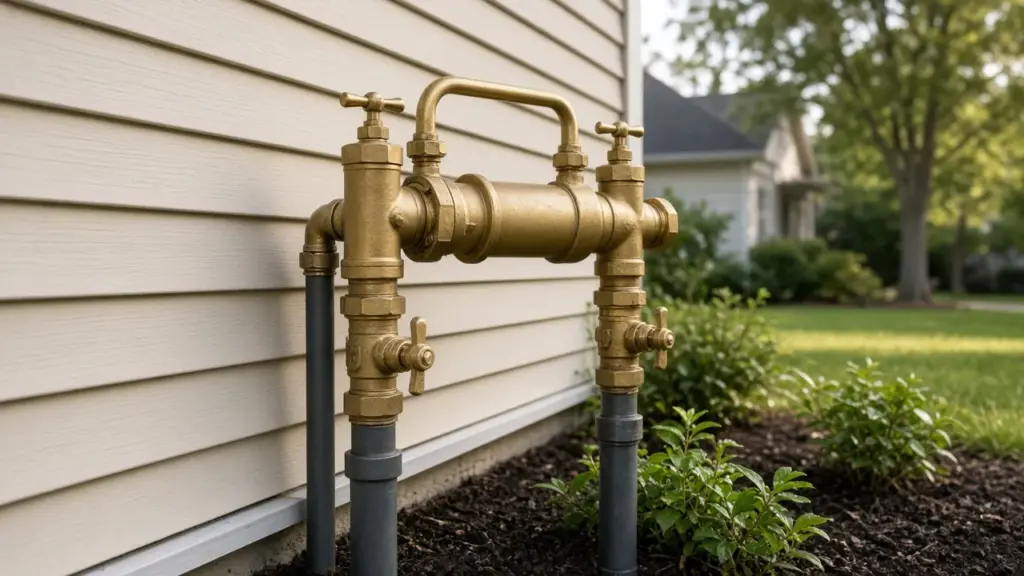
After a hard North Texas freeze, one of the most common irrigation calls involves a backflow preventer that is spraying water, dripping from a crack, or simply falling apart. Backflow preventers sit above ground and hold water in thin passages, making them the component most likely to break in a freeze.
Some freeze damage can be repaired with parts. When the body cracks, the assembly usually needs replacement. This guide explains how to recognize freeze damage, what replacement involves, and how to prevent it next time.
Why Backflow Preventers Crack
Water expands when it freezes. In a backflow preventer, water trapped in the body, bonnet, check valves, and test cocks has nowhere to go. The expanding ice can crack brass or bronze bodies, split plastic bonnets, and break internal parts. Our guide to why pipes burst in Dallas even though freezes are short explains why above-ground parts are especially vulnerable.
Signs of Freeze Damage
- Water spraying from the body, bonnet, or test cocks when the system is turned back on
- A visible crack in the body
- A bonnet that is split or lifted
- Test cocks broken off
- Water leaking from the shutoff valves
- A device that leaks from the top continuously
Our guide to a backflow preventer leaking from the top covers leaks that may not be freeze-related.
What to Do Right Away
- Close the irrigation shutoff valve upstream of the device. If there is no separate irrigation shutoff, you may need to close the main water shutoff until a repair is made.
- Keep the controller off so no zones try to run.
- Inspect the device and take photos of the damage and any model markings.
- Schedule a repair.
Closing the irrigation shutoff does not affect water to the house on systems where it is installed correctly.
Repair or Replace?
When Repair May Work
- A cracked bonnet on a pressure vacuum breaker can often be replaced.
- Damaged test cocks can be replaced.
- Internal seals and poppets can be replaced with repair kits.
When Replacement Is Usually Needed
- The body is cracked
- Multiple parts are damaged
- Parts are unavailable for an older model
- The device has frozen and been repaired repeatedly
What Replacement Involves
Replacing a backflow preventer typically includes:
- Shutting off water to the irrigation system.
- Removing the damaged assembly.
- Inspecting and repairing connected pipe, which is often damaged too.
- Installing a new assembly of the proper type and size.
- Pressurizing and checking for leaks.
- Testing the new assembly.
Our guide to PVB vs. RPZ vs. double check assemblies explains the device types used on irrigation systems.
Testing and Permits
Backflow prevention assemblies generally must be tested by a certified backflow prevention assembly tester when installed, and test results may need to be submitted to the water utility. Depending on the work, a permit may also be required. Our guides to backflow testing and irrigation permits explain the requirements. Confirm current rules with the City of Dallas.
Check Connected Pipe
When a backflow preventer freezes, the pipe leading to and from it is often damaged too. Copper can split, PVC can crack, and fittings can loosen. Inspect all exposed pipe and replace damaged sections during the repair.
After a Widespread Freeze
After major freeze events, many homes need backflow repairs at once, and parts can be in short supply. Keep the irrigation shutoff closed until repairs are made, and do not run the system with a damaged device.
Preventing the Next Freeze Crack
- Shut off and drain the device before hard freezes, following the manufacturer’s guidance.
- Insulate the device and exposed pipe with covers and foam insulation. Our guide to insulating exposed irrigation components covers materials.
- Know your shutoff and make sure it works.
- Consider an insulated enclosure for exposed locations.
Choosing Replacement Components
When replacing, consider:
- A device that matches the system’s requirements
- Installing a separate irrigation shutoff if one is missing
- Unions that make future replacement easier
- An insulated enclosure
Water Waste and Safety
A cracked backflow preventer can spray a large amount of water. If the leak is heavy and you cannot find the irrigation shutoff, close the main water shutoff to the house temporarily and call for help. Water spraying against the house or pooling near the foundation can cause additional damage.
Why Some Devices Crack and Others Do Not
After a freeze, it is common for one house on a street to have a cracked backflow preventer while the house next door is fine. Several factors make the difference:
- Whether the device was shut off and drained. A drained device has little water left to freeze.
- Exposure. Devices on north-facing walls or open corners get more wind and less sun.
- Insulation. A well-fitted cover slows heat loss significantly.
- Device type and condition. Older devices with worn parts may be more vulnerable.
- Duration of the freeze. Long freezes overwhelm insulation alone.
Knowing these factors helps you decide how much protection your device needs.
Moving a Backflow Preventer
When a device must be replaced, some homeowners ask whether it can be moved to a more protected spot. That may be possible, but backflow preventers have installation requirements, such as height above grade for certain device types, and the location must allow access for testing. Relocating involves rerouting pipe. Discuss options with the installer before the work begins.
Cost Factors
Replacement cost depends on the device type and size, the condition of connected pipe, accessibility, testing, and any permit requirements. Replacing damaged pipe along with the device adds to the job but prevents a second repair. Asking for an itemized explanation of what is being replaced helps you compare options.
Spring Startup After Replacement
If your device was replaced during winter, your spring startup should include a careful check of the new device. Open the shutoff slowly, watch for leaks at connections, and confirm the test tag or paperwork is on file. Walk each zone to catch any other freeze damage that did not show earlier. Our backflow prevention and irrigation code guide explains the broader rules for these devices in Dallas.
Temporary Measures Until Repair
If you must wait for a replacement, keep the irrigation shutoff closed and water only by hand. Hand watering, soaker hoses, and drip connected to a hose bib with its own backflow protection are allowed on any day in Dallas. Foundation beds can be watered with a soaker hose while the system is down. Do not bypass the backflow preventer with a straight pipe; that removes protection for the drinking water supply.
Frequently Asked Questions
Can a freeze-cracked backflow preventer be repaired?
Sometimes. Cracked bonnets, test cocks, and internal parts can often be replaced. A cracked body usually means replacement.
Does a new backflow preventer need to be tested?
Generally yes. Backflow assemblies typically must be tested by a certified tester after installation.
What should I do if my backflow preventer is spraying water?
Close the irrigation shutoff valve, keep the controller off, and schedule a repair.
How do I keep my backflow preventer from freezing?
Shut off and drain it before hard freezes and insulate it and exposed pipe.
Get Help After a Freeze
We repair freeze damage and coordinate backflow replacement and testing. See our sprinkler repair service, or contact us to schedule.
Request Service or call 214-227-7444
We serve homes throughout Dallas and nearby North Texas communities.