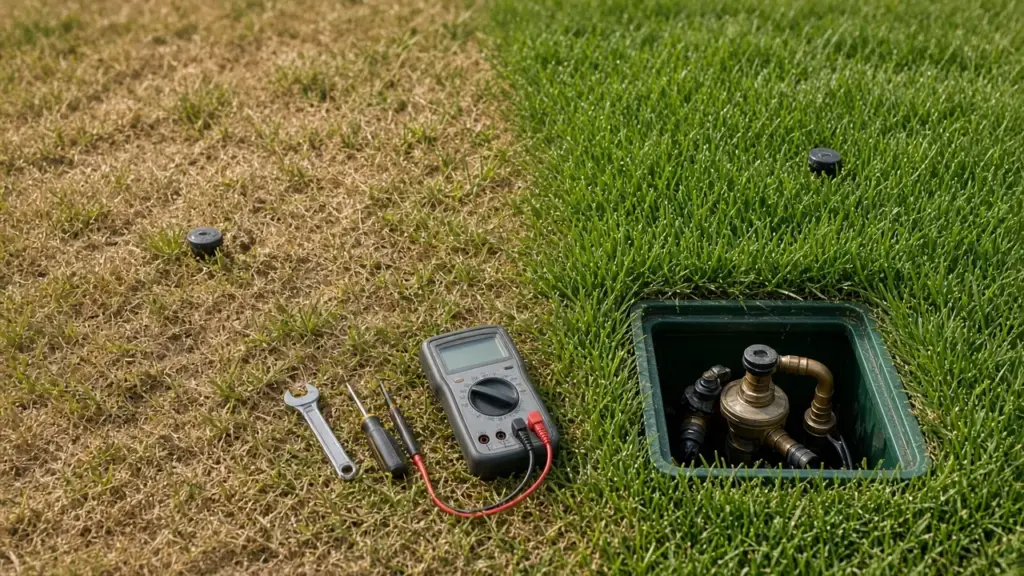
The controller says zone four is running. The yard says otherwise. When a sprinkler zone will not turn on, the problem could be anywhere from the water supply to the controller to the valve buried in a box across the yard. Working through the possibilities in order saves time and avoids replacing parts that are not broken.
This guide walks through a practical, step-by-step diagnosis for a zone that will not turn on. It complements our guide to a zone that will not turn off and our broader valve repair guide.
Step 1: Is It One Zone or All Zones?
Start by running every zone manually from the controller.
- If no zones run, the problem is likely upstream: the water supply, the backflow preventer, the controller’s power, or a common wire issue.
- If only one zone fails, focus on that zone’s controller output, wire, solenoid, and valve.
- If several zones fail, look for shared issues such as a damaged common wire or a failing controller.
Step 2: Check the Water Supply
If no zones work:
- Make sure the irrigation shutoff valve is open.
- Check both shutoff handles on the backflow preventer. Handles in line with the pipe are usually open.
- Look for freeze damage or leaks at the backflow preventer.
- Confirm the house has normal water pressure.
Our guide to what a backflow preventer does explains the valves on the assembly.
Step 3: Check the Controller
- Power: Is the display on? Check the outlet, any GFCI, and the transformer.
- Sensor: Is the rain and freeze sensor active and currently wet or cold? A sensor that is stuck in the active state will prevent zones from running. Many controllers let you temporarily bypass the sensor for testing.
- Program and manual run: Make sure you are starting the correct zone and that its run time is not set to zero.
- Error messages: Many controllers display a fault or short-circuit indicator for a specific station.
- Fuse or circuit breaker: Some controllers have a replaceable fuse or a reset for overloads.
Our controller repair guide covers controller problems in more detail.
Step 4: Test the Controller Output
With the zone running manually, a technician uses a multimeter to measure the voltage between the zone terminal and the common terminal. Most residential controllers send about 24 volts AC to an active zone.
- No voltage: the controller output is faulty, or the program is not actually running that zone.
- Normal voltage: the controller is working. Move to the wiring and valve.
Step 5: Test the Wiring and Solenoid
Measuring resistance across the zone wire and common wire at the controller, with the zone off, gives clues:
- Very high or infinite resistance: an open circuit, such as a cut wire or failed solenoid coil.
- Very low resistance: a short circuit, such as damaged insulation or a failed solenoid.
- Resistance in the typical range for a solenoid: the circuit is likely fine.
Testing at the valve itself, after disconnecting the solenoid, separates a bad solenoid from a bad wire. Wire breaks are common where fences, landscaping, or utility work crossed the wire path.
Step 6: Open the Valve Manually
At the valve box, most valves can be opened manually by:
- Turning the solenoid a quarter turn counterclockwise, or
- Opening the external bleed screw.
If the zone runs when opened manually, the valve’s hydraulics are fine and the problem is electrical: controller, wire, or solenoid. If the zone still does not run, the problem is in the valve or the supply to it. Close the solenoid or bleed screw after testing.
Step 7: Check the Valve Itself
If the valve will not open even manually:
- Flow control closed: Many valves have a flow control handle on top. If it is turned all the way down, the valve cannot open.
- Debris: Grit can block internal ports.
- Damaged diaphragm: A stiff or torn diaphragm may not lift.
- Supply to the valve: A break or blockage in the mainline before the valve can starve it.
Don’t Forget the Obvious
Before digging into wiring, rule out a few simple things that cause many “dead zone” calls: a zone accidentally left at a zero run time after a seasonal change, a program that does not include that zone, a manual flow control turned all the way down during a previous repair, or a valve box lid that was replaced over a pinched wire. Each takes a minute to check and can save a service visit.
Common Causes by Symptom
- Controller shows the zone running, no water, valve opens manually: likely a wire break or failed solenoid.
- Controller shows a station fault: likely a short circuit in the wire or solenoid.
- Valve will not open even manually: flow control closed, debris, diaphragm, or a supply problem.
- No zones run: supply, backflow preventer, controller power, sensor, or common wire.
- Zone works only sometimes: a loose or corroded splice, or a failing solenoid.
Wire Splices in Dallas Clay
Intermittent zones are often caused by splices that were not waterproofed. Wet clay holds moisture against connections, and they corrode over time. Proper repairs use gel-filled waterproof connectors. Our guide to why black clay makes repair harder covers other soil-related issues.
After the Repair: Check the Whole Zone
Once the zone runs again, do not stop at “water comes out.” Walk the zone and confirm:
- Every head pops up fully and rotates or sprays its full pattern.
- No new wet spots or bubbling soil appear.
- The valve closes completely when the zone ends.
- The controller runs the zone on schedule, not just manually.
A zone that has been off for weeks in Dallas heat may have dry, brown turf that needs a little time to recover. Resist the urge to add extra cycles; normal watering on your assigned days, with good coverage, is usually enough. Our sprinkler head repair guide covers adjusting heads after a repair.
Keep a Record
Write down what was found and fixed: which wire was cut, which solenoid was replaced, where the splice is. If the same zone fails again, that record points straight to the likely cause and saves time on the next visit.
When to Call a Professional
Homeowners can safely check the supply, controller settings, sensor, and manual valve operation. Tracing buried wire, replacing solenoids and diaphragms, and finding breaks are jobs where a technician’s tools and experience save time. If a zone has been off for a while during hot weather, it is worth getting it fixed quickly, since turf in that area will decline fast.
Frequently Asked Questions
Why does my zone run when I turn the solenoid by hand but not from the controller?
The valve works, so the problem is electrical: the controller output, the wire, or the solenoid.
Can a rain sensor stop a single zone from running?
A sensor usually stops all zones. If only one zone fails, look at that zone’s wire, solenoid, and valve.
What does a station fault message mean?
It usually indicates a short circuit on that zone’s wire or solenoid.
How do I find a broken sprinkler wire?
Technicians use wire-tracing equipment to follow the wire path and locate the break.
Can I replace a solenoid myself?
Many homeowners can with the water off, but testing first ensures the solenoid is really the problem.
Get a Dead Zone Working Again
If a zone will not turn on, our team can trace the cause and make the repair. Learn about our sprinkler repair service, or contact us to schedule.
Request Service or call 214-227-7444
We serve homes throughout Dallas and nearby North Texas communities.