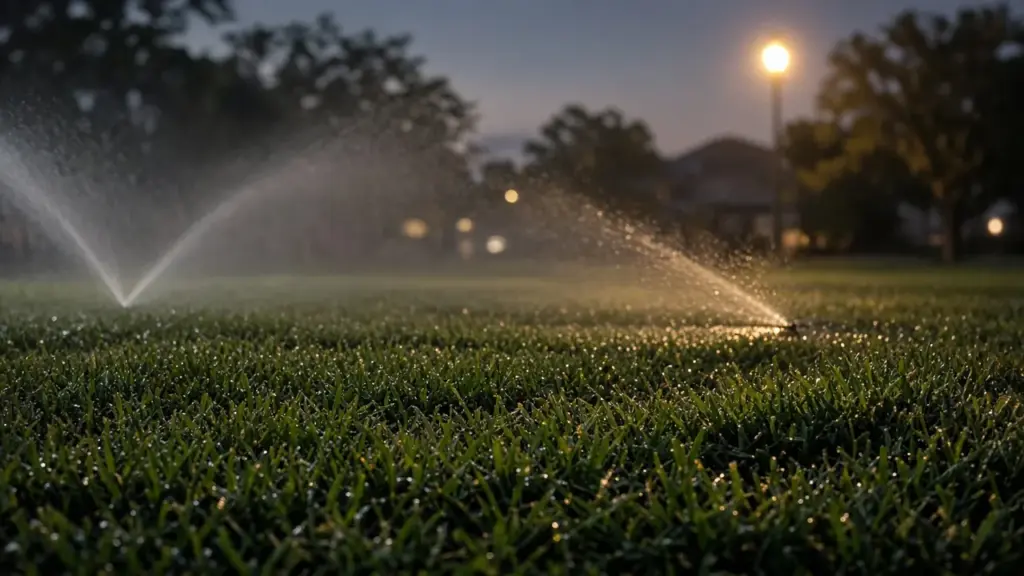
Dallas prohibits sprinkler watering between 10 a.m. and 6 p.m. year-round. That leaves two windows: evening and night after 6 p.m., or early morning before 10 a.m. Many homeowners choose evening because it seems convenient and the air is cooler. For St. Augustine lawns, though, watering in the evening or overnight can create conditions that favor fungal disease.
This guide explains why night watering can encourage fungus in St. Augustine and how to schedule irrigation to reduce the risk.
Why Leaf Wetness Matters
Many lawn fungi need moisture on grass blades to infect the plant. The longer leaves stay wet, the better the conditions for fungal growth. Temperature matters too: several common lawn diseases thrive in mild to warm, humid conditions.
When you water in the evening or at night, grass blades stay wet for many hours, often until the sun rises and dries them the next morning. Add dew, which forms naturally overnight, and the leaf wetness period can stretch even longer.
When you water in the early morning, the grass is already wet from dew, and watering adds little extra wet time. As the sun rises and temperatures climb, the blades dry within a few hours.
St. Augustine and Brown Patch
St. Augustine is the most common lawn grass in many Dallas neighborhoods, and it is susceptible to a fungal disease commonly called brown patch, also referred to as large patch in warm-season grasses. Brown patch typically appears as circular or irregular patches of yellowing and browning grass, sometimes with a darker ring at the edge. It tends to be most active in spring and fall when temperatures are mild and moisture is high.
Our guide to brown patch and overwatering in St. Augustine covers the disease in detail.
Other Fungal Issues
- Gray leaf spot can affect St. Augustine in warm, humid weather.
- Take-all root rot is another disease of St. Augustine associated with stress and moisture conditions.
Extended leaf wetness and excessive watering can contribute to several of these problems.
The Best Time to Water in Dallas
For most Dallas lawns, early morning is the best time to water:
- Before 10 a.m., as required by city rules.
- Grass dries quickly as the sun rises.
- Lower evaporation than midday.
- Calmer winds in many cases, which improves spray patterns.
- Water pressure is often good in early morning, though demand peaks can vary.
A common target is to finish watering well before 10 a.m. With cycle and soak, start early enough that the last cycle ends on time. Our guide to programming a controller for the Dallas schedule walks through start times.
When Evening Watering Might Be Used
Evening watering after 6 p.m. is allowed under Dallas rules. On large properties with many zones, fitting all cycles into the morning window can be difficult. If some zones must run in the evening, consider:
- Running zones with less disease-prone plantings in the evening
- Running evening cycles soon after 6 p.m. rather than late at night, so there is some time for drying
- Keeping evening run times short
- Reserving morning windows for St. Augustine
Overwatering Compounds the Problem
Timing matters, but so does the amount. St. Augustine lawns that receive more water than they need, particularly in cooler months, are more prone to fungal disease. Signs of overwatering include:
- Soggy soil
- Mushrooms
- Algae on the soil surface
- Thinning turf
Reducing run times in spring and fall and letting the rain sensor skip cycles helps. Our guide to adjusting run times month by month offers a seasonal framework.
Deep and Infrequent Watering
Watering deeply and infrequently encourages deeper roots and allows the surface to dry between watering days. Dallas’s twice-weekly limit fits this approach. Our guide to deep and infrequent watering for clay soil explains how.
Other Ways to Reduce Fungal Risk
- Improve airflow by pruning low branches and shrubs that trap moisture.
- Avoid excess nitrogen, especially in fall.
- Mow at the recommended height with a sharp blade.
- Fix drainage problems that keep soil saturated.
- Fix sprinkler problems that overwater specific areas, such as heads with low-head drainage or zones with poor distribution.
Shaded Lawns
Shaded areas dry more slowly after watering and dew, and St. Augustine in shade is often more prone to disease. Shaded zones generally need less water. Separate shaded areas onto their own zones or reduce their run times. Our guide to shade lawns and irrigation adjustments explains how.
Smart Controllers
Smart controllers can adjust watering based on weather and skip cycles when rain is forecast, reducing overwatering. Set them to water in the morning window, restrict them to your assigned days, and make sure they finish before 10 a.m.
Fitting Everything Into the Morning Window
With sprinkler watering prohibited from 10 a.m. to 6 p.m., the morning window runs from midnight to 10 a.m. Watering very early, such as midnight to 3 a.m., technically falls in the morning but behaves more like night watering, since grass stays wet until sunrise. For St. Augustine, starting cycles a few hours before sunrise and finishing before 10 a.m. usually balances good pressure, low evaporation, and quick drying.
To fit all zones into that window:
- Add up each zone’s total run time, including cycle and soak splits.
- Work backward from about 9:30 a.m. to find a start time.
- If the total does not fit, reduce run times on zones that need less water, such as shaded areas.
- Consider moving beds to drip, which is allowed any day and time.
Hand Watering and Leaf Wetness
Hand watering is allowed on any day, and it is sometimes used to help stressed spots. When hand watering St. Augustine, aim water at the soil rather than soaking the blades, and water early in the day so the grass dries.
Recognizing Fungus Early
Catching disease early makes it easier to manage. Look for:
- Circular or irregular patches of yellowing grass, especially in spring and fall
- Blades that pull easily from the stem at the base, which can indicate brown patch
- Patches that expand after periods of cool, wet weather
If you suspect disease, reduce watering, avoid nitrogen, and consult local extension resources or a lawn care professional about treatment. Our guide to St. Augustine watering and irrigation needs covers other aspects of caring for this grass.
Rain Sensor Settings
A working rain sensor, required in Dallas, skips cycles after rain so the lawn does not stay saturated. Check its setting and test it periodically.
Frequently Asked Questions
Why is watering at night bad for St. Augustine?
Night watering keeps grass blades wet for many hours, creating conditions that favor fungal diseases such as brown patch.
What is the best time to water a lawn in Dallas?
Early morning, finishing before 10 a.m., is usually best.
Can I water in the evening in Dallas?
Yes, sprinkler watering after 6 p.m. is allowed, but early morning is generally better for disease prevention.
Does overwatering cause brown patch?
Excess water and extended leaf wetness can contribute to brown patch, particularly in spring and fall.
Get Help Adjusting Your Schedule
We set up controllers for early morning watering, fix coverage problems, and reduce overwatering. See our sprinkler repair service, or contact us to schedule.
Request Service or call 214-227-7444
We serve homes throughout Dallas and nearby North Texas communities.