Most Dallas lawns grow in heavy clay, often the dark, sticky soil that swells when wet and cracks when dry. Clay behaves very differently from sandy or loamy soil, and it rewards a specific watering approach: water deeply, water less often, and give the soil time to absorb what you apply. That approach also fits naturally with the city’s twice-weekly watering limit.
This guide explains why deep and infrequent watering works in clay, how to do it without runoff, and how to tell whether it is working.
How Clay Handles Water
Clay particles are extremely small and packed closely together. That structure has two important effects:
- Slow intake. Water soaks into clay slowly. When sprinklers apply water faster than the soil can absorb it, the extra runs off onto sidewalks and streets or puddles on the surface.
- High holding capacity. Once water gets into clay, the soil holds it for a long time. A deep watering can supply grass roots for several days.
Those two traits point in the same direction. You do not need to water often, but when you do water, you need to apply the water slowly enough that it soaks in.
Why Deep Watering Builds Better Roots
Grass roots grow where water is available. Frequent, shallow watering keeps moisture near the surface, so roots stay shallow. Shallow roots dry out quickly in Dallas summer heat and leave the lawn dependent on constant watering.
Deep watering moistens the soil several inches down. As the surface dries between waterings, roots follow the moisture deeper. A deeper root system can draw on water stored in the soil, which helps the lawn handle heat and the days between watering.
What Infrequent Means in Dallas
Dallas limits automatic sprinklers and hose-end sprinklers to two assigned days per week, based on your address:
- Even addresses: Sundays and Thursdays
- Odd addresses: Wednesdays and Saturdays
Sprinkler watering is also prohibited between 10 a.m. and 6 p.m. year-round. See our guide to even and odd address watering days and the article on the year-round 10 a.m. to 6 p.m. ban.
Two waterings a week, applied deeply, is a good match for clay. In cooler months, many lawns need even less, and you can skip a day or pause watering entirely when rain has done the job.
Cycle and Soak: The Key Technique
The biggest challenge in clay is runoff. Spray heads in particular apply water quickly, often faster than clay can absorb it. The solution is cycle and soak: split each zone’s total run time into two or three shorter cycles with a break in between.
For example, instead of running a spray zone for 15 minutes straight, run it for three 5-minute cycles. During the gaps, while other zones run, water from the first cycle soaks in, making room for the next.
Most controllers allow multiple start times on a program. Set start times far enough apart that the soak periods are meaningful, and make sure the final cycle ends before 10 a.m. Our guide to programming a controller for the Dallas schedule walks through the settings. Some smart controllers have a built-in cycle and soak feature.
How Much Water to Apply
How much a lawn needs depends on grass type, sun exposure, season, and weather. Rather than relying on a fixed number, measure what your system applies and watch how the lawn responds. Our guide to how much water a Dallas lawn actually needs explains how to measure output with catch cups and adjust run times.
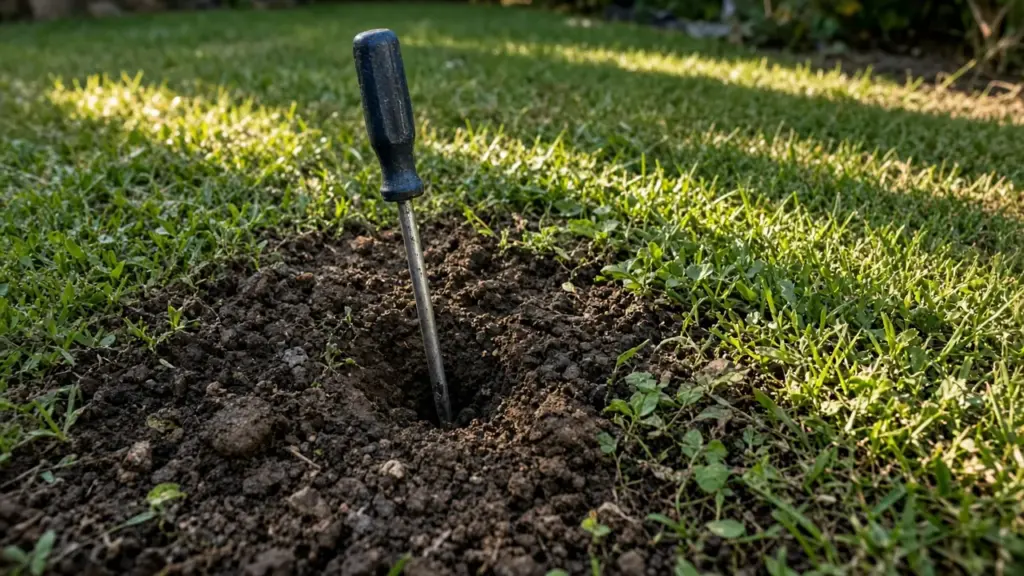
In general, aim to wet the soil to the depth of the root zone without runoff. You can check with a long screwdriver or soil probe: after watering, it should push into the soil easily to a depth of several inches. If it stops short, the water did not go deep enough.
Signs You Are Watering Too Often
- Shallow roots that pull up easily
- Mushrooms, moss, or algae in turf
- Fungal problems such as brown patch in fall
- Soft, squishy areas that stay wet
- Runoff on every cycle
Signs You Are Not Watering Deeply Enough
- Grass wilts quickly between waterings, with a blue-gray color or footprints that stay visible
- The soil probe will not push in beyond an inch or two after watering
- Dry spots even though the system runs as scheduled
If certain areas stay dry while others are fine, the issue may be coverage rather than run time.
Clay and Foundations
Clay’s tendency to shrink and swell affects foundations as well as lawns. Keeping soil moisture more consistent around the foundation can help reduce large swings in soil movement. Dallas allows foundation watering on any day and at any time using a hand-held hose, soaker hose, drip irrigation, or bucket. Our guide to foundation watering rules covers the details.
Improving Clay Over Time
Clay does not change quickly, but a few practices can help water soak in more readily:
- Core aeration pulls small plugs of soil, opening channels for water and air. It is especially useful where soil is compacted.
- Topdressing with compost after aeration adds organic matter over time.
- Leaving grass clippings returns organic matter to the soil.
- Avoiding traffic on wet soil helps prevent compaction.
Seasonal Adjustments
Deep and infrequent watering applies year-round, but the amount changes with the season. In summer, lawns use more water and may need both assigned days. In spring and fall, cooler temperatures and rain often mean one day is enough. In winter, dormant warm-season grass needs little or no irrigation. Use your controller’s seasonal adjustment or change run times as the weather shifts.
Your rain and freeze sensor, which is required in Dallas, helps by stopping irrigation after rain and during freezing temperatures. Test it periodically to make sure it works. See our guide to rain and freeze sensors.
Checking Your Work
After changing to a deep and infrequent schedule, give the lawn a few weeks to adjust, especially in warm weather. Roots take time to grow deeper. Watch for wilting between waterings and check soil depth with a probe. Adjust gradually rather than making large changes all at once.
Different Zones, Different Needs
Not every zone should get the same schedule. Rotor zones apply water more slowly than spray zones, so they often need longer run times but may need fewer cycle and soak splits. Shaded areas use less water than sunny areas. Slopes shed water faster and benefit from more, shorter cycles. Beds on drip irrigation need a completely different approach. Set each zone individually rather than using one run time for the whole system.
Common Mistakes
A few habits undermine deep watering in clay:
- Running a long single cycle on spray zones. Much of the water runs off before it can soak in.
- Adding extra days in heat waves. Dallas limits sprinkler watering to two days, and frequent watering keeps roots shallow. Hand watering stressed spots is a better short-term fix.
- Ignoring runoff. If water reaches the gutter, it is wasted and can lead to a violation.
- Never adjusting for season. A summer schedule in November wastes water and invites disease.
Frequently Asked Questions
Why is deep and infrequent watering better for clay soil?
Clay absorbs water slowly but holds it well. Deep watering moistens the root zone and encourages deeper roots, while infrequent watering lets the surface dry between waterings.
How do I prevent runoff on clay soil?
Use cycle and soak: split each zone’s run time into shorter cycles with breaks in between so water can soak in.
How many days a week should I water in Dallas?
No more than your two assigned days for sprinklers. In cooler months, one day or none may be enough.
How can I tell if water is soaking in deeply?
After watering, push a long screwdriver or soil probe into the ground. It should go in easily several inches.
Get Help Setting Up Your Schedule
We adjust controllers for cycle and soak, measure system output, and fix coverage problems that cause dry spots. See our sprinkler repair service, or contact us to schedule.
Request Service or call 214-227-7444
We serve homes throughout Dallas and nearby North Texas communities.