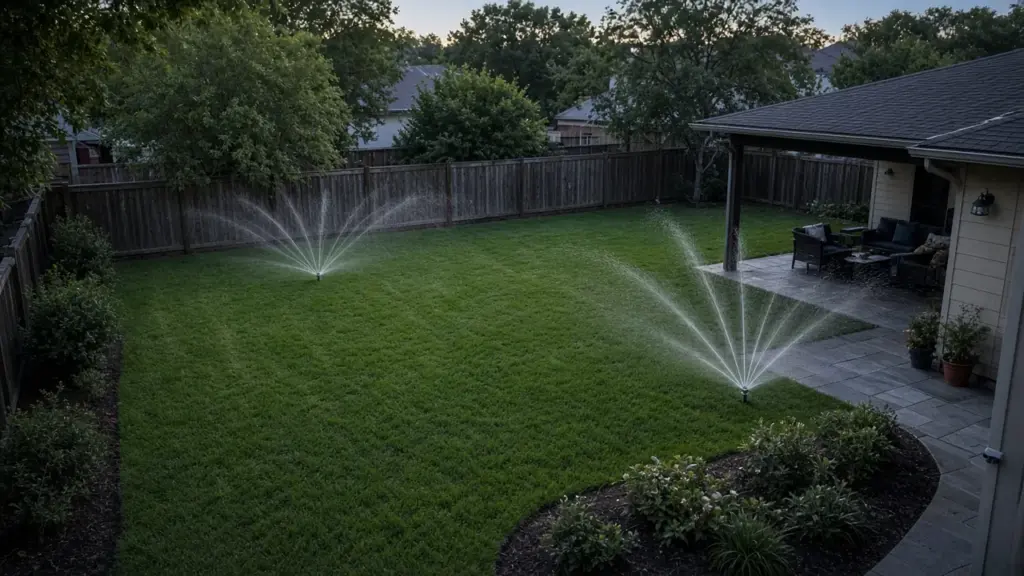
You start zone 3 and notice that zone 5 is also running. Or you see weak, sputtering spray across the yard because two zones are sharing the water supply at once. Two zones running together is a common irrigation problem, and it usually traces back to one of three places: the controller, the wiring, or a valve.
Running two zones at once splits available pressure, so neither zone gets full coverage. It can also double water use. This guide explains how to find the cause.
First: Is the Second Zone Really On?
Before diving into wiring, confirm what is happening. Walk the yard while a single zone runs from the controller. Note which heads are spraying. Then run the second zone alone and note its heads. Sometimes zones overlap in coverage, or a zone was wired to more heads than expected.
Cause 1: Controller Programming
The simplest explanation is programming.
- Overlapping programs. Two programs with start times close together can run at the same time on controllers that allow stacking or simultaneous programs.
- Duplicate zone assignments. A zone may be included in two programs.
- Master valve or pump settings misconfigured on some controllers.
Check: Review each program’s start times and zones. Many controllers run programs sequentially, but some allow overlap. Our guide to programming a controller for Dallas’s schedule explains programs and start times.
Cause 2: A Valve Stuck Open
If one zone keeps running after its cycle, or runs whenever another zone is on, a valve may be stuck partly open. A valve with debris under the diaphragm, a torn diaphragm, or a stuck solenoid may not close fully. When another zone pressurizes the mainline, the stuck valve may pass water too.
Check: Turn off the controller. If the second zone still seeps or runs, the valve is not closing. Our guide to a zone that will not turn off explains how to repair it.
Cause 3: The Flow Control or Manual Bleed
Many valves have a manual bleed screw or lever that opens the valve without the controller. If someone opened it during testing and did not close it, the valve may stay open or partially open.
Check: Make sure manual bleed screws and levers are closed on every valve.
Cause 4: Crossed or Shared Wiring
Each valve has two wires: a station wire connected to its zone terminal on the controller, and a common wire shared by all valves. If station wires are connected together, or if a splice has shorted between two station wires, both valves can activate when either station runs.
Common wiring problems include:
- Two station wires on the same terminal, sometimes done intentionally to run two valves as one zone, and sometimes by mistake
- Damaged insulation where two wires touch underground, often from shovels, aerators, or rodents
- Corroded splices that have bridged together in a wet valve box
- A wire cut and reconnected to the wrong wire after digging
Check: At the controller, look at each terminal. Is more than one wire connected to a station? Label wires by color and trace them. In valve boxes, inspect splices and replace any that are not in waterproof connectors.
Cause 5: Two Valves Wired as One Zone
Sometimes, two valves were deliberately wired to one station to combine areas. If the water supply cannot support both zones at once, coverage suffers. Separating them onto their own stations restores full pressure to each.
Diagnosing With a Multimeter
A multimeter can help identify wiring faults:
- Disconnect station wires at the controller.
- Measure resistance between each station wire and the common wire. A normal solenoid reads within a typical range listed by the manufacturer.
- Measure resistance between two station wires. A very low reading between station wires suggests they are shorted together.
If you are not comfortable working with wiring, a technician can trace faults with specialized equipment.
Checking Valve Boxes
Water-filled valve boxes are hard on wiring. Splices that are not sealed corrode and can short. Our guide to flooded valve boxes explains why water collects and how to fix it. Replace old wire nuts and tape with waterproof connectors designed for direct burial.
A Step-by-Step Approach
- Walk the yard while each zone runs alone to confirm which heads belong to which zone.
- Review controller programs for overlapping start times or duplicate zones.
- Turn off the controller and check whether any zone still runs, pointing to a stuck valve.
- Check manual bleed screws and flow controls on every valve.
- Inspect controller terminals for doubled wires.
- Test wires with a multimeter for shorts.
- Inspect valve box splices.
Why It Matters
Two zones running at once cause:
- Weak coverage, as pressure is split between zones
- Dry spots where heads cannot reach
- Higher water use
- Possible violations if the extra zone runs outside allowed hours
Related Valve Problems
If one zone runs weak on its own, see our guide to weak pressure on only one zone. If a zone will not turn on at all, our step-by-step diagnosis guide walks through it. Solenoid problems are covered in our guide to replacing a sprinkler solenoid.
Preventing Wiring Problems
- Use waterproof, direct-burial connectors for all splices.
- Keep valve boxes clear and draining.
- Mark wire routes so they are not cut during landscaping.
- Label wires at the controller.
- Call 811 before digging, and hand dig near known wire paths.
When the Controller Is the Problem
Occasionally, a failing controller activates more than one station. Lightning and power surges can damage controller outputs. If programming and wiring check out and two zones still activate together, the controller may be at fault. Testing station outputs with a multimeter or swapping the zone to another terminal can help confirm.
Mapping Your Zones
Many homeowners do not have an accurate map of which valve controls which heads. Creating one makes troubleshooting much faster. Run each zone and mark its heads with colored flags, then sketch the yard with zone numbers and valve locations. Note wire colors at each valve if you can see them. Keep the map with your controller notes. The next time something seems off, you can compare what is spraying with what should be spraying in seconds.
Adding Stations Instead of Doubling Up
If a controller has run out of stations, doubling two valves on one terminal can seem like an easy fix. It often causes the coverage problems described here. Expansion modules for many controllers add stations at modest cost, and replacing an older controller with a larger model is another option. Either keeps each valve on its own station so each zone gets the full water supply.
Frequently Asked Questions
Why are two sprinkler zones running at the same time?
Common causes include overlapping controller programs, a valve stuck open, an open manual bleed, crossed or shorted wiring, or two valves wired to one station.
How do I know if a valve is stuck open?
Turn off the controller. If the zone still runs or seeps, the valve is not closing.
Can bad wiring make two zones come on together?
Yes. Shorted station wires or wires connected to the wrong terminal can activate two valves at once.
Does running two zones at once hurt coverage?
Yes. Pressure is split between the zones, so heads often cannot reach their full distance.
Get Help With Valves and Wiring
We trace wiring faults, repair valves, and correct controller programming. See our sprinkler repair service, or contact us to schedule.
Request Service or call 214-227-7444
We serve homes throughout Dallas and nearby North Texas communities.