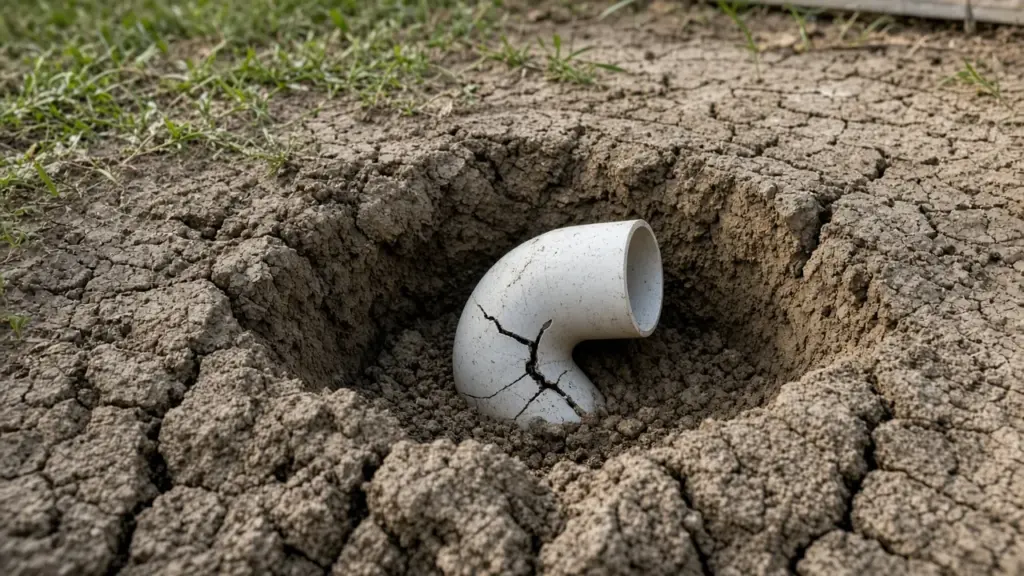
Many Dallas homeowners notice a pattern: sprinkler leaks seem to show up after long dry spells, after heavy rains following drought, or at the same spots year after year. One major reason is the soil itself. Much of Dallas sits on expansive clay, soil that swells when it absorbs water and shrinks as it dries. Buried pipe has no choice but to move with it.
This guide explains how clay movement stresses irrigation pipe, where cracks tend to appear, and what can reduce repeat breaks.
What Makes Dallas Clay Expansive
Expansive clays contain minerals that absorb water between their microscopic layers. When wet, the clay swells in volume. When dry, it shrinks and forms the wide cracks many Dallas homeowners see in late summer. The dark, sticky soils common in the area, often called black clay or blackland soils, are known for this behavior.
The movement can be substantial, and it is not uniform. Soil near a tree, a foundation, a flower bed, or a low spot may dry or wet at different rates than soil a few feet away. That uneven movement is what puts stress on buried pipe.
Our guide to why black clay makes sprinkler repair harder covers how this soil affects repair work.
How Clay Movement Damages Pipe
Bending and Shearing
When one section of soil drops as it dries while the adjacent section holds steady, pipe running between them is bent. Rigid PVC does not tolerate much bending. Over repeated cycles, stress concentrates at weak points and cracks form.
Pulling on Fittings
Fittings, such as tees, elbows, and couplings, are stiffer than straight pipe and are joined with solvent cement or threads. Soil movement tugs on these joints, and they often fail before the pipe itself does.
Stress at Heads and Risers
Where a lateral pipe connects to a sprinkler head, the soil around the head may move differently from the pipe. Rigid risers can crack at the threads. Flexible swing joints and funny pipe connections tolerate movement better.
Cracks Opening Around Pipe
In late summer, deep soil cracks can open alongside pipes. When heavy rain follows, soil swells quickly, sometimes shifting pipe that has lost support.
Our guide to soil cracks in summer and what they do to pipes covers the summer side of this cycle.
Where Cracks Usually Appear
- At fittings and joints, especially tees and elbows
- At heads and risers, where rigid connections meet moving soil
- Near trees, where roots dry soil unevenly and can push on pipe
- Along foundations, where soil moisture differs from the open lawn
- Under sidewalks and driveways, where soil beneath pavement stays moister than exposed soil
- At older repairs, where couplings and patches create stiff points
Mainline vs. Lateral Damage
Cracks on laterals leak only when a zone runs. Cracks on the mainline leak constantly because the mainline stays pressurized. A cracked mainline can waste a lot of water and saturate soil, which then swells and can cause further movement. Our guide to mainline vs. lateral line breaks explains the difference.
PVC vs. Poly Pipe
Older and newer Dallas systems use different pipe materials. PVC is rigid and strong but can crack under bending stress. Polyethylene (poly) pipe is flexible and tolerates soil movement better, though it has its own weaknesses, such as fittings that can loosen. Many systems use PVC for mainlines and poly or flexible pipe for some lateral connections. Our guide to PVC vs. poly pipe in older Dallas systems compares them.
Signs a Pipe Has Cracked
- Soggy spots that stay wet between watering days
- Weak pressure on a zone
- Water bubbling from the ground when a zone runs
- Unusually green patches in dry weather
- A water bill that rises without explanation
Our guide to using your water meter to test for irrigation leaks explains how to confirm a leak.
Reducing Repeat Breaks
You cannot stop clay from moving, but you can reduce the stress on pipe:
- Use flexible connections at heads. Swing joints or flexible pipe between the lateral and the head absorb movement.
- Bed pipe properly during repairs. Backfilling with care, removing rocks and debris, and compacting soil around the pipe gives it more even support.
- Avoid stiff clusters of fittings where possible.
- Keep soil moisture more consistent. Deep, infrequent watering and consistent foundation watering reduce extreme wet-dry swings.
- Fix leaks promptly. A leak saturates soil locally, creating uneven swelling that stresses nearby pipe.
- Consider rerouting pipe away from trees and foundations when repairing repeated failures.
Repairing Pipe in Clay
Repairing pipe in clay has its own challenges. Wet clay is heavy and sticky; dry clay is hard as brick. Excavate enough to expose clean pipe on both sides of the crack, and make sure the repair area is supported.
- For PVC, cut out the damaged section and install a coupling or repair fitting with proper solvent cement and cure time.
- Slip couplings or telescoping repair fittings can make repairs easier in tight spaces.
- Backfill carefully in layers, removing clods and rocks.
Timing Repairs
Clay is easiest to dig when moderately moist. Watering the area lightly a day before digging can soften hard summer clay. Avoid digging saturated clay, which is heavy and smears.
When Repeated Breaks Point to Bigger Issues
If the same area breaks every year, consider whether the pipe route makes sense, whether trees have grown into the area, or whether the pipe is simply old and brittle. At some point, replacing a section or rerouting a line costs less than repeated repairs. Our leak detection and pipe repair guide explains options.
Soil Movement and Foundations
The same soil movement that cracks pipe also affects foundations. Consistent moisture near foundations matters in Dallas. Dallas allows foundation watering on any day and at any time with a hand-held hose, soaker hose, drip irrigation, or bucket. Keeping irrigation leaks from saturating soil near the foundation is also important.
Trees, Roots, and Uneven Drying
Large trees draw a great deal of water from the soil, especially in summer. Soil within a tree’s root zone can dry much faster than soil in open lawn, creating a sharp boundary where pipe is bent as one side shrinks. Roots can also grow alongside and around pipe, and as they thicken, they push on it. When a pipe near a tree breaks repeatedly, rerouting the line farther from the trunk or switching to flexible pipe in that section may be the lasting fix. Always protect major roots when digging; cutting large roots can harm the tree.
Pipe Depth Matters
Shallow pipe is more exposed to the drying and cracking of surface soil, and to damage from aeration and edging. Deeper pipe sits in soil where moisture changes are somewhat less extreme. When lines are repaired or replaced, burying them at an appropriate depth helps. Older systems sometimes have pipe that has worked its way shallower over years of soil movement and erosion.
Seasonal Inspection Timing
Two times of year are especially good for checking for clay-related breaks: late summer, after the soil has dried and shrunk, and after the first heavy rains of fall, when swelling soil shifts pipe again. A walk-through of each zone at those times catches new cracks early.
Frequently Asked Questions
Why do sprinkler pipes crack in Dallas?
Expansive clay swells when wet and shrinks when dry, bending and pulling buried pipe and fittings.
Where do sprinkler pipes usually crack?
At fittings, heads, and risers, near trees and foundations, and under pavement.
Is poly pipe better than PVC in clay?
Poly is more flexible and tolerates movement better, while PVC is rigid and strong. Many systems use both.
How can I reduce repeat breaks?
Use flexible connections at heads, backfill carefully during repairs, keep soil moisture consistent, and fix leaks promptly.
Get Help With Cracked Pipes
We find and repair cracked sprinkler pipes in Dallas clay. See our sprinkler repair service, or contact us to schedule.
Request Service or call 214-227-7444
We serve homes throughout Dallas and nearby North Texas communities.