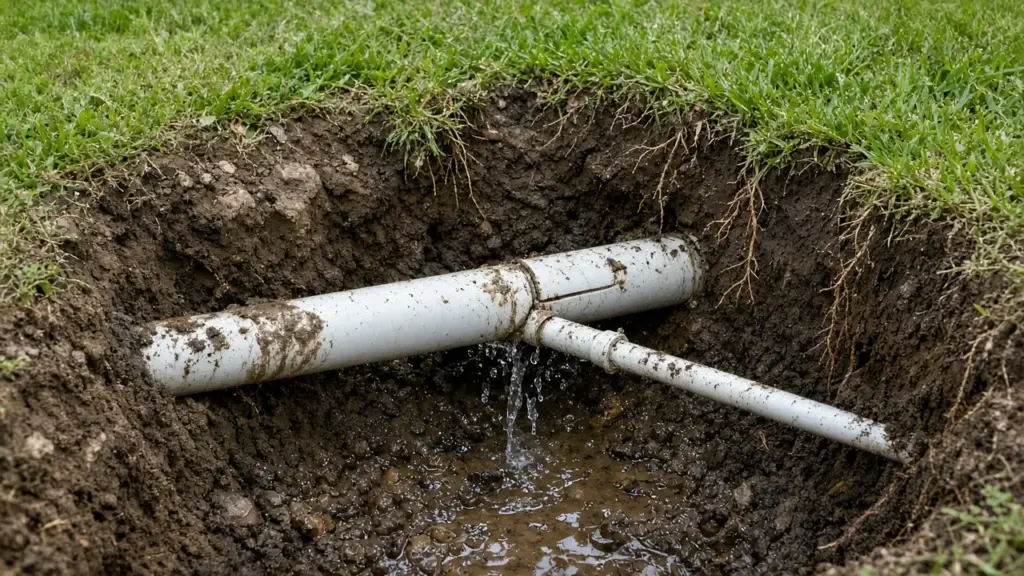
When a sprinkler pipe breaks, one of the first questions a technician asks is whether it is on the mainline or a lateral line. It is not just jargon. The answer tells you how urgent the repair is, how much water you may be losing, how to find the break, and what the repair involves.
This guide explains the difference between mainline and lateral breaks, how each one shows up in a Dallas yard, and how to tell them apart with simple checks.
Two Kinds of Pipe
A typical residential irrigation system has two kinds of pipe:
- The mainline carries water from the supply through the backflow preventer to the zone valves. It stays pressurized whenever the irrigation supply is open, which for most homes is all the time.
- Lateral lines carry water from each zone valve to that zone’s heads. They are pressurized only while that zone is running.
The valve is the dividing line. Everything upstream of the valves is mainline; everything downstream is lateral.
How a Mainline Break Behaves
Because the mainline is always under pressure, a break leaks continuously, day and night, whether any zone is running or not.
Signs of a mainline break
- A wet area that never dries, even on non-watering days
- Water running down the curb or across the sidewalk when the system is off
- The water meter’s leak indicator moving with all water off
- A noticeable increase in the water bill
- Low pressure across every zone
Why it is urgent
A mainline leak wastes water every hour. In Dallas clay, it can saturate a large area, soften soil, and create standing water. If it is near the house, it can add unwanted moisture near the foundation. Mainline breaks should be repaired promptly, and in the meantime the irrigation shutoff valve can be closed to stop the leak.
How a Lateral Break Behaves
A lateral line is pressurized only when its valve opens. A lateral break leaks only while that zone runs.
Signs of a lateral break
- Water bubbling or pooling when one specific zone runs
- Weak spray or heads that do not pop up on that zone
- A geyser from the ground near a head
- The wet area drying out between watering days
Why it still matters
A lateral leak wastes water only during that zone’s cycle, but it also robs the rest of the zone of pressure. Heads downstream of the break underperform, and turf in that zone can brown. Owners often increase run times, which makes the leak worse.
Simple Tests to Tell Them Apart
The meter test
- Turn off all water use in and around the house.
- Watch the water meter’s leak indicator.
- If it moves, close the irrigation shutoff valve.
- If the indicator stops, the leak is on the irrigation mainline or at a valve leaking through.
Lateral breaks will not show on this test when zones are off.
The zone test
Run each zone manually and walk it. A lateral break shows up only on its zone, with visible water and weak heads.
The dry-down test
Turn the system off for a few days. A lateral leak area will dry out; a mainline leak area stays wet.
Our leak detection guide walks through these tests in more detail, and our guide to signs of a hidden leak in clay soil explains why the wet spot may not be directly over the break.
A Special Case: Valves Leaking Through
A valve that does not close completely lets water pass into its lateral line constantly. That can look like a mainline leak, because water flows all the time, but it shows up at the lowest heads on that zone. Cleaning or rebuilding the valve fixes it. Our guide to a zone that will not turn off covers valve causes.
How the Repairs Differ
Mainline repairs
- The irrigation supply must be shut off before work starts.
- Mainline pipe is often larger and may be deeper.
- Mainline breaks near the backflow preventer or the house connection may involve fittings that must meet code.
- After repair, the line is pressurized and checked before backfilling, and the valves are checked for debris.
Lateral repairs
- Only the affected zone needs to be off.
- Lateral pipe is often smaller and shallower.
- Breaks commonly occur at tees and risers near heads, especially after impacts.
- After repair, the line is flushed with heads off to clear soil before reinstalling heads.
In Dallas clay, both types benefit from careful flushing and proper backfill. Our guide to why black clay makes repair harder covers soil-specific practices.
Common Causes of Each
Mainline breaks often come from freezes near the backflow preventer, tree roots, deep digging for fences or utilities, and soil movement stressing larger pipe.
Lateral breaks often come from vehicles and mowers hitting heads, shallow digging for beds and edging, and clay movement cracking rigid risers.
What to Do While You Wait for a Repair
- For a mainline break: close the irrigation shutoff valve, usually near the backflow preventer, and turn the controller off. The house keeps its water supply. If you need to water trees or beds before the repair, use a hose, which Dallas allows any day.
- For a lateral break: set that zone’s run time to zero or remove it from the program. Other zones can keep running on your assigned days.
- Mark the spot with a flag so the technician can find it, even if the area dries out.
- Note what you have seen: when the wet spot appeared, whether it is constant, and which zone makes it worse.
Why Dallas Soil Makes the Difference Important
In sandy soil, a mainline leak might drain away quietly. In Dallas clay, the same leak spreads along the trench and saturates the ground, which is why an always-wet patch deserves quick attention. Lateral breaks, by contrast, tend to cause visible problems in the zone itself, such as weak heads and brown turf downstream. Knowing which you have helps you judge how fast to act. Our sprinkler valve repair guide explains how the valves divide the two sides of the system.
Preventing Future Breaks
- Protect the backflow preventer and exposed mainline before freezes.
- Mark mainline and lateral routes before digging.
- Use flexible swing pipe at heads.
- Keep heads back from driveways and curbs.
- Consider a master valve, which keeps the mainline depressurized except when a zone is scheduled, limiting losses from mainline breaks.
Frequently Asked Questions
How do I know if my mainline is broken?
If an area stays wet all the time and the meter’s leak indicator stops when you close the irrigation shutoff, the mainline or a leaking valve is the likely source.
Can I keep using my sprinklers with a mainline leak?
It is best to close the irrigation shutoff and repair the leak promptly, since it leaks continuously.
Why are the heads on one zone weak?
A lateral break on that zone may be letting water escape before it reaches the heads.
What is a master valve?
A valve installed on the mainline that opens only when a zone is scheduled, so the mainline is not pressurized the rest of the time.
Are mainline repairs harder?
They can be, because the pipe may be larger or deeper and near code-regulated components. A technician can assess the specific situation.
Get Mainline and Lateral Repairs
Whether your leak runs around the clock or only when one zone is on, our team can find and fix it. Learn about our sprinkler repair service, or contact us to schedule.
Request Service or call 214-227-7444
We serve homes throughout Dallas and nearby North Texas communities.