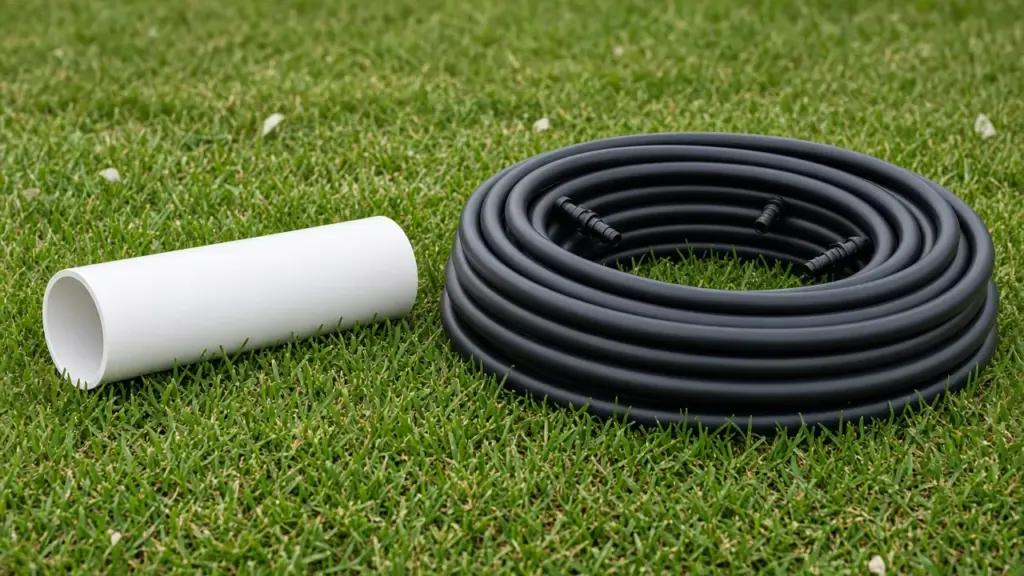
When a sprinkler line breaks, one of the first questions a technician asks is what kind of pipe is in the ground. In older Dallas systems, the answer might be PVC, polyethylene (poly), or a mix of both from different eras and repairs. The two materials behave differently, fail in different ways, and need different repair methods.
This guide explains the difference between PVC and poly pipe, how each holds up in Dallas clay, and what homeowners should know when repairs come up.
What Is PVC Pipe?
PVC (polyvinyl chloride) is the rigid white or gray pipe common in irrigation systems throughout Texas. It comes in straight lengths joined with solvent-welded fittings: primer and cement fuse the pipe and fitting together. PVC used in irrigation comes in different wall thicknesses and pressure ratings, such as Schedule 40 and various Class ratings.
Strengths:
- Rigid and holds its shape
- Handles the pressure found on mainlines
- Widely available and familiar to technicians
Weaknesses:
- Can become brittle with age and sun exposure
- Rigid joints can crack when soil shifts
- Glued joints can fail if they were not made properly
What Is Poly Pipe?
Polyethylene pipe is flexible black tubing that comes in coils. It is joined with barbed insert fittings held with clamps. Poly is more common in colder climates, but some older North Texas systems and some lateral lines use it.
Strengths:
- Flexible, so it bends around obstacles
- Tolerates some soil movement
- Handles freezing better than rigid pipe in some situations
Weaknesses:
- Barbed fittings and clamps can loosen or corrode over time
- Can be crushed or kinked
- Rodents and roots can damage it
- Generally used for laterals rather than high-pressure mainlines
How Dallas Clay Affects Each
Dallas black clay shrinks and swells dramatically with moisture changes. That movement stresses pipe.
- PVC: Rigid pipe does not flex, so movement concentrates stress at joints and fittings. Cracked fittings and split pipe near elbows and tees are common in shifting clay.
- Poly: Flexible pipe tolerates movement better, but the barbed fittings are weak points. Clamps can loosen as soil shifts, and fittings can pull apart.
Our complete guide to Dallas clay soil explains shrink-swell in more detail.
Common Failure Points in Older Systems
- Brittle PVC: older pipe, especially thin-wall pipe, can crack when dug near or when a heavy vehicle passes over.
- Failed glue joints: poorly primed or cemented joints can pull apart years later.
- Poly fittings: barbed fittings crack, clamps corrode, and connections separate.
- Transitions: where poly meets PVC, adapters and clamps can be weak points.
- Root damage: roots can squeeze or crack pipe of either type.
Our article on mainline versus lateral line breaks explains why the location of a break matters as much as the material.
How Repairs Differ
PVC repairs
A technician cuts out the damaged section and replaces it with new pipe and fittings, typically using couplings or slip-fix repair couplings. Proper primer and cement and adequate cure time are essential. The trench must be dug wide enough to work cleanly.
Poly repairs
The damaged section is cut out and replaced with new poly and barbed couplings, secured with clamps. Some repairs transition from poly to PVC where it makes sense.
Mixed systems
When a system has both, a technician may convert sections to one material during repairs, especially where poly fittings keep failing.
Should You Replace Old Pipe?
Not necessarily. If breaks are rare and pressure is good, spot repairs make sense. Consider replacing sections or the whole system when:
- Breaks happen frequently in the same area
- The pipe is brittle and cracks during every repair
- Poly fittings keep separating
- Pressure is low because pipe is undersized for the zones
Our article on whether it is time to replace your system covers the decision in more depth.
How to Tell What You Have
If you are not sure, look at an exposed section during a repair, at the backflow preventer risers, or near the valves. White or gray rigid pipe is PVC. Black flexible tubing is poly. A technician can also tell from the type of fittings used at heads and valves.
Signs of a Pipe Problem
- A wet spot that never dries
- Low pressure on one zone
- Water bubbling up near heads
- A sudden jump in the water bill
- Sinking soil or a depression in the lawn
Our guide to signs of a hidden sprinkler leak in clay soil walks through these clues, and our leak detection and pipe repair guide covers finding and fixing leaks.
Protecting Pipe in Clay
- Repair leaks promptly so wet clay does not soften around pipe
- Use proper backfill and compaction after repairs
- Avoid driving heavy vehicles over lawn areas with pipe
- Keep water off foundations and pipe trenches where possible
Why Pipe Depth Matters
Pipe that sits too shallow is more likely to be hit by aerators, edgers, and shovels, and more exposed to temperature swings. Pipe buried deeper is better protected but harder to reach. During repairs, a technician will usually match the existing depth, and may recommend reburying sections that have worked their way close to the surface.
What Happens During a Typical Pipe Repair
Knowing what to expect makes a repair visit less mysterious.
- Locate the leak. The technician uses clues like wet soil, pressure readings, and the zone layout to narrow down where the break is.
- Shut off the water. The zone or the entire irrigation supply is shut off.
- Dig carefully. In Dallas clay, digging is slow. The hole needs to be large enough to expose undamaged pipe on both sides of the break.
- Identify the pipe. The material, size, and fittings determine the repair parts.
- Cut out the damage. The cracked section is removed with clean, square cuts.
- Install the repair. For PVC, that means primer, cement, and couplings; for poly, barbed fittings and clamps.
- Flush and test. The zone is run to flush debris and check the repair for leaks before backfilling.
- Backfill and restore. Soil is replaced in layers and firmed, and the turf is set back in place.
Glued PVC repairs need cure time before full pressure, per the cement manufacturer’s directions. Rushing that step can cause a repair to fail.
Older Systems and Undersized Pipe
Some older systems were built with pipe that was adequate for the original design but not for later additions. When zones were added or heads upgraded, the same pipe was asked to carry more water. Symptoms include weak heads at the end of a zone and poor performance when the house is using water at the same time. Replacing a key section with larger pipe, or splitting a zone, can restore performance. Our guide to a zone that will not turn on covers related pressure checks.
Frequently Asked Questions
Is PVC or poly better for sprinkler systems in Dallas?
Both have uses. PVC is common for mainlines and laterals in Texas. Poly flexes with soil movement but relies on barbed fittings that can loosen. The right choice depends on the application.
Why does my PVC pipe keep cracking?
Clay movement, aging brittle pipe, poor glue joints, and roots are common causes.
Can PVC and poly be connected?
Yes, with appropriate adapters, though transitions can be weak points if not done well.
Should I replace all my old pipe?
Only if breaks are frequent, pipe is brittle, or pressure is inadequate. Otherwise, spot repairs are often enough.
Get Pipe Repair Help
We repair PVC and poly lines, fix transitions, and evaluate older systems. See our sprinkler repair service, or contact us to schedule.
Request Service or call 214-227-7444
We serve homes throughout Dallas and nearby North Texas communities.