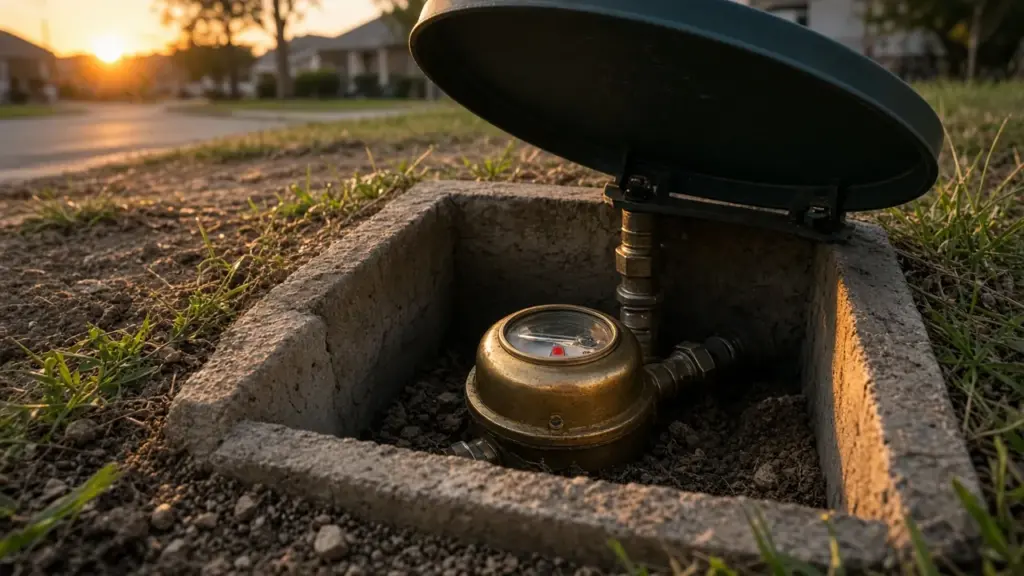
A slow sprinkler leak can hide underground for months, softening soil, wasting water, and quietly raising your bill. One of the simplest tools for catching it is already in your front yard: the water meter. With a few minutes and a little patience, you can use the meter to tell whether water is flowing somewhere it should not be, and whether the irrigation system is the likely culprit.
This guide explains how to find and read your meter, how to run a basic leak test, and what to do with the results.
Finding Your Meter
In most Dallas neighborhoods, the water meter sits in a box near the street, often at the front property line, sometimes in the parkway strip or near the driveway. The lid may be concrete, metal, or plastic. Lift it carefully, as insects and spiders sometimes shelter inside. Clear away any dirt or water covering the meter face.
If you share a meter box with a neighbor, make sure you are looking at the meter for your address. Some utilities label meters, and the meter number on your bill may help.
Reading the Meter
Meters vary, but most residential meters have:
- A register showing total water use, like an odometer
- A sweep hand that rotates as water flows
- A leak indicator, often a small triangle, star, or wheel that spins with even very small flow
The leak indicator is the key for this test. If it moves when no water should be flowing, water is going somewhere.
Step 1: Turn Off All Water Use
Make sure nothing in or around the house is using water:
- No faucets, showers, toilets refilling, washing machine, dishwasher, or ice maker cycling
- No sprinklers running
- No pool auto-fill running
Step 2: Watch the Leak Indicator
Watch the leak indicator for a few minutes. If it stays still, there is no significant leak at the moment. If it moves, even slowly, water is flowing.
For a slower leak, you can also note the register reading, wait an hour or two without using water, and check again. Any change points to a leak.
Step 3: Isolate the Irrigation System
If the indicator moved, the next step is to find out whether the flow is going to the irrigation system or the house.
Most irrigation systems have an isolation valve that shuts off water to the sprinkler system, often near the backflow preventer. Close that valve and watch the meter again.
- If the indicator stops, the leak is likely in the irrigation system.
- If it keeps moving, the leak is likely in the house plumbing or the service line from the meter to the house. Call a plumber.
Our guide to backflow preventers shows where irrigation shutoffs are typically found.
Where Irrigation Leaks Hide
If the meter points to the irrigation system with all zones off, the leak is on the part of the system that is always pressurized: the mainline from the backflow preventer to the valves, the backflow preventer itself, or a valve that is leaking internally or at its inlet.
Leaks on laterals, the pipes that run from valves to heads, only leak when their zone runs. A meter test with everything off will not catch them. For those, watch each zone run and look for geysers, bubbling, and soggy spots.
Our article on mainline versus lateral line breaks explains the difference.
Testing Individual Zones
You can also use the meter to compare zones. Run one zone at a time and note how fast the sweep hand moves, or the register change over a set time. A zone that uses far more water than similar zones may have a leak or a broken head. This requires a meter you can read precisely, and it helps to note normal readings when the system is working well.
Signs That Support a Leak Finding
- A soggy spot that never dries
- Green, lush grass in one area during dry weather
- A valve box that stays full of water
- Weak pressure on a zone
- A water bill that jumps without explanation
Our guides to a soggy spot that never dries and signs of a hidden sprinkler leak in clay soil cover these clues.
What to Do Next
- Mainline or backflow leak: keep the irrigation isolation valve closed and schedule a repair. A mainline leak wastes water continuously.
- Lateral leak: find it by running zones one at a time.
- House or service line leak: call a plumber.
Our leak detection and pipe repair guide explains repairs.
A Few Cautions
- Meter boxes can hold water, insects, and sharp edges. Use gloves and a flashlight.
- Do not force stuck valves; they can break.
- Some meters and boxes belong to the utility. Avoid damaging the meter or connections, and contact the utility if the meter itself appears to leak.
Make It a Habit
Run a quick meter check a few times a year, especially in spring after startup and in late summer after heavy use. It takes just a few minutes and can catch leaks long before they show up on your bill.
Reading Your Bill Too
Your water bill shows usage by billing period. Comparing it with the same month last year gives context. A sudden increase without a change in watering habits is a good reason to run a meter test.
Smart Meters and Online Usage
Some utilities offer online portals that show water use in more detail, sometimes daily. If your account provides that information, a sudden rise in overnight use, when little water should be flowing, can point to a leak. It is a useful complement to the physical meter test.
When the Leak Indicator Moves Only Sometimes
An intermittent leak can be confusing. A toilet flapper that leaks off and on, an ice maker refilling, or a water softener regenerating can all move the indicator for a while and then stop. If your results are inconsistent, repeat the test at a different time, such as late at night, and make sure appliances are idle. With the irrigation isolation valve closed, the house side should show no movement at all when nothing is in use.
Checking the Backflow Preventer
The backflow preventer sits on the always-pressurized side of the system, so a leak there shows up on a meter test. Look for water dripping from the relief port or test cocks, or pooling under the device. A pressure vacuum breaker that spits water when the system pressurizes is common, but continuous dripping means it needs attention.
Recording a Baseline
When the system is freshly repaired and working well, note how fast the meter moves while each zone runs. Keep those numbers with your controller notes. Later, if a zone’s reading is noticeably higher than the baseline, you have an early sign of a broken head or lateral leak.
Frequently Asked Questions
How do I check for a sprinkler leak with my water meter?
Turn off all water use, watch the leak indicator, then close the irrigation isolation valve. If the indicator stops, the leak is likely in the irrigation system.
Where is my water meter?
Usually in a box near the street at the front of the property.
Will a meter test find every sprinkler leak?
A test with everything off catches leaks on the always-pressurized parts of the system. Leaks on laterals appear only when a zone runs.
What if the meter keeps moving with the irrigation shut off?
The leak is likely in the house plumbing or service line. Call a plumber.
Get Help Finding a Leak
We track down irrigation leaks and repair mainlines, valves, and backflow preventers. See our sprinkler repair service, or contact us to schedule.
Request Service or call 214-227-7444
We serve homes throughout Dallas and nearby North Texas communities.