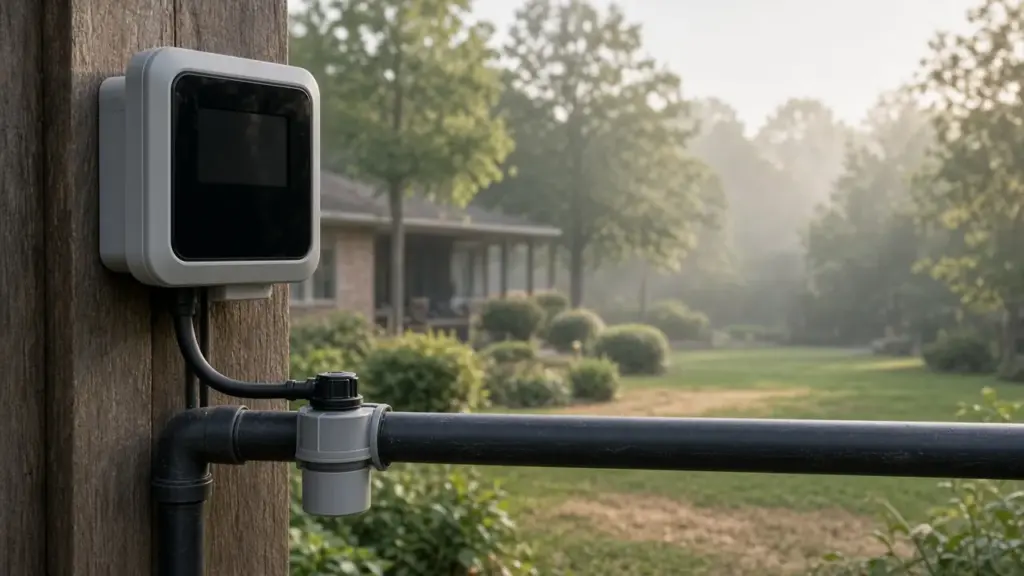
A broken sprinkler head can pour water onto a lawn or down the street for weeks before anyone notices, especially if the system runs early in the morning before the household is awake. Leaks on the mainline can go even longer undetected. Flow sensors, paired with compatible smart controllers, can catch these problems early by measuring how much water the system uses and flagging anything unusual.
This guide explains how flow monitoring works, what it can and cannot catch, and what to consider before adding it.
What a Flow Sensor Does
A flow sensor is a device installed in the irrigation mainline, usually after the backflow preventer and before the zone valves. It measures how much water passes through the pipe. The controller reads the sensor and compares the flow with what it expects for each zone.
When a zone uses much more water than normal, the controller can flag high flow, which often means a broken head, a cracked pipe, or a popped-off fitting. When water flows while no zone is running, the controller can flag unscheduled flow, which may indicate a leaking valve or mainline leak. When a zone uses much less than normal, the controller may flag low flow, which can point to a clogged filter, a valve that did not open, or low supply pressure.
Learning Normal Flow
Most systems with flow monitoring learn what each zone normally uses. After installation, the controller runs each zone and records its typical flow. It then sets thresholds above and below that baseline. If flow falls outside the thresholds, the controller alerts you and, depending on the model and settings, can shut off the zone.
A learning cycle should be run when the system is working properly. If a broken head is present during learning, the controller will treat that high flow as normal.
What Flow Monitoring Can Catch
- Broken heads that gush water
- Cracked lateral pipes leaking during a zone’s run
- Popped-off drip fittings
- Mainline leaks when no zones run, if the system monitors for unscheduled flow
- Stuck valves passing water when they should be closed
- Clogged filters or valves that fail to open, via low flow
What It May Miss
- Small leaks that stay within normal flow variation
- Leaks upstream of the sensor, such as at the backflow preventer
- Coverage problems, such as misaligned heads, that do not change flow
- Very small drip zones where changes are tiny
Flow monitoring is a useful tool, but it does not replace walking the system periodically. Our guide to using your water meter to test for irrigation leaks explains a simple manual check.
Master Valves
Many flow monitoring setups pair the flow sensor with a master valve, a valve on the mainline that opens only when a zone is scheduled to run. If a mainline leak develops, the master valve keeps the mainline depressurized between cycles, limiting water loss. When the controller detects high flow, it can close the master valve.
Controller Compatibility
Not every controller supports flow sensors. Some smart controllers support them natively, while others require a specific brand of sensor or an add-on module. Check compatibility before buying. Our guides to Rachio smart controller setup, Rain Bird ESP-TM2 setup, and Hunter Pro-C and X2 troubleshooting cover popular models.
Installation Considerations
- Location: The sensor goes in the mainline, typically downstream of the backflow preventer and upstream of all zone valves. It should be installed in a straight run of pipe as directed by the manufacturer.
- Pipe size: Sensors are sized to the pipe and expected flow range.
- Wiring: The sensor connects to the controller’s sensor terminals or to a wireless module.
- Valve box: Sensors are typically installed in a valve box for access.
Installation involves cutting into the mainline, so it is a good project to combine with other repairs or a controller upgrade.
Alerts and Response
Smart controllers can send alerts to your phone. When an alert arrives:
- Check which zone triggered it.
- Run that zone and walk it.
- Look for broken heads, geysers, and wet areas.
- If the alert indicates unscheduled flow, close the irrigation isolation valve and check valves and the mainline.
Respond promptly. A broken head during a long run time can waste a lot of water.
Dallas Watering Rules and Smart Controllers
Smart controllers should still be set to follow Dallas rules: automatic sprinklers limited to your two assigned days, and no sprinkler watering between 10 a.m. and 6 p.m. year-round. Automatic systems also require rain and freeze sensors. Many smart controllers use weather data, but Dallas rules require a sensor; check that your setup complies. Our guide to a controller that waters on the wrong days helps keep the schedule right.
Is Flow Monitoring Worth It?
Flow monitoring tends to make the most sense when:
- The system is large, with many zones
- The household is often away or asleep during watering
- The system has a history of broken heads from traffic or mowing
- You are already upgrading the controller or repairing the mainline
- You want to catch mainline leaks quickly
For a small system you check regularly, periodic meter tests and walk-throughs may be enough.
Maintaining a Flow Sensor
- Relearn flow after repairs or changes to zones
- Keep the sensor’s valve box clear
- Check wiring connections
- Watch for false alerts, which may indicate thresholds set too tightly
Pairing Flow Data With Other Checks
Flow data is most useful when combined with regular observation. Review the controller’s flow history occasionally. A zone whose flow gradually creeps upward may have a slow developing problem, such as a worn nozzle or a small crack. A zone with steadily falling flow may have a clogging filter. Combined with seasonal walk-throughs, flow data helps you catch trends before they become failures.
Setting Sensible Thresholds
Most controllers let you adjust how far above or below normal flow must go before an alert. Thresholds set too tight produce false alarms from normal variation in water pressure, which can vary through the day across a utility system. Thresholds set too loose miss smaller problems. Start with the manufacturer’s recommended settings, watch alerts for a few weeks, and adjust. Relearn baselines after any repair that changes a zone, such as new nozzles or added heads.
Drip Zones and Flow Monitoring
Drip zones use far less water than spray zones, so changes in flow are small in absolute terms. A single popped-off emitter may not trigger an alert, but a disconnected supply line usually will. Some controllers allow separate thresholds for low-flow zones. Pair flow monitoring on drip with periodic visual checks of beds and emitters.
Combining With a Leak-Aware Routine
Flow monitoring works best as part of a routine: a seasonal walk-through of each zone, an occasional meter check with everything off, and prompt attention to alerts. Our leak detection and pipe repair guide describes how leaks are located once a sensor or meter test flags one.
Frequently Asked Questions
What does an irrigation flow sensor do?
It measures water flowing through the irrigation mainline so a compatible controller can detect high, low, or unscheduled flow.
Can a flow sensor detect broken sprinkler heads?
Yes. A broken head typically increases flow on its zone, which can trigger an alert.
Do all smart controllers support flow sensors?
No. Check compatibility with your controller before buying a sensor.
Where is a flow sensor installed?
In the mainline, typically after the backflow preventer and before the zone valves.
Get Help Adding Flow Monitoring
We upgrade controllers, install flow sensors, and repair the leaks they find. See our sprinkler repair service, or contact us to schedule.
Request Service or call 214-227-7444
We serve homes throughout Dallas and nearby North Texas communities.