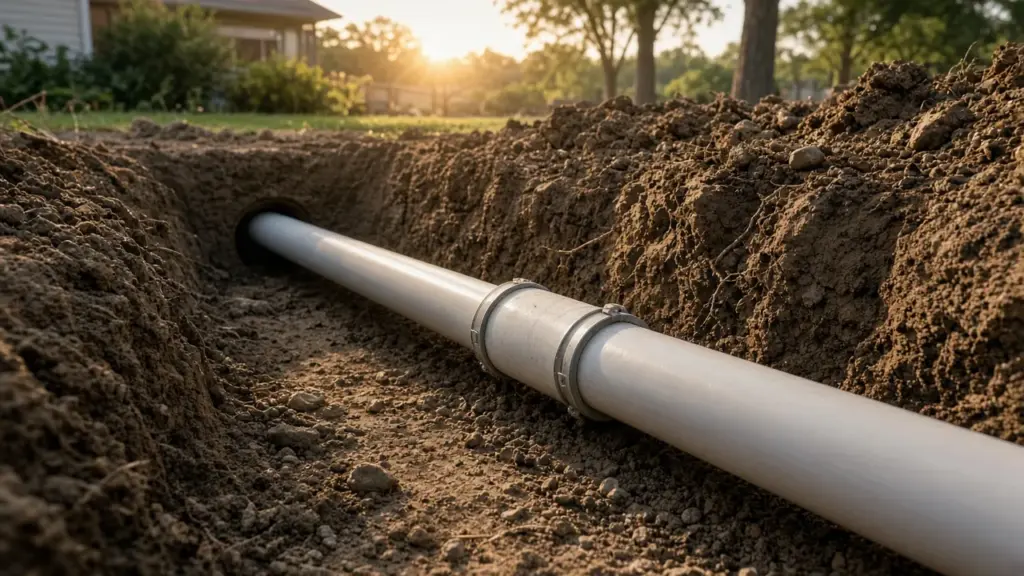
When a PVC sprinkler pipe cracks, there are two common ways to fix it: a standard glued repair using couplings and solvent cement, or a slip fix, also called a telescoping repair coupling. Both can produce a lasting repair when done correctly. Each has situations where it works best.
This guide explains how each method works, their pros and cons, and tips for repairing pipe in Dallas clay.
Finding the Damage First
Before choosing a repair method, expose the damaged pipe. Dig carefully around the leak area until you have clean, undamaged pipe on both sides of the crack. In Dallas clay, that may mean a wider hole than expected, since clay sticks to tools and pipe. Our guides to signs of a hidden sprinkler leak in clay soil and a soggy spot that never dries help locate leaks.
Turn off the controller, and for a mainline repair, close the irrigation shutoff.
The Standard Glued Repair
A standard glued repair uses regular PVC couplings and a short section of new pipe:
- Cut out the damaged section with a PVC cutter or saw.
- Clean and deburr the pipe ends.
- Dry fit the new section and couplings.
- Apply primer where required by local practice or the cement manufacturer, then solvent cement.
- Assemble quickly and hold joints briefly.
- Allow proper cure time before pressurizing.
The Challenge: Pipe Movement
Standard couplings require sliding a coupling fully onto each pipe end. With pipe held in place by soil, there is often little room to flex the pipe. Installers sometimes need to dig a longer trench to bend the pipe enough to fit couplings, or use a slip coupling (a coupling without an internal stop) that can slide completely onto one pipe and then back over the joint.
Pros
- Inexpensive parts
- Strong, permanent joints when done correctly
- Familiar method
Cons
- Needs enough room to flex pipe or use slip couplings
- Requires clean, dry pipe for good solvent welds
- Cure time before pressurizing
- Wet clay and mud make clean joints difficult
The Slip Fix (Telescoping Coupling)
A slip fix is a telescoping repair coupling. It consists of an outer barrel and an inner section that slides in and out. It can be collapsed to fit into a gap, then extended to span the cut.
- Cut out the damaged section.
- Clean and deburr the pipe ends.
- Collapse the slip fix, place it in the gap, and extend it over both pipe ends.
- Glue the ends onto the pipe according to the manufacturer’s directions.
- Allow cure time before pressurizing.
Some slip fix products use internal seals on the sliding section and are glued only at the ends.
Pros
- Repairs longer gaps without flexing pipe
- Faster in tight spaces
- Good for repairs under or near hardscape
Cons
- Costs more than standard couplings
- Must be sized correctly for the pipe
- Depends on internal seals, which must be kept clean during installation
- Must be installed straight
Which Should You Use?
- Short crack with room to flex pipe: a standard glued repair works well.
- Tight space, rigid pipe, or long gap: a slip fix saves time.
- Near pavement or foundation: slip fixes can reduce digging.
- Mainlines: either can work, but mainline repairs should be done carefully because the mainline is always pressurized. Our guide to mainline vs. lateral line breaks explains why.
Tips for Repairs in Dallas Clay
- Keep joints clean. Mud on a joint can cause a failed solvent weld. Wrap pipe ends in a clean rag or plastic bag while working.
- Pump or bail water from the hole so joints stay dry.
- Support pipe during cure. Do not let pipe shift or bend while cement sets.
- Backfill carefully in layers, removing rocks and clods. Poor backfill can stress the repair as clay shrinks and swells.
Our guide to why sprinkler pipes crack when clay shrinks and swells explains how soil movement affects repairs.
Repairing Poly Pipe
Many systems use polyethylene pipe for some lines. Poly is repaired with barbed insert fittings and clamps rather than glued couplings. Our guide to PVC vs. poly pipe in older Dallas systems explains the difference.
Common Mistakes
- Not cutting back to clean, round pipe. Cracked or oval pipe will not seal.
- Skipping deburring. Burrs can scrape cement off during assembly.
- Using the wrong cement for the pipe type.
- Pressurizing too soon. Follow cure times.
- Dirt in the pipe. Flush lines after repair.
- Twisting a slip fix so seals are damaged.
Testing the Repair
After cure time, turn water on slowly and run the zone. Leave the hole open and watch the repair under pressure for leaks. Check again after a watering cycle before backfilling completely if practical.
Repairs Near Fittings
Cracks often occur at or next to fittings such as tees and elbows. If the damage reaches the fitting, cut out the fitting as well and replace it, using short pieces of pipe and couplings or slip fixes to connect to the existing line. Trying to glue a new coupling onto a cracked fitting rarely holds. When a lateral tee feeds a sprinkler head riser, it is a good time to replace a rigid riser with a swing joint, which better tolerates soil movement.
Repairs Under Sidewalks and Driveways
When a break occurs under pavement, the repair often happens at the edge, with the damaged section bypassed or replaced by pulling new pipe through a sleeve. Slip fixes are useful here because they allow repairs in cramped holes next to concrete. Our guide to repairing sprinkler pipe under sidewalks and driveways covers those situations in more detail.
Parts to Keep on Hand
If you handle minor repairs yourself, a small kit saves trips to the store:
- A PVC cutter sized for your pipe
- A few couplings and slip couplings in common sizes
- A slip fix in your most common pipe size
- Primer and solvent cement appropriate for your pipe
- Clean rags
- A bucket or small pump for bailing water from the hole
Check the dates on cement cans; old cement that has thickened will not make good joints.
When to Call for Help
Repairs on the mainline, near the backflow preventer, under large slabs, or close to tree roots and utilities can be more involved. If a break keeps recurring in the same spot, the underlying cause, such as tree roots or poor backfill, may need attention. Our leak detection and pipe repair guide explains how technicians locate and repair leaks.
Frequently Asked Questions
Is a slip fix as good as a glued coupling?
When installed correctly, both can make lasting repairs. Slip fixes are especially useful in tight spaces or for longer gaps.
How long should PVC cement cure before turning water on?
It depends on the product, pipe size, and temperature. Follow the cement manufacturer’s directions.
Can I repair sprinkler pipe in wet clay?
Yes, but keep joints clean and dry, bail water from the hole, and backfill carefully.
Do I need primer for sprinkler pipe repairs?
Follow the cement manufacturer’s directions and local requirements. Many PVC joints use primer before solvent cement.
Get Help With Pipe Repairs
We find and repair cracked sprinkler pipe in Dallas clay. See our sprinkler repair service, or contact us to schedule.
Request Service or call 214-227-7444
We serve homes throughout Dallas and nearby North Texas communities.