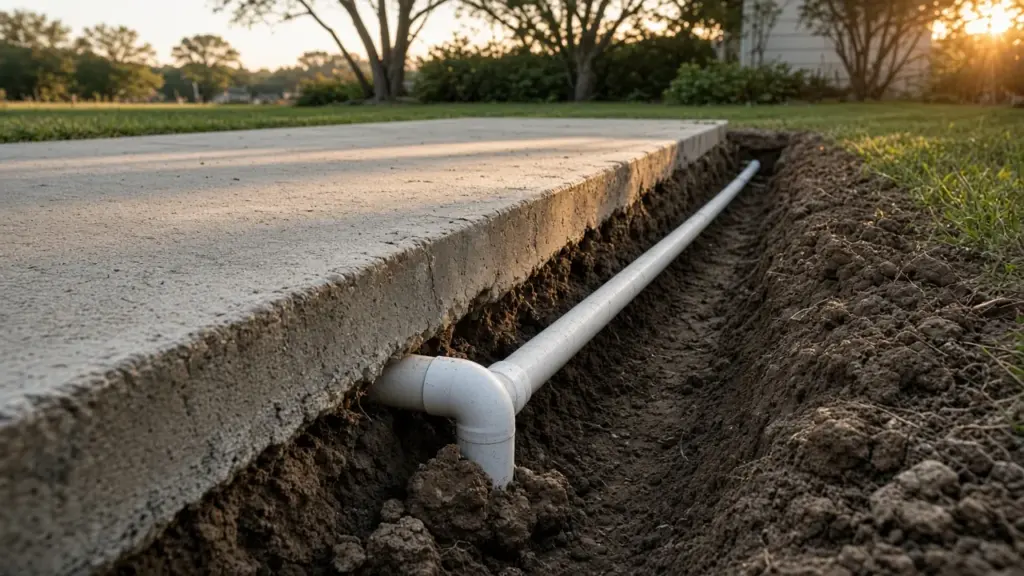
Most sprinkler repairs happen in the lawn, where digging is easy to hide. But sprinkler pipe often crosses under sidewalks, driveways, and patios to reach parkway strips and side yards. When a leak develops under concrete, the repair is more complicated. Nobody wants to break a driveway to fix a small pipe.
This guide explains how leaks under concrete are found, the options for repair, and how to prevent future problems.
Why Pipe Under Concrete Fails
- Clay movement: Dallas clay shrinks and swells, and concrete slabs move with it. Pipe under the slab edge takes stress.
- Settling: Soil under concrete can settle, leaving pipe unsupported.
- Heavy loads: Vehicles on driveways put weight on the soil beneath.
- Roots: Tree roots often grow under sidewalks and driveways and can crush pipe.
- Age: Older pipe becomes brittle.
Our article on why black clay makes sprinkler repair harder explains how clay affects pipe.
Signs of a Leak Under Concrete
- Water seeping from cracks or joints in the concrete
- A wet or soggy strip along one edge of a sidewalk or driveway
- Weak pressure on a zone that crosses concrete
- Soil washing out from under the edge of the slab
- A wet spot that appears when a particular zone runs
If the leak is on the mainline, water may flow constantly, even when zones are off. Our article on mainline versus lateral line breaks explains the difference.
Step 1: Confirm the Leak Location
Before any digging, confirm that the leak is under the concrete and not nearby. Run each zone and watch where water appears. Check the water meter with everything off to see whether the mainline is leaking. A technician may use pressure testing to isolate the leaking section.
Our leak detection and pipe repair guide walks through the process.
Step 2: Identify the Pipe Route
Find where the pipe enters and exits the concrete. Heads or valves on each side show where the pipe likely runs. Digging at both edges of the slab exposes the pipe and confirms the route.
Repair Options
Option 1: Reroute around the concrete
Often the simplest solution is to abandon the pipe under the concrete and route new pipe around it, for example around the end of a sidewalk. This avoids breaking concrete but may require a longer run.
Option 2: Bore under the concrete
A new pipe can be pushed or bored under the slab without breaking it. Techniques vary, from water jetting to mechanical boring tools, depending on the distance and soil. In heavy clay, boring takes effort but is often possible for sidewalks and some driveways.
Option 3: Use an existing sleeve
Some installations include a sleeve, a larger pipe under the concrete that carries the irrigation pipe. If a sleeve exists, the old pipe can sometimes be pulled out and new pipe pulled through.
Option 4: Break and replace a section
When other options are not practical, a section of concrete may need to be cut and removed to reach the pipe, then replaced. This is a last resort.
Option 5: Cap the line
If the pipe under the concrete served only a small area, such as a few parkway heads, capping it and serving that area another way, or converting to a different approach, may make sense.
Choosing the Best Option
A technician considers:
- Whether the pipe is a mainline or lateral
- How long the crossing is
- Soil conditions
- Whether a sleeve exists
- The cost and appearance of each option
Wires Under Concrete
Valve wires often cross concrete alongside pipe. If a wire is damaged under concrete, the same options apply: reroute, bore, or use a sleeve. A wire tracer helps locate breaks.
Preventing Future Problems
- Install sleeves when new concrete is poured, even if no pipe is needed yet
- Keep heads off slab edges where vehicle tires and mowers can hit them
- Repair leaks quickly so water does not undermine concrete
- Watch trees near sidewalks and driveways
Our guide to adding irrigation after a landscape redesign covers planning sleeves during hardscape projects.
Why Speed Matters
A leak under concrete can wash soil out from beneath the slab, leading to settling or cracks. In clay, excess water also causes swelling that can lift the slab edge. The longer a leak runs, the more damage it can do. If you suspect a leak under concrete, shut off the affected zone or the irrigation supply and schedule a repair.
Parkway Strips
In many Dallas neighborhoods, a parkway strip between the sidewalk and the street is watered by heads fed from pipe crossing under the sidewalk. These crossings are among the most common under-concrete repairs. Converting parkway heads to strip nozzles or rotary nozzles on a new, rerouted line can solve both the leak and overspray problems.
What to Expect During the Repair
An under-concrete repair usually takes longer than a lawn repair. Expect digging on both sides of the slab, some trial and error to confirm the route, and possibly specialized tools for boring. The technician should explain the options before starting and let you choose based on cost, disruption, and appearance. Once the new pipe is in place, the zone is flushed and tested before the holes are backfilled and turf is restored.
Cost Considerations
Costs vary widely depending on the option chosen, the length of the crossing, and soil conditions. We do not publish flat prices because each situation is different, but rerouting or boring is usually less disruptive than breaking concrete. A clear diagnosis up front avoids unnecessary work.
Temporary Measures While You Wait
If you discover a leak under concrete and cannot get it repaired right away, a few steps limit damage:
- Turn off the affected zone at the controller so it does not run on its scheduled days.
- If the leak is on the mainline, close the irrigation isolation valve near the backflow preventer so the line is not under constant pressure.
- Hand water areas served by that zone if needed during hot weather. Hand watering is allowed any day in Dallas.
- Keep vehicles off a driveway edge that appears to be undermined.
- Note what you see, including where water appears and when, to help the technician.
These measures buy time without letting water keep flowing under the slab.
Frequently Asked Questions
Can a sprinkler pipe under a driveway be fixed without breaking concrete?
Often, yes. Rerouting around the slab, boring under it, or pulling new pipe through an existing sleeve are common options.
How do I know if a leak is under my sidewalk?
Look for water seeping from concrete joints, a wet strip along one edge, weak pressure on a zone that crosses the sidewalk, or soil washing out from under the slab.
What is an irrigation sleeve?
A larger pipe installed under concrete so irrigation pipe and wire can pass through without breaking the slab.
Is a leak under concrete urgent?
Yes. Water can undermine the slab and cause settling or cracking.
Get Help With a Leak Under Concrete
We locate and repair sprinkler leaks under sidewalks and driveways, often without breaking concrete. See our sprinkler repair service, or contact us to schedule.
Request Service or call 214-227-7444
We serve homes throughout Dallas and nearby North Texas communities.