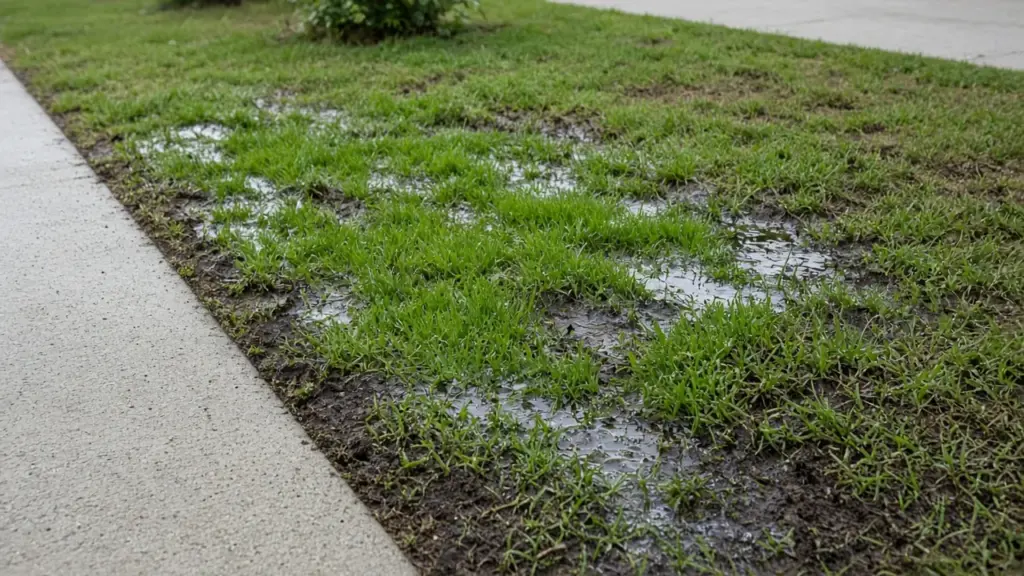
Irrigation leaks behave differently in heavy clay than in sandy soil. In sand, water drains down and away. In the dense clay common across Dallas, water spreads sideways along the pipe trench, surfaces somewhere unexpected, or simply stays hidden while the soil slowly saturates. That makes leaks easy to miss and easy to misdiagnose.
This guide covers the signs of a hidden irrigation leak in clay soil, why clay makes leaks harder to find, and simple checks to confirm a leak before anyone starts digging.
Why Clay Hides Leaks
Clay particles are tiny and tightly packed. Water moves through clay slowly, and it tends to follow the path of least resistance. In an irrigated yard, that path is often the loose backfill in the trench where the pipe was laid. As a result:
- Water can travel several feet along the pipe before surfacing.
- The wettest spot may not be directly above the break.
- A slow leak may never surface; it just keeps the soil saturated.
- During dry weather, a leak can hide in cracks as clay shrinks.
Our Dallas clay soil guide explains how clay affects irrigation in general.
Warning Signs to Watch For
A spot that never dries
The most common sign is a patch that stays soft or muddy between watering days. If you water twice a week and one area is still squishy days later, look closer.
Extra-green or fast-growing grass
A strip of grass that grows faster or stays greener than the rest of the lawn, especially in a line, often traces a leaking pipe underneath.
Weak heads on one zone
If heads at the end of a zone barely pop up or spray short while the zone runs, water may be escaping somewhere along the lateral line. Compare it with other zones.
Water in the gutter when nothing is running
Water trickling down the curb or across the sidewalk with the system off suggests a mainline leak or a valve that is leaking through.
A soggy valve box
Valve boxes collect water in clay, but a box that refills quickly after being emptied, without rain, often points to a leaking valve or fitting.
Sinking soil or small depressions
Over time, a leak can wash soil away or soften it enough that a small dip forms, often near a head or along a pipe route.
Mushrooms, algae, or moss
Persistent moisture encourages mushrooms and algae in turf and beds. They are not proof of a leak, but they are worth investigating in areas that should dry out.
A higher water bill
A leak on the mainline runs whenever the irrigation supply is on, which is usually all the time. That can show up as a steady increase in your water bill.
Is It a Leak, Overwatering, or Drainage?
These three problems can look alike in clay. A few questions help sort them out:
- Does the spot stay wet with the system off for several days? That points to a leak or a drainage issue rather than overwatering.
- Does it get wet only when one zone runs? That points to a lateral line leak or a broken head on that zone.
- Does it get wet after rain, even with the system off? That points to grading or drainage.
- Is the entire lawn soft? That points to overwatering or run times that are too long.
Simple Checks Before You Dig
The water meter test
- Turn off all water use inside and outside the home.
- Watch the meter’s leak indicator.
- If it moves, close the irrigation shutoff.
- If the indicator stops, the leak is on the irrigation side.
Our leak detection guide walks through this in more detail.
Zone-by-zone observation
Run each zone manually for a few minutes and walk it. Look for bubbling soil, water pooling around a head, or heads that underperform. Note which zone makes the wet spot worse.
The dry-down test
Turn the system off for a few days, if weather allows, and watch the suspect area. If it dries out, the problem is related to watering, either a lateral leak or overwatering. If it stays wet, suspect a mainline leak, a leaking valve, or drainage.
Probe the soil
Push a screwdriver or soil probe into the ground in a line across the wet area. The softest spot is often closer to the actual break than the visible puddle.
Where Leaks Commonly Occur
- At heads and risers, where clay movement cracks rigid fittings. Our sprinkler head repair guide covers swing pipe repairs.
- At tees and elbows on lateral lines.
- At valves and manifolds, often after freezes.
- Near trees, where roots crack or lift pipe.
- Along fences and new beds, where digging damaged lines.
- Under driveways and walks, where repairs are harder.
Why Prompt Repair Matters
A hidden leak wastes water and keeps clay saturated. Saturated clay can lead to soggy turf, fungal disease, mosquitoes in standing water, and uneven soil moisture near foundations. Leaks on the mainline run constantly. Fixing leaks also helps the rest of the zone perform, since water that escapes through a break is water that never reaches the heads.
Leaks That Look Like Other Problems
Some leaks are misread as lawn or controller problems for weeks.
- Brown patches beyond a leak. When water escapes early in a lateral line, heads farther down the zone may not pop up fully, so the lawn at the end of the zone browns. Owners often raise the run time, which only makes the wet spot worse. Our valve repair guide explains how to check a weak zone.
- Fungus in St. Augustine. Constant moisture from a slow leak can encourage fungal problems that look like a turf disease issue first. Our guide to irrigating by grass type covers how St. Augustine reacts to excess water.
- A controller that seems to water too much. If a zone looks like it runs on the wrong days, but the controller program is correct, a valve leaking through may be keeping it wet.
Keeping Leaks From Coming Back
Once a leak is repaired, a few habits help prevent the next one: use flexible swing pipe at heads, mark pipe routes before digging, protect the backflow preventer before freezes, and walk each zone monthly while it runs so small changes get noticed early. Keeping a simple zone map also makes the next leak easier to trace.
Frequently Asked Questions
Why is the wet spot not where the pipe broke?
In clay, water often travels along the loose soil of the pipe trench before surfacing. The break may be several feet away.
Can a leak go unnoticed for months?
Yes. Slow leaks in clay can keep soil saturated without ever creating a visible puddle, especially along a pipe trench.
How do I know if it is the sprinklers or the house plumbing?
Use the meter test. If closing the irrigation shutoff stops the meter’s leak indicator, the leak is on the irrigation side.
Will a leak damage my lawn?
Constant moisture can cause soft, patchy turf and fungal problems, while the rest of the zone may get too little water.
Should I dig to find it myself?
It is best to confirm the zone and narrow the area first. For mainline leaks, repairs near concrete, or unclear locations, a technician can find the break with less digging.
Get a Hidden Leak Found and Fixed
Our team can test your system, pinpoint the leak, and make a clean repair. Learn about our sprinkler repair service, or contact us to schedule a visit.
Request Service or call 214-227-7444
We serve homes throughout Dallas and nearby North Texas communities.