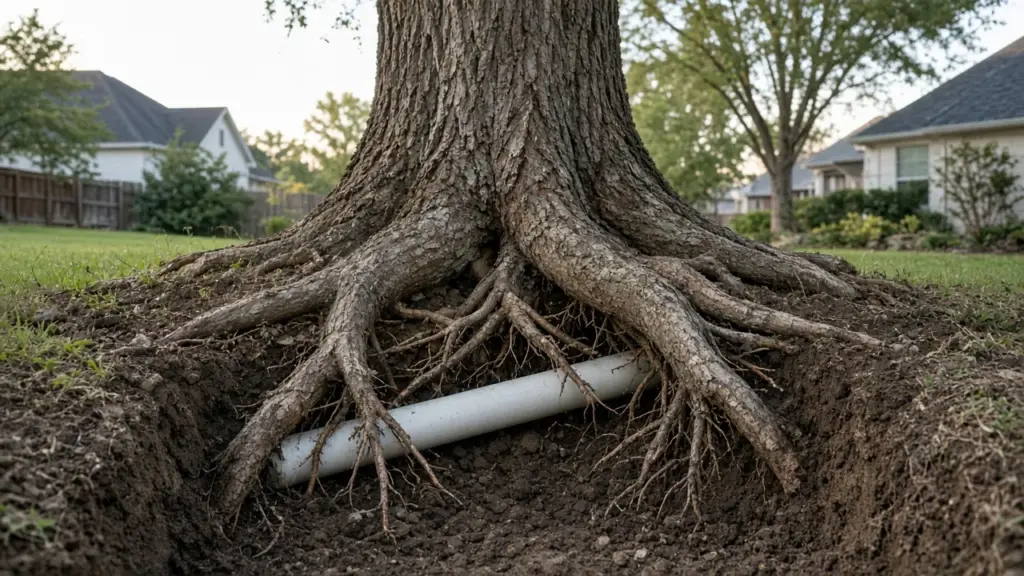
Dallas is known for its mature shade trees: live oaks, cedar elms, pecans, and red oaks that tower over established neighborhoods. Those trees add beauty and value, but their roots share the soil with sprinkler pipe, and over time the two often collide. Root damage is a common cause of recurring leaks, sunken or tilted heads, and zones that lose pressure in older yards.
This guide explains how roots affect sprinkler lines, how to recognize root-related damage, and how to repair it while protecting the tree.
How Roots Damage Sprinkler Systems
Crushing and Cracking
As roots grow in diameter, they push against anything in their path. A root growing next to or beneath PVC pipe can gradually bend and crack it. Fittings, which are stiffer than pipe, are especially vulnerable.
Lifting and Tilting Heads
Roots growing beneath or beside sprinkler heads can lift them above grade or tilt them, causing spray to go in the wrong direction or making heads targets for mowers.
Entering Cracks
Roots seek water. If a pipe develops a small crack or a fitting leaks, roots can grow toward the moisture and into the opening, enlarging the crack and sometimes clogging the pipe.
Drying Soil Unevenly
Large trees pull significant water from the soil. The soil around their roots dries and shrinks faster than soil in open lawn. In Dallas clay, this uneven shrinkage stresses pipe that runs between the two areas. Our guide to why sprinkler pipes crack when clay shrinks and swells explains this effect.
Signs of Root Damage
- Recurring leaks in the same area near a tree
- Heads that tilt or rise over time
- Weak pressure on a zone passing near a tree
- Soggy spots near trees that do not dry out
- Heads that stop working because the pipe feeding them is blocked or crushed
Our guides to signs of a hidden sprinkler leak in clay soil and a soggy spot that never dries can help confirm a leak.
Repairing Pipe Near Roots
Dig Carefully
Hand dig near trees rather than using power equipment. Expose roots gently and avoid tearing them. Air excavation tools, used by some professionals, can expose roots without damage.
Protect Major Roots
Cutting large roots can harm a tree’s health and stability. As a general guideline, avoid cutting roots larger than a couple of inches in diameter without consulting an arborist, particularly close to the trunk. Many repair approaches can work around roots instead.
Repair Options
- Replace the damaged section and reroute the pipe around the root, if there is room.
- Tunnel under large roots rather than cutting them.
- Use flexible pipe in the section near the tree, which tolerates root pressure and soil movement better than rigid PVC.
- Relocate the line farther from the trunk when repairs keep recurring.
Our guides to slip fix couplings vs. glued repairs and PVC vs. poly pipe cover repair methods and materials.
Rerouting Around Trees
When a line near a tree fails repeatedly, rerouting may be the lasting fix. A new route should avoid the area closest to the trunk where roots are largest. Keep in mind that tree roots often extend well beyond the canopy, so completely avoiding roots may not be possible. The goal is to avoid the largest roots and the area of greatest root density.
Heads Near Trees
Heads close to trunks are often lifted or tilted by roots and blocked by the trunk itself. Moving heads away from the trunk, or converting the area around the tree to mulch with drip irrigation, often works better. Grass under dense shade struggles anyway, and a mulched ring benefits the tree.
Watering Trees Properly
Trees need deep, slow watering across their root zone, not just at the trunk. Lawn sprinklers provide some water, but trees benefit from dedicated drip rings or bubblers, especially during drought. Our guide to watering trees with drip rings and bubblers explains setups. Dallas allows drip irrigation on any day, which is helpful for trees in summer heat.
Preventing Root Problems in New Installations
When installing or redesigning irrigation near trees:
- Route mainlines and laterals away from the trunk
- Use flexible pipe and swing joints near trees
- Avoid placing heads right at the trunk
- Consider drip for tree areas
- Plan for future root growth
When to Call an Arborist
If repairs require cutting significant roots, or if a tree shows signs of stress such as dieback, leaf scorch, or leaning, consult a certified arborist. Protecting a mature tree is usually worth more than the convenience of a straight pipe route.
Roots and Clay Soil Together
In Dallas, root damage and clay movement often occur together. Trees dry the soil around them, clay shrinks, and pipes shift. When the soil rewets, it swells. Over years, this cycle combined with root growth stresses pipe. Consistent watering practices help reduce extreme soil moisture swings.
Foundations and Trees
Tree roots near foundations are a separate concern, but consistent soil moisture near the foundation matters in Dallas clay. Dallas allows foundation watering any day and at any time using a hand-held hose, soaker hose, drip irrigation, or bucket.
Common Dallas Trees and Their Roots
Different trees behave differently near irrigation. Many of the large shade trees common in Dallas, such as live oaks, cedar elms, pecans, and red oaks, develop extensive root systems that spread widely near the surface, where most irrigation pipe runs. Fast-growing trees planted close to houses and driveways can quickly reach pipe and heads. Smaller ornamental trees typically cause fewer problems but can still lift nearby heads. When planting new trees, consider where irrigation lines run and give both room to grow.
Clogged Lines From Root Entry
When roots enter a crack, they can form a mat inside the pipe that restricts flow. Heads downstream may lose pressure gradually over months, then stop working entirely. If several heads at the end of a lateral near a tree weaken together, a root-clogged pipe is a possibility. The fix is to expose and replace the affected section, since roots inside the pipe will regrow if simply cleared.
Protecting Trees During Repairs
Repair work can harm trees if done carelessly. Keep heavy equipment off the root zone where possible, since compaction damages roots. Pile excavated soil away from the trunk. Backfill promptly so exposed roots do not dry out, and water the area after the repair. These steps help the tree recover from any disturbance.
Budgeting for Recurring Repairs
A line that breaks near the same tree every year adds up. Track repair dates and costs. When the pattern is clear, rerouting or switching to flexible pipe near the tree is often the better long-term investment. Our leak detection and pipe repair guide covers how technicians find and repair these leaks.
Frequently Asked Questions
Can tree roots break sprinkler pipes?
Yes. Growing roots can crush and crack pipe, lift heads, and enter existing cracks.
Should I cut tree roots to repair a sprinkler line?
Avoid cutting large roots without consulting an arborist. Rerouting, tunneling, or using flexible pipe can often work around roots.
How do I know if roots are causing my sprinkler leaks?
Recurring leaks near a tree, heads lifting or tilting, and weak pressure on zones near trees are common signs.
What pipe is best near trees?
Flexible pipe tolerates root pressure and soil movement better than rigid PVC in areas near trees.
Get Help With Root Damage
We repair and reroute sprinkler lines near trees with care. See our sprinkler repair service, or contact us to schedule.
Request Service or call 214-227-7444
We serve homes throughout Dallas and nearby North Texas communities.