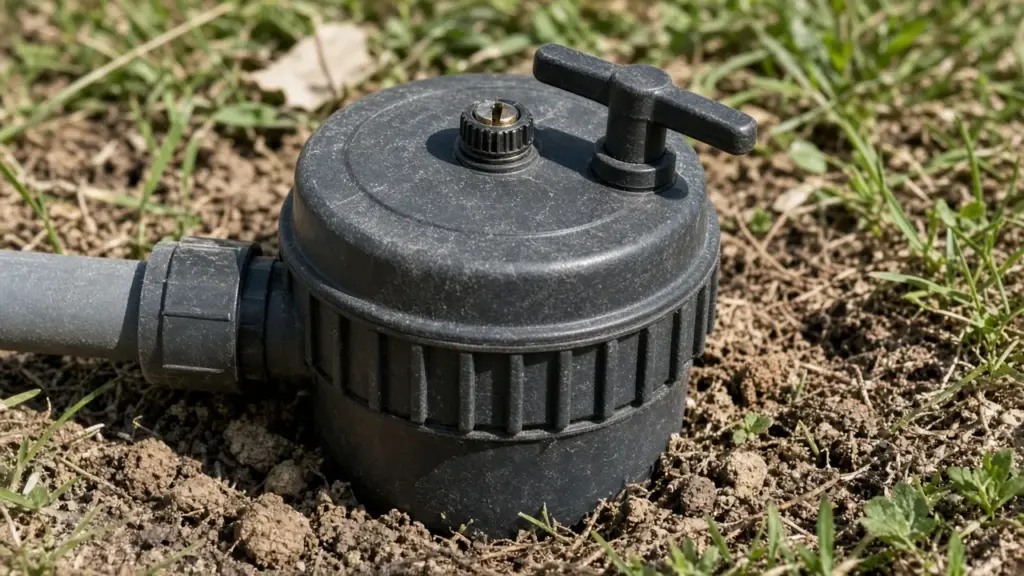
Open a valve box and look at the top of a typical residential sprinkler valve. Besides the solenoid, you will often see a small screw or lever, the manual bleed, and on many valves, a handle or stem on top of the bonnet, the flow control. These small features are useful for testing and troubleshooting, but when they are left in the wrong position, they cause some of the most common irrigation problems: zones that will not shut off, zones with weak pressure, and zones that will not come on at all.
This guide explains what each feature does and how to use them properly.
How a Diaphragm Valve Works
Most residential irrigation valves are diaphragm valves. Water enters the valve and also fills a small chamber above a flexible diaphragm through a tiny port. Pressure above the diaphragm, combined with a spring, holds the valve closed.
When the controller sends power to the solenoid, the solenoid lifts a plunger and opens a passage that releases water from the chamber above the diaphragm. With pressure above the diaphragm released, water pressure below pushes the diaphragm up and the valve opens. When the solenoid closes, the chamber refills and the valve closes.
The Manual Bleed
The manual bleed opens the valve without the controller by releasing water from the chamber above the diaphragm, just as the solenoid does.
Types of Manual Bleed
- External bleed screw: a small screw on the bonnet. Opening it releases water from the chamber into the valve box or outlet, opening the valve.
- Internal bleed: on many valves, turning the solenoid a quarter turn counterclockwise releases water internally, opening the valve without discharging water into the box.
- Bleed lever: some valves use a lever instead of a screw.
When to Use It
- Testing whether a valve opens mechanically when a zone will not run from the controller
- Flushing a zone after repairs
- Running a zone briefly for inspection when the controller is unavailable
If a zone opens with the manual bleed but not from the controller, the problem is likely electrical: the solenoid, wiring, or controller. Our guide to a zone that will not turn on walks through the diagnosis.
Common Mistakes
- Leaving the bleed open. The valve stays open and the zone runs continuously. If a zone will not shut off, check the bleed first.
- Overtightening the bleed screw. It can strip or crack the bonnet.
- Turning the solenoid too far when using the internal bleed, which can unscrew it and release pressure suddenly.
Our guide to a zone that will not turn off covers other causes.
The Flow Control
The flow control is a stem or handle on top of the bonnet that limits how far the diaphragm can open. Turning it clockwise lowers the stem, restricting the diaphragm and reducing flow. Turning it counterclockwise raises it, allowing more flow.
What It Is Used For
- Fine-tuning zone pressure when a zone has more pressure than it needs, such as when heads are misting
- Helping close a valve that is slow to shut or stuck open, by screwing the stem down
- Turning off a single zone at the valve in an emergency on some models
Common Mistakes
- Leaving the flow control turned down after troubleshooting, which causes weak pressure on the zone. If one zone has weak pressure, check its flow control. See our guide to weak pressure on only one zone.
- Turning it fully closed, which can prevent the valve from opening at all.
- Using flow control instead of fixing a pressure problem. If pressure is too high across the system, head-level or system-level regulation is often a better solution than throttling valves.
Not Every Valve Has Both
Many valves have a manual bleed but no flow control. Heavier-duty models more often include flow controls. Check your valve model. Our guides to Rain Bird DV vs. JAR-TOP vs. PGA valves and Hunter PGV troubleshooting describe features on common models.
A Troubleshooting Sequence
Zone will not shut off:
- Close the external bleed screw.
- Tighten the solenoid clockwise, hand tight.
- Turn the flow control down to see if the valve closes.
- If it still runs, clean the valve or replace the diaphragm.
Zone will not turn on:
- Check the controller and rain sensor.
- Open the manual bleed. If the zone runs, the problem is electrical.
- Check that the flow control is open.
- Test the solenoid and wiring.
Zone has weak pressure:
- Check that the flow control is fully open.
- Check for broken heads or leaks.
- Check the valve for debris.
After Using the Bleed or Flow Control
Always return the bleed to closed and the flow control to its intended position after testing. A quick check before closing the valve box lid prevents most problems.
Using the Bleed During a Walk-Through
The manual bleed is handy during seasonal inspections. With a helper at the valve box, you can open each zone in turn and walk the yard without going back and forth to the controller. Use the internal bleed where available so water is not discharged into the box. When finished, close each bleed and then run every zone once from the controller to confirm normal operation. That final controller test catches any valve left partially open.
Water in the Valve Box After Using the Bleed
An external bleed screw releases a small amount of water into the valve box each time it is used. That is normal. But if a box stays full of water long after testing, a bleed screw may not be fully closed, or the valve may be leaking elsewhere. Our guide to flooded valve boxes explains how to find the source.
Labeling for the Next Person
Some homeowners set flow controls deliberately on certain zones to reduce misting. If you do, note the setting, such as the number of turns from fully open, in your system notes. Otherwise, the next person to troubleshoot the zone may open it fully and change the zone’s performance, or assume it was left partially closed by mistake. Our valve repair guide covers other valve features and repairs.
Safety Tip
When turning a solenoid for the internal bleed, turn only a quarter turn. Unscrewing it too far can release it from the bonnet under pressure, spraying water and possibly losing small parts in the valve box.
Frequently Asked Questions
What does the bleed screw on a sprinkler valve do?
It opens the valve manually by releasing water from above the diaphragm, allowing you to run a zone without the controller.
Why won’t my sprinkler zone turn off?
Check that the bleed screw is closed and the solenoid is tight. Debris or a torn diaphragm are other common causes.
What does the flow control on a sprinkler valve do?
It limits how far the valve opens, reducing flow. It can fine-tune pressure or help close a valve.
Can the flow control cause low pressure?
Yes. If it is turned down, the zone will have reduced pressure.
Get Help With Valve Problems
We troubleshoot valves, replace diaphragms and solenoids, and fix zones that will not turn on or off. See our sprinkler repair service, or contact us to schedule.
Request Service or call 214-227-7444
We serve homes throughout Dallas and nearby North Texas communities.