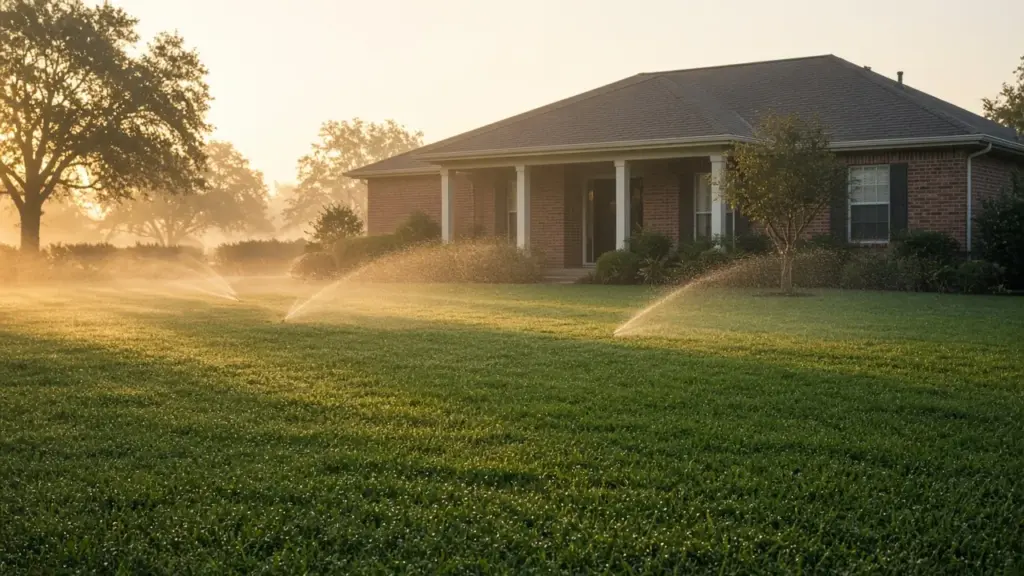
For years, Dallas homeowners only had to think about the daytime watering ban during the warm months. From April through October, sprinklers had to stay off between 10 a.m. and 6 p.m.; the rest of the year, midday watering on your assigned days was allowed. That changed with the City of Dallas Water Conservation Ordinance update on May 13, 2026. The time-of-day restriction now applies all year.
This guide explains what changed, what stayed the same, and the practical adjustments that keep your lawn healthy and your system compliant in fall, winter, and early spring.
What Changed
According to Dallas Water Utilities:
- Before the update: sprinkler and hose-end sprinkler watering was prohibited from 10 a.m. to 6 p.m. only from April 1 through October 31.
- After the May 13, 2026 update: watering with automatic irrigation systems or hose-end sprinklers is prohibited between 10 a.m. and 6 p.m. on any day of the year, including your assigned watering days.
What Stayed the Same
- Twice-weekly maximum: automatic irrigation is still limited to two days per week based on your address.
- Day assignments: addresses ending in 0, 2, 4, 6, or 8 (and properties without a number) water Sundays and Thursdays; addresses ending in 1, 3, 5, 7, or 9 water Wednesdays and Saturdays.
- Rain and freeze sensors: still required on automatic systems.
- Hand watering, soaker hoses, and drip: still allowed on any day.
- Foundation watering: the ordinance clarifies foundations may be watered any day, at any time, with a hand-held hose, soaker hose, drip, or bucket.
Our Dallas watering schedule guide covers all the current rules.
Why It Matters in Cooler Months
Some homeowners used to shift watering to midday in winter to avoid freezing temperatures in the early morning. That is no longer allowed with sprinklers. The good news is that warm-season lawns need very little water in winter, and there are better ways to avoid freeze problems than watering at noon.
Winter
Dormant St. Augustine, Bermuda, and zoysia use much less water than they do in summer. Many Dallas lawns need only occasional watering during long dry stretches. When you do water:
- Choose early evening after 6 p.m. or early morning before 10 a.m. on milder days.
- Skip watering entirely when a freeze is forecast. Your freeze sensor should handle this automatically, but keep an eye on forecasts.
- Consider hand watering or a soaker hose for small dry areas, which is allowed any time.
Early spring
As lawns green up, water needs rise gradually. Mornings can still be cold. Program start times so watering happens after the coldest part of the night has passed but still finishes before 10 a.m. On cold mornings, the freeze sensor will prevent watering.
Fall
Fall lawns still need water, especially during warm, dry spells, but less than in summer. Reduce run times with seasonal adjust and keep the morning schedule.
Adjusting Your Controller
The main change is making sure no program runs past 10 a.m. or starts before 6 p.m. in any season.
- Review every program. Look for winter programs or start times that were set for midday.
- Check total run time. Add up all zones plus soak time and make sure the program ends before 10 a.m.
- Lower seasonal adjust in cooler months so programs finish sooner.
- Update smart controller restrictions. Many smart controllers let you set blocked hours. Block 10 a.m. to 6 p.m. every day.
- Confirm the freeze sensor is connected and active.
Our step-by-step controller programming guide walks through each setting, and our controller repair guide covers smart models.
Morning or Evening?
With midday watering off the table year-round, you have two windows: before 10 a.m. and after 6 p.m.
Morning is generally better for turf. Wind is often lower, evaporation is lower, and grass dries during the day, which reduces fungal problems. In winter, mornings can be near freezing, so start times may need to be later in the morning.
Evening works too, but turf stays wet overnight. In warm months that can encourage brown patch in St. Augustine. In cold months, evening water can freeze on walks and driveways. If you water in the evening, start soon after 6 p.m. rather than late at night.
What About Large Systems?
Large properties with many zones sometimes struggle to finish before 10 a.m. Options include:
- Split zones across both watering days so each day runs a shorter program.
- Upgrade to lower-rate, more efficient heads that work well with cycle and soak.
- Use evening windows for some zones.
- Move beds to drip, which is allowed on any day.
- Ask about variances if you manage a large property; the ordinance allows variances in certain circumstances.
Efficiency Helps You Stay Within the Window
The less water you waste, the shorter your programs can be. Fixing broken heads, adjusting overspray, and repairing leaks all shorten the time you need. Our sprinkler head repair guide is a good place to start, and our clay soil guide explains cycle and soak for heavy soils.
A Sample Seasonal Approach
Every yard is different, but many Dallas homeowners find a pattern like this works within the year-round rules:
- Summer: early morning start on both assigned days, cycle and soak on lawn zones, seasonal adjust at its highest setting, finished well before 10 a.m.
- Fall: same days and start time, seasonal adjust reduced step by step as temperatures fall, skip cycles after good rains.
- Winter: controller set to a low seasonal adjust or off during dormancy, freeze sensor active, occasional deep watering on a mild assigned day during long dry stretches, trees and beds hand watered as needed.
- Spring: a slightly later morning start to avoid the coldest hours, seasonal adjust raised gradually as the lawn greens up, a full zone check before summer.
Write your plan down and tape it inside the controller door. It makes seasonal changes quick and helps anyone else who manages the system.
Rain and Freeze Sensors Matter More Now
Because midday watering is no longer an option in winter, early morning and evening cycles are more likely to fall near freezing temperatures. A working freeze sensor keeps the system from spraying water onto cold sidewalks and streets, where it can form ice. If your sensor is old, damaged, or disconnected, have it checked before winter.
Frequently Asked Questions
When did the year-round time-of-day rule take effect?
The City of Dallas Water Conservation Ordinance was updated on May 13, 2026, making the 10 a.m. to 6 p.m. restriction apply year-round.
Can I water at noon in January?
Not with sprinklers or an automatic system. Hand watering, soaker hoses, and drip are allowed at any time.
Does this apply to drip irrigation?
The time-of-day restriction applies to automatic irrigation systems and hose-end sprinklers. Drip irrigation, soaker hoses, and hand watering are allowed any day; check current city guidance for details.
What if my system cannot finish before 10 a.m.?
Split the program across both watering days, use evening windows for some zones, improve efficiency, or move beds to drip.
Do I need a new controller?
Usually not. Most controllers can be programmed to comply. A smart controller can make it easier by blocking restricted hours automatically.
Get Help Adjusting for the New Rules
We can reprogram your controller, shorten run times with efficiency upgrades, and confirm your sensor works. Learn about our sprinkler repair service, or contact us to schedule.
Request Service or call 214-227-7444
We serve homes throughout Dallas and nearby North Texas communities.