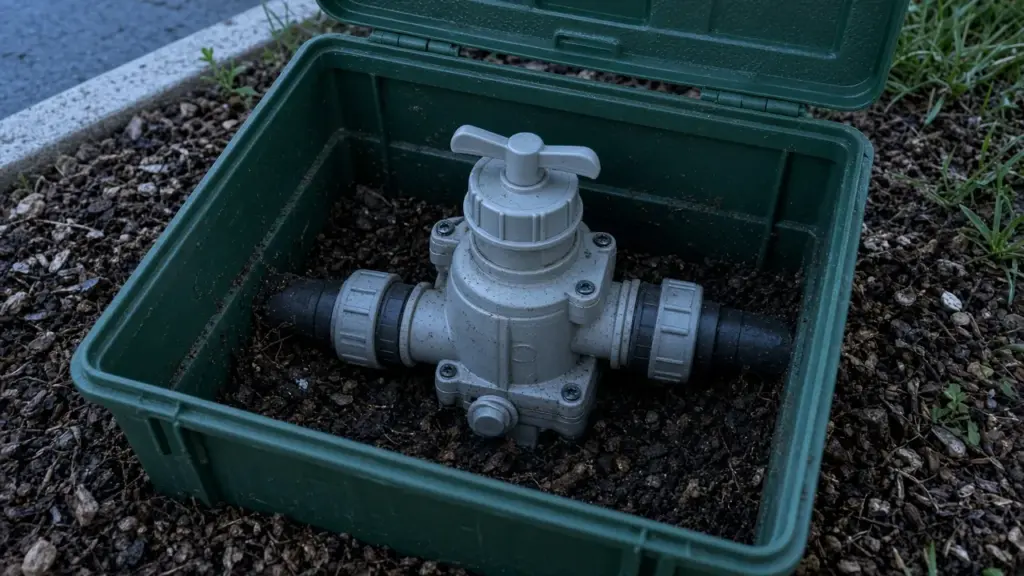
The Hunter PGV is a widely used residential irrigation valve, and you will find it in many Dallas valve boxes. Like other diaphragm valves, it is reliable, but it can develop problems over time: zones that will not turn on, zones that will not shut off, weeping heads, or weak flow.
This guide walks through common PGV problems and how to troubleshoot them. Always consult Hunter’s documentation for your specific model, since PGV valves come in several versions.
PGV Basics
The PGV is a solenoid-operated diaphragm valve. Key features on many models include:
- Bonnet: held on by screws on standard models. Hunter also offers a PGV version with a jar-top style bonnet.
- Solenoid: threads into the bonnet and opens the valve when the controller sends power.
- Manual bleed: an external bleed screw, and an internal bleed achieved by turning the solenoid slightly.
- Flow control: available on some models, allowing flow adjustment and helping to close the valve manually.
Available in globe and angle configurations, with slip or threaded connections.
Problem 1: Zone Will Not Turn On
Check the Controller
Confirm the controller is powered, the station is programmed, and the rain sensor is not suspending watering. Try a manual run of the station.
Try the Manual Bleed
Open the external bleed screw or turn the solenoid a quarter turn counterclockwise. If the zone comes on, the valve is mechanically working, and the problem is electrical: the solenoid, wiring, or controller.
Check the Solenoid
With a multimeter, measure resistance across the solenoid leads. Compare the reading with the manufacturer’s specifications. An open or shorted reading means the solenoid needs replacement. Our guide to replacing a sprinkler solenoid without replacing the valve explains how.
Check the Wiring
Inspect splices in the valve box for corrosion or loose connections. Check the common wire, which is shared by all valves. If several zones fail, the common wire may be damaged. Our step-by-step diagnosis for a zone that will not turn on covers electrical troubleshooting.
Check Flow Control
If the flow control is turned all the way down, the valve cannot open. Turn it counterclockwise to open.
Problem 2: Zone Will Not Shut Off
- Manual bleed open: make sure the bleed screw is closed and the solenoid is fully tightened.
- Debris under the diaphragm: sand or grit can hold the diaphragm open.
- Torn diaphragm: a tear allows water to pass.
- Stuck solenoid plunger: debris can keep the plunger from seating.
- Controller issue: confirm the controller is not sending power by disconnecting the station wire.
Our guide to a zone that will not turn off explains these causes in detail.
Problem 3: Heads Weep After Shutoff
If the lowest heads keep seeping after the zone shuts off:
- Low-head drainage: water drains from the pipe through the lowest head. Check valves in heads solve this.
- Valve not sealing fully: debris or a worn diaphragm lets a small amount of water pass.
If seepage continues for hours, suspect the valve.
Problem 4: Weak Flow
- Check that the flow control is open
- Look for debris restricting the valve
- Check for a partially clogged solenoid port
- Confirm the problem is not elsewhere, such as broken heads or a lateral leak
Our guide to weak pressure on only one zone covers other causes.
Problem 5: Leaking at the Bonnet
A leak at the bonnet can come from loose screws, a damaged bonnet, or a diaphragm seal that is not seated. Tighten screws evenly without overtightening. Replace a cracked bonnet.
Cleaning a PGV Valve
- Shut off water to the irrigation system.
- Relieve pressure with the bleed screw.
- Clear dirt from the valve box.
- Remove bonnet screws and lift the bonnet.
- Remove the spring and diaphragm, noting orientation.
- Rinse the diaphragm and inspect for damage.
- Clean the valve body and ports gently.
- Reassemble with the diaphragm and spring in the correct position.
- Tighten screws evenly.
- Restore water slowly and test.
Replacing the Diaphragm
Replacement diaphragm assemblies are available for PGV valves. Match the part to your valve model and size.
When to Replace the Valve
- Cracked body
- Stripped bonnet screw holes
- Repeated failures after repair
- Parts unavailable for a very old model
Flooded Valve Boxes
PGV valves are often installed in boxes that collect water, making repairs messy and corroding wiring. Our guide to flooded valve boxes explains solutions.
Identifying Your PGV Model
Hunter has produced the PGV in several versions over the years, and repair parts vary. Look on the bonnet and body for markings indicating the model and size, such as the pipe size and whether the valve is globe or angle. Note whether the bonnet uses screws or a jar-top style, and whether there is a flow control handle on top. A clear photo of the valve, including markings, makes ordering the right diaphragm or solenoid much easier.
Tools for PGV Repairs
A small kit covers most PGV troubleshooting:
- A screwdriver for bonnet screws and the bleed screw
- A multimeter for solenoid and wiring checks
- Waterproof wire connectors rated for direct burial
- A replacement solenoid and diaphragm assembly that match your model
- A small cup or scoop for bailing water from the valve box
- Clean rags
Working Safely in Valve Boxes
Valve boxes can hold standing water, insects, and occasionally snakes or other animals seeking shelter, especially in summer. Lift the lid carefully, look before reaching in, and wear gloves. Controller voltage for irrigation valves is low, but disconnect the station or turn off the controller before handling wiring.
Multiple Valves Failing at Once
If several PGV valves fail at the same time, the valves themselves are rarely all broken. More likely causes include a damaged common wire, a controller problem, a tripped transformer, or an issue with water supply such as a closed shutoff or a failed backflow preventer. Check those shared components before replacing individual valves.
Keeping Parts Consistent
When a valve manifold has several PGV valves, keeping them the same model simplifies maintenance. A spare solenoid and diaphragm assembly that fits all of them lets you fix most failures in minutes. Our valve repair guide covers valve problems across brands.
Seasonal Checks
In spring, open each valve box, clear debris, check splices, and run each zone from the controller to confirm every valve opens and closes cleanly. Catching a slow-closing valve early prevents wasted water and soggy spots during the summer season.
After the Repair
Run the repaired zone through a full cycle from the controller and watch the valve box during and after. The bonnet should stay dry, the zone should open promptly, and it should close within a few seconds when the cycle ends.
Frequently Asked Questions
Why won’t my Hunter PGV valve open?
Common causes include a failed solenoid, damaged wiring, controller problems, or a flow control turned fully closed.
How do I manually open a Hunter PGV valve?
Open the external bleed screw or turn the solenoid a quarter turn counterclockwise.
Why won’t my PGV valve shut off?
Debris under the diaphragm, a torn diaphragm, an open bleed, or a stuck solenoid are common causes.
Can I replace just the PGV diaphragm?
Yes. Diaphragm assemblies are available for PGV valves.
Get Help With Valve Problems
We troubleshoot and repair Hunter and other irrigation valves across Dallas. See our sprinkler repair service, or contact us to schedule.
Request Service or call 214-227-7444
We serve homes throughout Dallas and nearby North Texas communities.