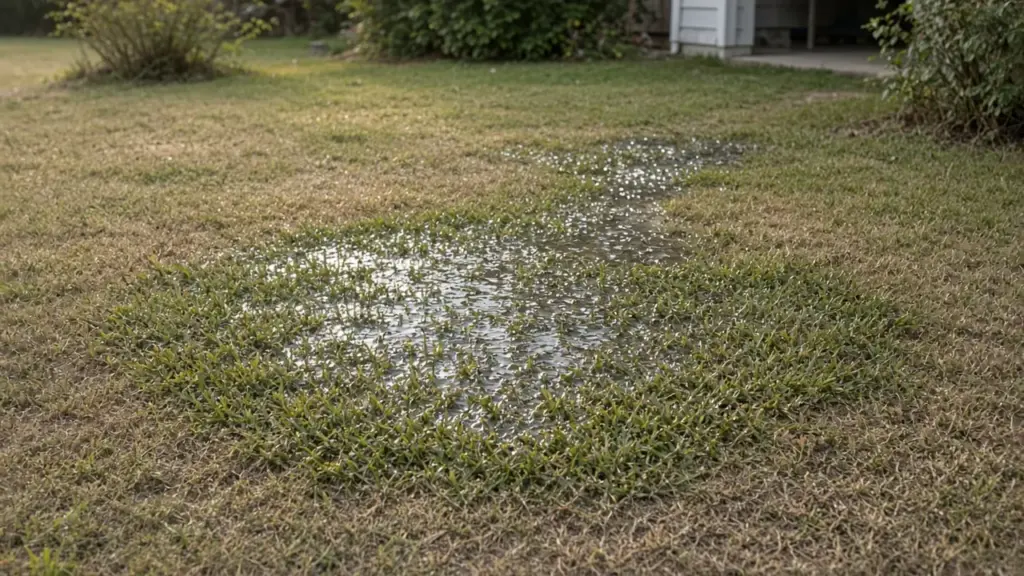
Every lawn gets wet after watering or rain. But a spot that stays soggy for days, even in dry, hot weather, is telling you something. In Dallas clay, water does not drain quickly, so a small, steady source of water can keep an area soft indefinitely. The source might be a sprinkler leak, a weeping valve, a broken head, low-head drainage, or something outside the irrigation system entirely.
This guide walks through how to find the source of a soggy spot that never dries.
Step 1: Observe the Pattern
Before you dig, gather clues.
- When is it wettest? Right after a particular zone runs, all the time, or after rain?
- How big is it? A small circle around a head, a strip along a line, or a broad area?
- Is water visible? Bubbling, seeping, or just soft ground?
- Where is it? Near a head, a valve box, the house, the street, or a low point?
- Is the grass greener there? Lush growth in dry weather suggests a constant water source.
Step 2: Check the Water Meter
Turn off all water use inside and outside the house. Then look at your water meter. Many meters have a small leak indicator that spins or moves with even slight flow. If it moves with everything off, water is flowing somewhere.
Next, close the irrigation isolation valve (often near the backflow preventer) and check the meter again. If the meter stops, the leak is likely in the irrigation system. If it keeps moving, the leak may be in the household plumbing or the service line, which calls for a plumber.
Step 3: Rule Out a Mainline Leak
The mainline runs from the backflow preventer to the valves and is pressurized all the time. A mainline leak keeps an area wet constantly, even when zones are off. Signs include a soggy spot along the route between the backflow preventer and the valves, or near a valve box, that stays wet regardless of the schedule.
Our article on mainline versus lateral line breaks explains the difference.
Step 4: Check for a Weeping Valve
A valve that does not close completely lets water trickle through to the zone after it shuts off. Water drains to the lowest heads, keeping that area wet. Signs include a head at the low end of a zone that seeps or dribbles long after the zone stops. Debris, a worn diaphragm, or a damaged seat can cause it.
Our guide to a zone that will not turn off covers valve problems.
Step 5: Look for Low-Head Drainage
Low-head drainage looks similar to a weeping valve, but it stops once the pipe drains. After each cycle, water in the lateral drains out through the lowest heads. On a slope, that can soak one spot every watering day. Check valves in heads stop it.
Step 6: Inspect Heads and Laterals
Run the zone that covers the area and watch:
- Bubbling around a head suggests a broken riser or fitting
- A geyser suggests a broken head or missing nozzle
- Water rising from the ground where there is no head suggests a cracked lateral
- Weak pressure on the zone suggests a significant leak
Our guide to signs of a hidden sprinkler leak in clay soil covers more clues.
Step 7: Consider Overwatering
If there is no leak, the zone may simply apply too much water for that spot. Shade, a low point, overlapping heads, or a spray head with a high precipitation rate can keep one area wetter than the rest. Adjust nozzles, reduce run time, or use cycle and soak.
Step 8: Consider Drainage
If the spot is wet mainly after rain, drainage may be the issue. Low spots, poor grading, and downspouts that discharge onto flat ground can all create persistent wet areas. Our guide to standing water after watering helps separate irrigation from drainage.
Step 9: Consider Non-Irrigation Sources
Not every soggy spot is a sprinkler problem.
- Household plumbing leaks in the service line from the meter to the house
- Pool or spa leaks near pool equipment or plumbing
- Air conditioner condensate lines discharging onto the lawn
- Sewer line problems, which may produce odors
- Natural seeps in some areas after wet periods
If the water meter test points away from irrigation, call a plumber.
Step 10: Dig Carefully
Once you have narrowed the source, dig carefully. Dallas clay is dense and holds water, so expect mud. Expose the pipe or fitting, find the crack, and repair it properly. Our leak detection and pipe repair guide covers repairs.
Why It Matters
A soggy spot is more than a nuisance:
- Wasted water raises your bill
- Turf damage and fungal disease
- Mosquito breeding in standing water
- Soil movement in expansive clay, especially near foundations
- Damage to hardscape if water undermines sidewalks or driveways
Keep a Log
If the source is not obvious, keep a simple log for a week: note when the spot looks wettest, which zones ran, and whether it rained. Patterns often reveal the cause.
What a Technician Brings
When a soggy spot stumps you, a technician can help with tools and experience: pressure testing to isolate a leaking section, wire tracing to find valves, and the ability to recognize subtle clues. Isolating the problem before digging saves time and minimizes lawn damage, especially in clay where every hole is slow work.
Timing Your Observations
Check the spot at different times: early morning before watering, right after a cycle, midafternoon, and the next day. A spot that is wettest right after one zone runs points to that zone. A spot that looks the same no matter when you check points to a constant source like the mainline or a plumbing leak. A spot that dries between watering days but never fully firms up may be a combination of overwatering and poor drainage.
Common Culprits by Location
Where the soggy spot sits often hints at the cause:
- Near the backflow preventer or valve boxes: mainline or valve leaks are likely
- At the bottom of a slope: low-head drainage or a weeping valve
- Around a single head: a cracked riser, fitting, or head body
- Along a straight line between heads: a cracked lateral
- Near the house: AC condensate, a downspout, a plumbing leak, or a foundation drip line running too long
- Near the street or meter: a service line leak, which is a plumbing issue
Use location as a starting point, then confirm with the meter test and by watching zones run.
Frequently Asked Questions
Why does one spot in my yard stay wet?
Common causes are a sprinkler leak, a weeping valve, low-head drainage, overwatering in that area, poor drainage, or a plumbing leak.
How do I know if the leak is in my sprinkler system?
Use your water meter. With all water off, if the meter moves, close the irrigation isolation valve. If the meter stops, the leak is likely in the irrigation system.
What is low-head drainage?
Water draining out of the lowest heads after a zone shuts off, often creating a wet spot at the bottom of a slope.
Could a soggy spot be a plumbing leak?
Yes. If the meter keeps moving with the irrigation shut off, the leak may be in household plumbing or the service line.
Get Help Finding the Source
We track down persistent wet spots and repair sprinkler leaks, valves, and heads. See our sprinkler repair service, or contact us to schedule.
Request Service or call 214-227-7444
We serve homes throughout Dallas and nearby North Texas communities.