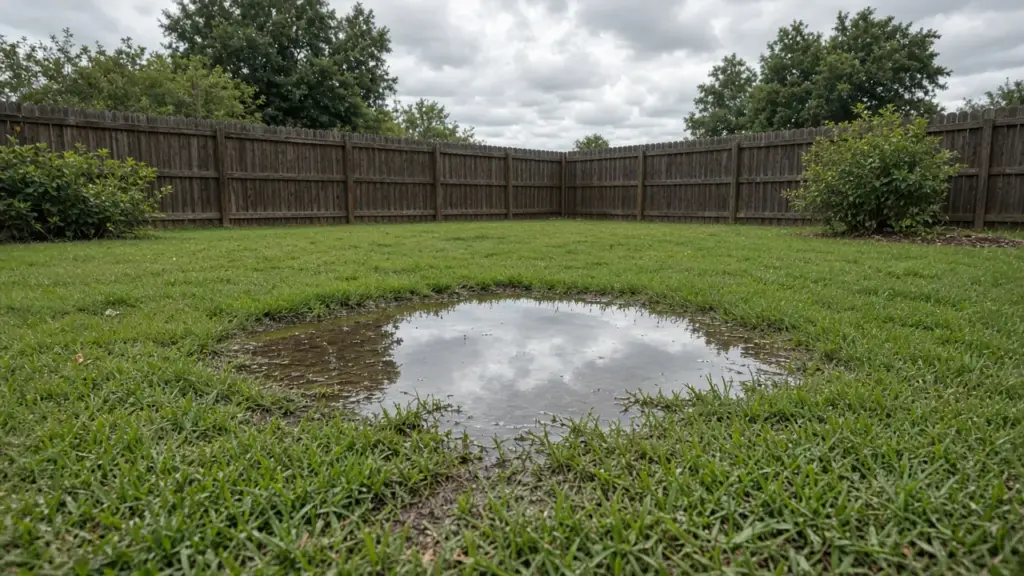
You walk outside after an early morning watering cycle and find a puddle in the same low spot again. Maybe it is along the driveway, near the curb, or in the middle of the back yard. In Dallas, standing water after irrigation is common, and it usually traces back to one of two root causes: the sprinkler system is putting down more water than the soil can take, or the yard itself does not move water away. Often it is a mix of both.
Sorting out which problem you have matters, because the fixes are very different. Adjusting a controller costs nothing. Regrading a yard or adding a drain is a real project. This guide walks through how to tell the difference and what to check first.
Why Dallas Yards Hold Water
Much of Dallas sits on heavy clay soil, often called blackland clay. Clay particles are tiny and pack tightly, so water enters slowly. Many clay soils absorb only a fraction of an inch of water per hour, while a typical spray zone can apply water faster than that. When application outpaces absorption, water runs to the lowest point and sits.
Our complete guide to Dallas clay soil explains how clay shrinks, swells, and seals, and our article on why black clay makes sprinkler repair harder covers what that means for pipes and heads.
The Irrigation Causes
Start with the sprinkler system, because it is easier and cheaper to rule in or out.
Run times that are too long
A single long cycle on clay almost always produces runoff. If a zone runs 20 or 30 minutes straight, the first several minutes soak in and the rest runs off. The fix is cycle and soak: split the run into two or three shorter cycles with time between them. Our guide to programming a controller for the Dallas watering schedule shows how to set it up while still finishing before 10 a.m.
Low-head drainage
When a zone shuts off, the water left in the lateral pipe drains out through the lowest head. If the puddle always forms around one head at the bottom of a slope, and it keeps seeping for a while after the zone stops, low-head drainage is a likely cause. Heads with built-in check valves stop this.
A leak
A cracked pipe, a broken fitting, or a head that is leaking at the base can put water into the soil every time the zone runs, and in the case of a mainline leak, all the time. Signs include a spot that stays wet on non-watering days, soft ground, or water bubbling up near a head. Our guide to signs of a hidden sprinkler leak in clay soil walks through the checks.
A broken or misaligned head
A broken head can gush far more water than a normal nozzle. A head that is tilted or has the wrong nozzle can soak one area while leaving another dry. Watch each zone run and look for geysers, bubbling, or heads spraying the same spot another head already covers.
A valve that will not fully close
If a valve weeps after the zone shuts off, water keeps trickling to the lowest heads. The puddle grows even on days the system is not scheduled.
The Drainage Causes
If the irrigation checks out, the yard itself may be the problem.
Low spots and poor grading
Settling over time, tree root decay, and past construction can leave depressions where water collects. Any water, from rain or sprinklers, ends up there.
Grading toward the house
Soil should slope away from the foundation. If it slopes toward the house or is flat, water can collect near the foundation.
Compacted soil
Foot traffic, vehicles, and construction compact soil so it absorbs even less water than normal clay.
Blocked or missing drainage
Downspouts that empty onto flat ground, clogged drain inlets, and yards with no path for water to leave all lead to puddling.
A Simple Test to Tell the Difference
Here is a practical way to narrow it down.
- Watch after rain. If the same spot puddles after a moderate rain with the sprinklers off, drainage is at least part of the problem.
- Watch after irrigation only. On a dry week, run the zone that covers the area. If it puddles only after irrigation, focus on the system.
- Check timing. Water that appears during the cycle points to application rate or a broken head. Water that seeps after the cycle points to low-head drainage or a weeping valve. Water that appears on non-watering days points to a leak.
- Check the meter. With all water off inside and outside, watch your water meter. If it moves, there may be a leak somewhere.
What to Fix First
- If it is the controller: switch to cycle and soak and trim run times.
- If it is a head or valve: repair or replace the part; add check-valve heads on slopes.
- If it is a leak: repair the pipe, then let the area dry and watch whether the puddle returns.
- If it is drainage: consider regrading, redirecting downspouts, or adding drainage. Our drainage service covers these fixes.
Why Standing Water Is Worth Addressing
Standing water is more than an eyesore. It can damage turf, encourage fungal disease in lawns like St. Augustine, breed mosquitoes, and waste water you pay for. Water that collects near the foundation also contributes to uneven soil moisture, which matters on Dallas clay.
Common Dallas Scenarios
A few patterns show up again and again in Dallas yards.
The curb puddle. Water collects along the curb or in the parkway strip after the front zone runs. Often a spray head is aimed at the street, the nozzle radius is too long, or the lowest head drains the lateral after shutoff. Adjusting arcs and adding a check-valve head usually solves it.
The downhill fence line. In a sloped back yard, water gathers at the bottom along the fence. This is frequently a combination: runoff from long cycles plus a natural low point. Cycle and soak on the upper zones, plus a small drainage improvement at the bottom, often works better than either fix alone.
The spot that never dries. A patch stays soft days after watering, even in summer. That pattern points strongly to a leak, a weeping valve, or a broken fitting, not to normal irrigation.
The side yard between houses. Narrow side yards get little sun, so water evaporates slowly. Spray zones in these areas often need shorter run times than sunny zones.
Seasonal Changes
Standing water often shows up more in spring and fall, when temperatures drop but run times have not been adjusted from summer. Use your controller’s seasonal adjust feature to scale back as the weather cools. If puddles disappear once run times drop, the system was simply applying more water than the lawn needed. Our freeze protection guide for backflow preventers covers the winter side of seasonal care.
Frequently Asked Questions
How do I know if standing water is from my sprinklers?
If the spot puddles only after irrigation and not after rain, or if water appears during or right after a zone runs, the system is likely the cause.
Can overwatering alone cause standing water?
Yes. On clay soil, long cycles apply water faster than it can soak in, so it runs to low spots and sits.
What is low-head drainage?
It is water draining out of the lowest head after a zone shuts off. It can create a puddle at the bottom of a slope. Heads with check valves stop it.
When should I call about drainage instead of irrigation?
If a spot puddles after rain with the sprinklers off, or water collects near the foundation, it is time to look at grading and drainage.
Get Help With Standing Water
We can check your zones, run times, heads, and valves, and help you sort out whether the problem is irrigation, drainage, or both. See our sprinkler repair service, or contact us to schedule a visit.
Request Service or call 214-227-7444
We serve homes throughout Dallas and nearby North Texas communities.