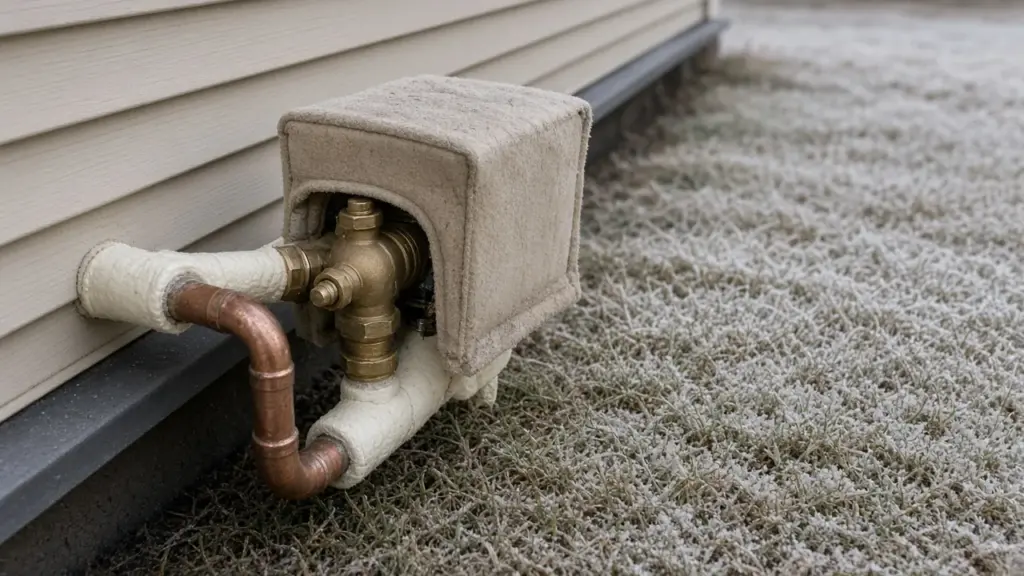
Search for sprinkler winterization and you will find instructions written for places where the ground freezes for months: blow out every line with compressed air, drain every component, and leave the system off until spring. Dallas is different. Most winters bring mild days broken up by short cold snaps, and the ground rarely freezes deeply. But a single hard freeze can still crack a backflow preventer or an exposed pipe, and the February 2021 winter storm showed how damaging a prolonged freeze can be.
This guide explains what winterization really means for a Dallas sprinkler system: what needs protection, what does not, and how to prepare for both short cold snaps and longer freezes.
What Is Actually at Risk
The backflow preventer
This is the most vulnerable part. It sits above ground, full of water, exposed to wind. When water inside freezes and expands, it can crack the body, the bonnet, or internal parts. Our backflow and irrigation code guide explains why this device matters.
Exposed piping
Any pipe above ground, such as the risers leading to and from the backflow preventer, is at risk. So are pipes in shallow or exposed areas near foundations and walls.
Valves and manifolds near the surface
Valve boxes offer some protection, but valves close to the surface can crack in hard freezes, especially if the box lid is missing.
Heads and lateral lines
Buried lateral lines and heads are usually less vulnerable because soil insulates them. Damage is still possible in severe or prolonged cold, particularly in shallow lines.
Controllers and sensors
Controllers mounted outdoors can be affected by extreme cold, and a freeze sensor must be working to prevent the system from running when it is below freezing.
Why Full Blow-Outs Are Usually Not Necessary
In cold climates, lines are blown out because the ground freezes deep enough to reach buried pipe for long periods. In Dallas, freezes are usually brief and the soil stays warmer than the air. For most homes, protecting the above-ground components is the priority. That said, if you plan to leave a property unoccupied through winter, or a prolonged hard freeze is forecast, a more complete shutdown and drain may be worthwhile.
Before the First Freeze
- Check the freeze sensor. Confirm it is connected and active on the controller. Dallas requires a working rain and freeze sensor.
- Reduce watering. Warm-season lawns need much less water as they go dormant. Lower seasonal adjust.
- Locate the irrigation shutoff. Know where it is and make sure it turns easily.
- Replace missing valve box lids.
- Get insulation ready for the backflow preventer.
For a Short Cold Snap
For a typical overnight freeze:
- Insulate the backflow preventer with a cover or wrap made for backflow assemblies. Cover exposed pipes as well.
- Turn the controller to off or rain mode for the freeze period, even if you have a sensor.
- Avoid watering the day before a hard freeze to prevent ice on walks and streets.
For a Prolonged or Severe Freeze
When forecasts call for extended below-freezing temperatures:
- Turn off the controller.
- Close the irrigation shutoff valve.
- Drain the backflow preventer following the manufacturer’s instructions. This usually involves opening the test cocks and, on some models, turning the ball valves to a partially open position. If you are unsure, have a professional do it.
- Insulate the backflow preventer and exposed pipes.
- Leave everything off until temperatures rise and stay above freezing.
After a Freeze
- Inspect the backflow preventer for cracks, bulges, or water leaking from the body.
- Close any test cocks and return valves to their normal position.
- Open the supply slowly to reduce pressure surges.
- Watch the backflow preventer for leaks as it fills.
- Run each zone and look for broken heads, leaks, or weak zones.
Freeze damage often appears only when the system is pressurized again, sometimes weeks later during spring startup. Our year-round maintenance calendar includes spring startup steps. If you find wet spots or weak zones, our leak detection guide can help.
Repairing Freeze Damage
- Cracked backflow preventers should be repaired or replaced by licensed professionals, since the device protects the drinking water supply, and testing may be required after replacement.
- Cracked valves and manifolds can often be rebuilt or replaced. Our valve repair guide covers this.
- Broken pipes are cut out and replaced, and lines are flushed.
When to Call a Professional
Some winter tasks are simple, such as turning the controller off or fitting an insulated cover. Others are better left to a technician:
- Draining a backflow assembly you are not familiar with
- Repairing or replacing a cracked backflow preventer or bonnet
- Finding a leak that appears after the supply is turned back on
- Relocating or enclosing an exposed backflow preventer that freezes every year
A technician can also check the assembly’s condition in the fall and recommend an insulated enclosure if yours sits in a windy, exposed spot.
Winter Watering
Dormant warm-season grass needs little water, but a long dry spell can stress lawns and trees. When you do water in winter:
- Water only on your assigned days, and never between 10 a.m. and 6 p.m.; that restriction now applies year-round.
- Choose mild days, not days before a freeze.
- Consider hand watering or a soaker hose for trees and dry beds.
Our Dallas watering schedule guide covers the rules.
Common Winterization Mistakes in Dallas
- Wrapping the backflow preventer too late. Protection should go on before temperatures drop, not after ice has formed.
- Using plastic sheeting alone. Thin plastic holds little heat and can trap moisture. Use insulation made for backflow assemblies.
- Forgetting the risers. The exposed pipes above and below the backflow preventer freeze too. Cover them along with the assembly.
- Closing the shutoff without draining. Closing the valve stops new water, but the assembly is still full. For long freezes, drain it as the manufacturer directs.
- Leaving test cocks open after a freeze. Close them before turning water back on, or the assembly will spray and lose pressure.
- Assuming no leak means no damage. Some cracks only open under full pressure. Watch the system closely during the first few runs after a freeze.
Protecting Controllers and Sensors
Outdoor controllers in weatherproof cabinets generally handle Dallas winters, but make sure the cabinet door closes fully and seals. Clear leaves from rain and freeze sensors so they read conditions correctly. If your sensor was damaged by hail or wind during the year, replace it before winter so the system cannot run during a freeze.
Frequently Asked Questions
Do I need to blow out my sprinkler lines in Dallas?
Usually not. Protecting the backflow preventer and exposed pipe is the priority. Consider a full shutdown and drain for prolonged freezes or unoccupied properties.
What temperature should I worry about?
Protect exposed components whenever a hard freeze is forecast. Wind and duration matter as much as the lowest temperature.
Can I just wrap the backflow preventer with a towel?
Purpose-made insulated covers work better and stay dry. Wet towels can freeze and offer little protection.
My backflow preventer is leaking after a freeze. What now?
Close the irrigation shutoff and have it inspected. Cracked assemblies usually need repair or replacement by a licensed professional.
Should I turn off my controller all winter?
Not necessarily. Lower the seasonal adjust and keep the freeze sensor active. Turn it off during freezes.
Get Freeze Prep and Repair Help
We can check your backflow preventer, insulate or drain exposed components, and repair freeze damage. Learn about our sprinkler repair service, or contact us to schedule.
Request Service or call 214-227-7444
We serve homes throughout Dallas and nearby North Texas communities.