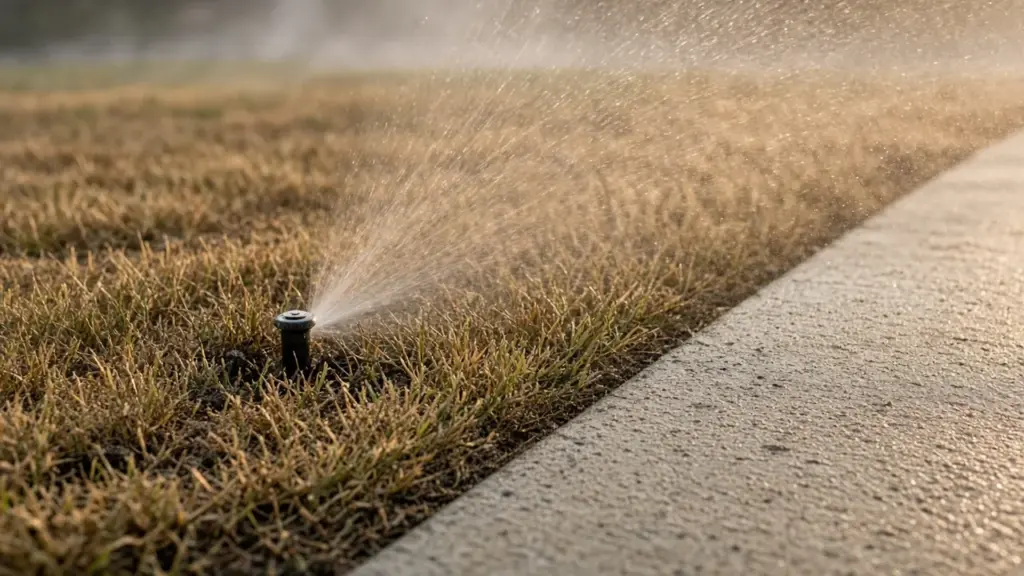
By July, Dallas lawns face their toughest stretch of the year. Long runs of very hot days, strong sun, warm nights, and dry spells push turf to its limits. Brown patches appear, especially along sidewalks, driveways, and west-facing slopes. The instinct is to water more, but Dallas limits automatic irrigation to two assigned days per week, and more water is not always the answer anyway.
This guide explains how to help your lawn through July and August with smart irrigation adjustments.
Understand Heat Stress
When temperatures soar, grass loses water faster than roots can replace it. Signs of heat stress include:
- A dull, bluish-gray color
- Leaf blades folding or rolling
- Footprints that remain visible
- Brown patches, often starting near concrete or on slopes
Some warm-season grasses, especially Bermuda, may go semi-dormant during extreme heat and drought, turning tan but recovering when conditions improve.
Step 1: Check Coverage Before Adding Water
Most summer brown spots are coverage problems, not total water problems. A single sunken, tilted, or clogged head can leave a crescent of brown turf while the rest of the zone looks fine.
Walk every zone while it runs:
- Do all heads pop up fully?
- Does spray reach the next head?
- Are any nozzles clogged or misting?
- Are any heads blocked by grass or tilted?
Our complete guide to sprinkler head repair covers common fixes, and our guide to raising sunken sprinkler heads addresses one of the most common summer culprits.
Step 2: Water Deeply on Your Assigned Days
On your two assigned days, water deeply enough to moisten the root zone. Use seasonal adjust to increase run times during peak heat, within reason. Deep watering encourages roots to grow down where soil stays cooler and moister.
Dallas assigns Sundays and Thursdays to addresses ending in an even number and Wednesdays and Saturdays to addresses ending in an odd number. Our guide to even and odd address watering days explains the schedule.
Step 3: Use Cycle and Soak
Summer clay can crack and then seal over, shedding water. Split each zone’s run time into shorter cycles with soak time between them so water soaks in rather than running into the street.
Step 4: Finish Before 10 a.m.
Dallas prohibits sprinkler watering between 10 a.m. and 6 p.m. year-round. Early morning is the best window in summer: cooler temperatures and calmer winds mean less evaporation. With longer summer run times and cycle and soak, check that all zones finish in time. If not, consider moving some zones to start after 6 p.m.
Step 5: Hand Water Hot Spots
Dallas allows hand watering any day, at any time. Areas along sidewalks, driveways, and curbs heat up more than the rest of the lawn. A few minutes of hand watering on hot spots between irrigation days can help without changing the whole system.
Step 6: Adjust Mowing
Mow at the higher end of the recommended range for your grass. Taller grass shades the soil and roots. Keep mower blades sharp; dull blades shred leaf tips and increase water loss. Avoid mowing during the hottest part of the day.
Step 7: Go Easy on Fertilizer
Fertilizing heavily during peak heat pushes growth that needs more water. Follow local guidance on timing, which often favors spring and early fall for warm-season lawns.
Step 8: Watch for Pests and Disease
Not all summer brown patches are drought. Chinch bugs can cause brown patches in St. Augustine, often in hot, sunny areas. Grubs can damage roots. If a brown area does not respond to water, look closer or consult a lawn care professional.
Step 9: Check the System for Leaks
Summer is when leaks are most costly. Watch for soggy spots, weak pressure, and rising water bills. Our leak detection guide explains what to look for.
What Not to Do
- Do not water every day. Automatic irrigation is limited to twice weekly, and daily shallow watering promotes shallow roots.
- Do not water midday with sprinklers. It is prohibited and wasteful.
- Do not add run time to fix one dry spot. Fix the head.
- Do not let water run into the street. Runoff is wasteful and can violate city rules.
- Do not panic about dormancy. Some browning in extreme heat is normal for certain grasses.
Parkways, Slopes, and West-Facing Areas
The hardest areas to keep green in summer are parkway strips, slopes, and areas facing west. Concrete radiates heat, slopes shed water, and west exposure gets the harshest afternoon sun. Consider rotary nozzles, cycle and soak, and hand watering for these spots. In some cases, a drought-tolerant planting on drip may be a better long-term solution for a parkway strip.
After the Heat Breaks
When temperatures ease in September, reduce run times. Lawns often recover quickly once heat and water stress let up. Our guide to the year-round maintenance calendar covers fall adjustments.
A Midsummer Check-In Routine
Once a week in July and August, take a quick walk around the lawn early in the morning while a zone runs. Look for heads that have been knocked out of alignment by mowers, nozzles clogged by debris, and new dry spots. Catching a problem the day it starts can save a week of browning. Keep a few spare nozzles and a head adjustment tool handy so you can fix small issues on the spot.
Signs Your Lawn Is Recovering
When adjustments are working, you will notice turf regaining its normal color, footprints disappearing quickly, and brown crescents near heads filling in over a few weeks. If a patch shows no improvement after coverage fixes and deeper watering, look for pests, disease, compacted soil, or buried debris beneath the turf.
Heat Waves and Your Equipment
Extreme heat is hard on equipment too. Controllers mounted in direct sun can overheat, plastic parts become brittle, and pressure fluctuations during peak neighborhood water use can reduce head performance. Keep outdoor controllers shaded when possible, and if heads perform poorly only during early morning peak demand, try staggering start times.
A Word on Water Bills
Summer water bills are typically the highest of the year. Efficient irrigation keeps them in check: fix leaks promptly, keep water off pavement, use cycle and soak, and avoid watering more than the lawn needs. Watching your bill month to month also helps you catch leaks early.
Frequently Asked Questions
Should I water more in July and August?
Increase run times on your assigned days if needed, but check coverage first. Most dry spots are coverage issues.
Can I water my lawn more than twice a week in summer?
Automatic sprinklers are limited to twice a week on assigned days, but hand watering, soaker hoses, and drip are allowed any day.
Why is my lawn browning along the sidewalk?
Concrete radiates heat, and heads near edges are often misaligned or blocked. Check coverage and consider hand watering.
Is it bad if my Bermuda goes dormant in summer?
Bermuda can go semi-dormant during extreme heat and drought and typically recovers when conditions improve.
Get Summer Irrigation Help
We check coverage, fix heads, and tune schedules for peak summer. See our sprinkler repair service, or contact us to schedule.
Request Service or call 214-227-7444
We serve homes throughout Dallas and nearby North Texas communities.