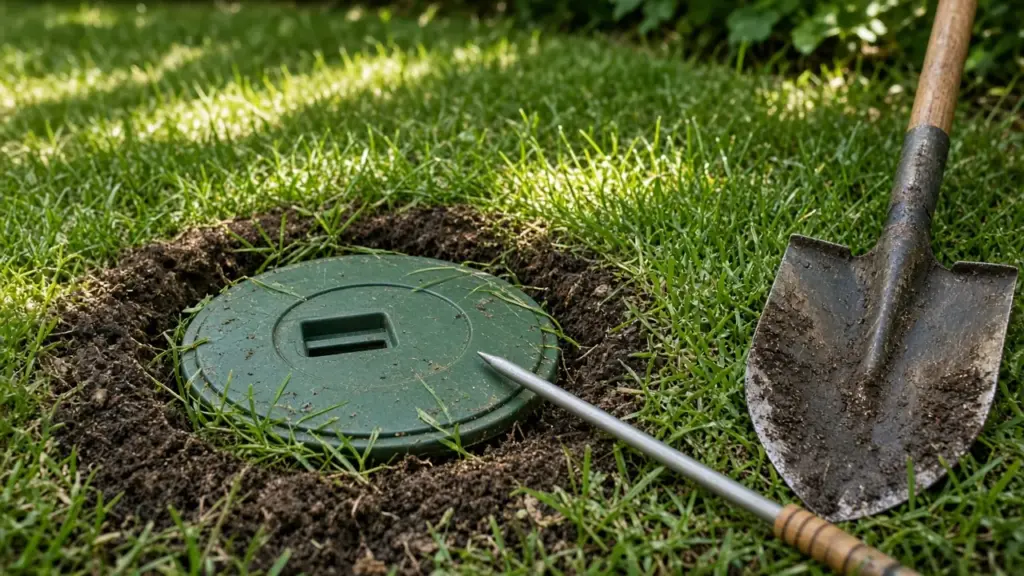
Every sprinkler zone is controlled by a valve, and most valves live in plastic boxes buried at ground level. In a new yard, the green or black lids are easy to spot. In an established Dallas yard, those lids often disappear under turf, mulch, soil, or years of landscaping. When a zone fails and you need to reach its valve, finding the box can become the hardest part of the job.
This guide explains where valves are usually located, how to search methodically, and what to do once you find the box.
Why Valve Boxes Disappear
- Turf grows over the lid. St. Augustine and Bermuda runners spread across lids within a few seasons.
- Mulch and soil build up in beds over time.
- Landscape changes add beds, pavers, or edging over old boxes.
- Grade changes from settling or regrading can bury lids.
- Lids get damaged and are covered rather than replaced.
Where Valves Are Usually Located
Installers tend to follow common patterns, so start with the likely spots.
- Near the backflow preventer. Valves are often grouped downstream of the backflow device, commonly near the front of the house.
- Near the water meter or main line route. The mainline runs from the backflow toward the valves, so valves often sit along that route.
- Along the foundation. Valve boxes are frequently placed in beds near the house.
- Near the corners of the house. Side yards and corners are common.
- Grouped in manifolds. Several valves may share one large box or sit in adjacent boxes.
- Near the zones they control. Some systems have valves scattered across the yard, especially after additions.
Step 1: Gather Clues From the Controller
Count the stations in use on the controller. That tells you how many valves to find. Notice the wire bundle leaving the controller and where it exits the house. The wire runs to the valves, so its direction is a clue.
Step 2: Listen and Watch
Run the zone that needs work. At the valve, you may hear a click when it opens and the hiss of water. Walk likely areas while a helper turns the zone on and off at the controller. The sound may lead you to the box.
Step 3: Look for Surface Clues
- A slight rectangular or round depression or mound
- A change in turf color or texture over a lid
- A section of bed where mulch is unusually deep
- An old lid edge peeking through grass
Step 4: Probe Carefully
Use a thin metal rod or long screwdriver to probe gently in likely spots. A plastic lid feels different from soil or rock. Probe lightly so you do not crack a lid or puncture pipe or wire.
Step 5: Follow the Pipe
If you know where the zone’s heads are, the lateral pipe runs back from those heads to the valve. Dig carefully at the head nearest the likely valve location to see which way the pipe runs. Following the pipe takes patience in clay, but it leads to the valve.
Step 6: Trace the Wire
Irrigation technicians often use a wire tracer, a tool that sends a signal down the valve wire so a receiver can follow it above ground. This is one of the most reliable ways to locate buried valves and wire breaks. It is also how professionals find valves that have been buried under concrete or relocated.
What to Do Once You Find It
- Clear the box. Remove soil, roots, and debris so you can see the valve.
- Check the lid. Replace cracked or missing lids to keep soil out.
- Raise the box to grade if it sits low, using box extensions if needed.
- Label the valve. Tag the valve with its zone number.
- Map it. Measure from two fixed points, such as house corners, and record the location.
Mapping Your System
A simple valve map saves time for every future repair. Sketch the house and yard, mark each valve with its zone number, and add measurements from fixed points. Photograph the map and keep a copy with your controller. If your valves are grouped, note which valve in the group controls each zone.
Why Buried Valves Cause Problems
- Repairs take longer. Time spent searching adds to every service call.
- Emergencies are harder to handle. If a valve sticks open, you need to find it quickly or shut off the system at the backflow or main.
- Valves fail faster. Boxes packed with soil let roots and debris reach the valve.
- Flooded boxes. Low boxes collect water and soil.
Our guide to sprinkler valve repair explains how valves work and why they fail, and our guide to a zone that will not turn off covers one of the problems where finding the valve quickly matters.
When to Call a Pro
If you have searched the likely spots and still cannot find the valve, a technician with a wire tracer can usually locate it without digging up the whole yard. That is often faster and less damaging than trenching in clay.
Preventing Lost Valve Boxes
- Trim turf back from lids a few times a season
- Keep mulch below the top of boxes in beds
- Replace damaged lids promptly
- Tell landscapers where boxes are before bed or paver work
- Keep your valve map current
Our year-round maintenance calendar is a good reminder to check valve boxes each spring and fall.
A Note on Safety
Before digging, remember that other utilities may run through your yard. Texas 811 provides free locating of public utility lines before digging. Private lines such as irrigation are not located by 811, so use care and dig by hand near known utilities.
Valves Under Concrete or Decks
Sometimes a valve ends up under a patio, deck, or walkway added after the system was installed. If a valve fails in that situation, the choices are to access it from underneath, cut an access opening, or relocate the valve to an accessible spot. Relocating usually means rerouting a short section of pipe and wire so the new valve box sits in a bed or lawn edge. It is more work up front but makes every future repair easier.
Troubleshooting Tip
If you need to turn off a zone that is stuck on and cannot find its valve, shut off the water supply to the irrigation system at the isolation valve near the backflow preventer, or at the main if needed. Our guide to a zone that will not turn on walks through valve diagnosis once you find it.
Frequently Asked Questions
Where are sprinkler valves usually located?
Commonly near the backflow preventer, along the foundation, near the corners of the house, or grouped in manifold boxes along the mainline route.
How do I find a buried sprinkler valve box?
Count stations, follow the wire from the controller, listen while the zone cycles, look for surface clues, probe gently, or follow the lateral pipe from the nearest head.
What is a wire tracer?
A tool that sends a signal along valve wire so a receiver can follow it above ground to the valve.
Should I raise a buried valve box?
Yes. Box extensions bring lids to grade so boxes stay clean and easy to find.
Get Help Finding Your Valves
We locate buried valves, map systems, and repair valves and wiring. See our sprinkler repair service, or contact us to schedule.
Request Service or call 214-227-7444
We serve homes throughout Dallas and nearby North Texas communities.